Search This Blog

Thursday, September 10, 2015

Dorothy Day is the perfect role model for post-abortion women

Dorothy Day is the perfect role model for post-abortion women
by Mary O'Regan
posted Friday, 4 Sep 2015

Dorothy Day
As Pope Francis makes provisions for priests and abortion, we must invoke Day's intercession

In her youth, Dorothy Day was surrounded by many influential voices who encouraged her to be sexually active before marriage. Emma Goldman egged her on to try ‘free love’, but Day was reluctant to let go of her natural inhibitions and start sleeping around. Later Day would write in her own autobiography that she had been repulsed by Goldman’s many sexual affairs. A dear friend of Day’s, Peggy Baird tried to sell Day on the idea that extra-marital sex was a good thing because it broke down barriers between men and women. Baird was unnerved by Day’s unwillingness to give in to sexual desire.

As a 21 year old, Day did, however, have a dalliance with another journalist, and became pregnant as a result. The fellow was a cad and pressurised her to have an abortion, and in September 1919, 86 years ago this month, Day made a decision that she would bitterly regret for the rest of her life. She had an illegal abortion. Afterwards, Day was weighted down with a guilt-fuelled depression. Reflecting on Day’s distress, it calls to mind Pope Francis’ words this week, when he described post-abortion women as bearing, ‘the scar of this agonizing and painful decision’.

Pope Francis has made provisions for all priests during the Year of Mercy to absolve the sin of abortion. Our Pope has not minced his words in decrying, ‘the tragedy of abortion’ and in being clear that the opportunity for confession is open to women with ‘a sincere heart’. On the part of a woman who has had an abortion, there must be genuine contrition for her sin, and a firm purpose of amendment never to have an abortion again.

Dorothy Day was one such woman who showed great remorse after her abortion, and who vowed never to commit the same mistake again. Day suffered from psychological problems after her abortion, and sought solace in prayer. Day had thought that her illegal abortion had rendered her sterile, but in 1928, she gave birth to her daughter, Tamar. After she baptised her baby, her live-in boyfriend, Forster Batterham rejected her. For at least five years after they had split, Day wrote letters to Batterham, beseeching him to return to her and marry her. Day even asked him, ‘do I have to be condemned to celibacy all my life?’ Reminding Batterham that she did not take naturally to a casual sex lifestyle she wrote, ‘you know I am not a promiscuous creature in my love.’ Batterham would not relent because he eschewed all religious practice.

Day would not leave the Catholic Church, in order to win back Batterham, it had been her refuge during her post-abortion grief. In 1932, Day met Peter Maurin, and they founded the Catholic Workers’ Movement. They ran soup kitchens and set up urban houses of hospitality, caring for the homeless and the hungry when the Great Depression was at its worst. The houses of hospitality took in many pregnant mothers over the years. There was one married lady called Elizabeth whose husband was a drug addict. Elizabeth was heavily pregnant when she left her husband and sought refuge in a house of hospitality. When Elizabeth had given birth, Day prepared a little bed for the baby and gave Elizabeth cute baby clothes, and said that an atmosphere of great joy flooded the house of hospitality because of the newborn baby.

In later years, Day’s daughter, Tamar would go on to be a mother of a very large family. Day’s sister Della had worked for Margaret Sanger, the infamous founder of Planned Parenthood. Della tried to tell her Catholic convert sister that Tamar should not have so many kids. Della may have been implying that Tamar should be open to aborting future pregnancies – Day’s grandchildren! Day wouldn’t fall for the Planned Parenthood line, and refused to accept Della’s point of view. Day knew the bitter pain of losing a child in an abortion and would not visit it on her own daughter, Tamar.

Dorothy Day has been given the title Servant of God, and as we approach the Year of Mercy, we must invoke Dorothy Day’s intercession for women who intend to confess the sin of abortion. Day is the perfect role model for post-abortion women. She had the humility and purity of heart to admit that her abortion was a grave mistake, she was sincerely contrite and later on she helped vulnerable pregnant women avoid the trap of abortion that she had fallen prey to. The Year of Mercy could well be the time when we see Dorothy Day’s intercession burn bright.

Wednesday, September 9, 2015

Carmelite Martyrs of Compiègne rest at Picpus Cemetery Paris

Picpus Cemetery Paris
Written by Linda Mathieu in Paris, Quirky


In a seldom visited corner of Paris, near Place de la Nation in the 12th arrondissement, is Picpus Cemetery, one of the city’s most unusual burial grounds – the last resting place of a hero of the American Revolution and victims of the French Revolution, a plot where the history of France is preserved…

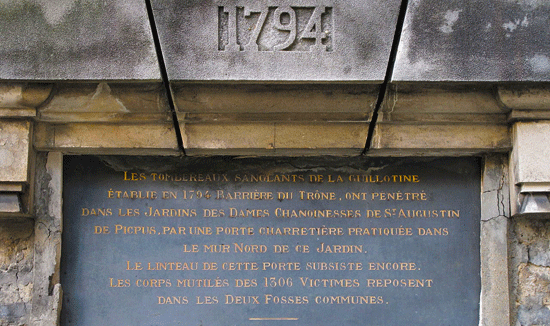
Here, between June 14th and July 27th, 1794, 1306 people who were executed during the French Revolution were buried. The beheadings had by this time become extreme and many innocent people were killed on ridiculous grounds. Amongst the condemned were 16 Carmelite nuns, all singing as they were led to the scaffold; one-by-one, there were led up the steps to the block, singing until the very end. “The Terror” only stopped when Maximillien Robespierre, a major influence during the time of the French Revolution and alleged to be the main instigator of the executions, was himself beheaded.

A guillotine had been set up at Place du Trone-Renverse, today Place de la Nation, a short walk away. Corpses had been thrown into two hastily dug graves at the bottom of the garden of a former convent. The families of some of the victims later bought the property, built a chapel and solicited a religious order, the Sisters of the Congregation of the Sacred Hearts of Jesus and Mary, to offer up prayers for the victims.

This is how Picpus Cemetery came to be one of two private cemeteries in Paris which has many tombs of French aristocracy and to this day in fact, only decendants of the victims can be buried here. Today you can still see a small portion of the original wooden fence that had once enclosed the graves, as well as the original entrance for the carts bringing the bodies. You can visit the chapel where the names, ages, and some occupations can be found engraved on the huge plaques on either side of the altar at the front of the church. In the cemetery itself, which lies behind the chapel, there are some beautiful tombs though many are worn away with age.


One tomb is of particular importance to American visitors, this is the burial site for the Marquis de Lafayette, French hero of the American Revolution. His grave is maintained by a local chapter of the DAR (Daughters of the American Revolution) and an American flag is always flown. Relatives of his wife were executed and buried here so she wished to be as well and he followed her on. He helped America during its Revolution and asked that soil from Bunker Hill be put on his grave. A ceremony is held at his graveside every July 4th often attended by the American Ambassador.

While Lafayette and his family survived the terror of his country’s own revolution, many of his wife’s family did not. And since a prerequisite to be buried at Picpus is having a family member perish on the guillotine that cruel summer of 1794, he and his wife rest near the entrance to the mass grave area.

It can be a hard place to find as the grounds lie behind two plain brown doors at 35 rue Picpus. Admission costs two euros and you will be directed toward the chapel where the names, ages, and some occupations can be found engraved on the walls on either side of the altar at the front of the church. In the cemetery itself, which lies behind the chapel, are some beautiful tombs, many of them worn with age.

It’s worth a visit to this quiet and often forgotten place. Another corner of Paris where a portion of French history is preserved.

Hours
The cemetery hours are erratic and unpredictable. Generally, Picpus is open Tuesday-Sunday, often from 2-6, mid-April to August. From October to mid-April it is open 2-4. There is no website but you can phone to check that it is open: 01 43 44 18 54. Nearest metro: Picpus and Nation.

It is closed on holidays, Mondays and during September as well as for the US Fourth of July celebration when there is usually a ceremony attended by the US ambassador.

Read about the incredible project to build a replica ship of the one on which the Marquis de Lafayette sailed to America: Hermione - the French ship that helped to win America’s freedom

Linda Mathieu, a native Texan, lives in France with her French husband. She was a Paris Tour Guide and is the author of Secrets of a Paris Tour Guide, available at www.amazon.com.

From: http://www.thegoodlifefrance.com/picpus-cemetery-paris/

St. Anne and child Virgin Mary

[image[4].png]
St. Anne and child Virgin Mary with baby Jesus :)

From:
https://blogger.googleusercontent.com/img/b/R29vZ2xl/AVvXsEiXF_FuQYKGw_VUj05OXgSDW54eTf4PUZszuvDSesBcG48zEpGWVCF0JyUGO4yCyesGUL9vtNNJV1D_Gfimev2Hc7E-5FsCXNl4-HpTk3KTx1I0JCl2Cy6tFF9LYENIsu-TQ_HzLOkdoRQ/s1600-h/image%5B4%5D.png

Tuesday, September 8, 2015

Blessed feast of the Nativity of Mary :)

From: 
http://communio.stblogs.org/index.php/2014/09/nativity-of-mary-2/

Orthodox Patriarch of Constantinople rebukes Moscow, underlines importance of ties with Rome

Those darned Russians...

It's easier to have a simple relationship with another party when they aren't in your backyard uninvited. From the Russian perspective the Greek Catholics operating in Slavic lands are unwelcome visitors knocking over their garden gnomes. While many would disagree with this role of Uniatism, that's the Muscovite party line and the primary impediment to Russia getting on board the Greek ecumenical train. I'm not sure how calling them "diabolical" is going to help things.

(Catholic Culture) - Orthodox Patriarch Bartholomew I of Constantinople underlined the importance of ecumenical ties with Rome, and criticized the resistance of the Russian Orthodox Church, in an August 29 address. The Ecumenical Patriarch—recognized as the “first among equals” of the world’s Orthodox leaders—stressed the primary importance of ecumenical affairs, and reiterated that his role involves “protecting the unity of the whole Orthodox Church.”

He said that opposition to ecumenical unity reflects a “diabolical” impulse. Patriarch Bartholomew said that his continuing contacts with the Holy See are a critical component of his ecumenical work. He expressed his enthusiasm for the planned worldwide Orthodox council, but conceded that it cannot accurately be described as an ecumenical council “because Western Christians are not invited to participate as members.”

The Ecumenical Patriarch—who has frequently sparred in recent years with the leaders of the Patriarchate of Moscow—clearly appeared to be criticizing the Russian Orthodox leadership when he spoke critically about Orthodox bodies that “maintain intimate connections with the government of their land and enjoy abundant financial support,” and advance the political interests of their nations.

Pope Francis announces biggest changes to annulment process in centuries

Pope Francis announces biggest changes to annulment process in centuries

By Abby Ohlheiser, Michelle Boorstein and Sarah Pulliam Bailey September 8 at 9:14 AM

Pope Francis arrives to lead the weekly audience in 
St. Peter’s Square at the Vatican on June 24. 
(Filippo Monteforte/AFP/Getty Images)
Pope Francis on Tuesday announced sweeping revisions to the Catholic Church’s marriage annulment process, changes that are designed to speed up and simplify the often lengthy procedure. The changes, according to Vatican experts, appear to be the most far-reaching made to the church’s annulment process in centuries.

The announcement, containing changes that will make it easier for Catholics to remarry, comes about a month before a major meeting at the Vatican, where Catholic leadership will examine the church’s views on family issues, including divorce and remarriage.

The changes will eliminate a requirement that all annulment decisions get a second judgement and will allow local bishops to expedite the annulment process for some cases. The revisions also expand the local bishop’s role in judging nullification proceedings. Although dramatic, the changes do not alter the Catholic Church’s teaching that marriages are permanent.

The revisions were announced in two Apostolic Letters from Francis, which, translated from their Latin titles, are called “The Gentle Judge, The Lord Jesus” and “The Meek and Merciful Jesus.” They were presented at a news conference at the Vatican on Tuesday. The documents were released in Latin and Italian.

Current Catholic teaching on marriage doesn’t recognize divorce. Catholics who are granted a civil divorce and then remarry are ineligible to take Communion, a key part of active Catholic life. Instead, a Catholic who wants to end his or her marriage must be granted an annulment, a process that many Catholics believe is too costly and complicated.

The changes will probably split Catholic opinion between those who believe that a streamlining of the annulment process is needed and will help bring back more Catholics to the church, and those who worry that the revisions could make it too easy to move on from a marriage, which Catholic teaching dictates is a permanent sacrament.

In a recent Pew poll, 62 percent of American Catholics said the church should allow divorced Catholics who divorce and remarry without an annulment to receive Communion.

The number of annulments in the United States has been on the decline in recent decades. Annulment procedures in the country dropped from 72,308 in 1989 to 23,302 in 2014, according to the Center for Applied Research in the Apostolate at Georgetown University.

An annulment is granted by a Catholic tribunal if it agrees that a marriage originally thought to be valid was actually missing at least one crucial element from the start, meaning that it was never really a true marriage in the first place. The length of the process varies between dioceses but can take 12 to 18 months, according to the U.S. Conference of Catholic Bishops.

One of the changes implemented by the pope will eliminate the “second instance” of that tribunal, meaning that all couples seeking annulment will have to obtain only one sentence from a single tribunal. “The moral certainty reached by the first judge according to law should be sufficient,” the letter reads.

“It’s a sweeping reform. It’s a dramatic reform,” said Chad Pecknold, a theologian at Catholic University. “It’s a reform which essentially takes away the whole judicial process for deciding whether a marriage was null or not.”

Another change will reduce the process of that first tribunal down to one judge, Pecknold noted. Formerly, a tribunal consisted of at least two priests and one canon lawyer, who could be a layperson or clergy.

Francis has changed that and placed the responsibility of the “first instance” of the tribunal into the hands of a single judge, who must always be clergy. Pecknold added, “A lot of my canon lawyer friends want to quit today.”

Austen Ivereigh, a papal biographer and commentator on the Vatican, called it “revolutionary” that Francis has granted bishops the power to nullify a marriage – a power that has rested with church courts. Bishops, he said, could also delegate that power to priests. This will make annulments more accessible, especially in much of the developing world, where, Ivereigh said, many areas have no church courts.

“This is the most far-reaching reform to the Church’s nullity process in 300 years,” he added.

Tuesday’s announcement is procedural; it makes no change in the way the church sees marriage and its permanent nature.

However, Ivereigh said the change shows Francis has been listening to regular Catholics and “the reason for this change is that society has changed. This speeded-up procedure recognizes and reflects a new reality.”

He predicted some conservatives would be critical of this change because they will see it undermining the concept of marriage as a bond that cannot be dissolved. The best-known of this group is American Cardinal Raymond Burke, who led the Vatican’s supreme court until he was removed by Francis because, Ivereigh said, Burke opposed annulment changes.

Another change announced on Tuesday will allow bishops the ability to further expedite the annulment process for some particularly straightforward cases — a process that Pecknold said would allow the bishop to essentially “write a note.”

That process could be open to abuse, he added: “The moment that you put in an exception that makes everybody’s job easier, guess what everybody’s going to do?”

Kurt Martens, a professor of canon law at Catholic University, said that the expedited process would apply to Catholic couples facing certain conditions, including those who have an abortion, a grave contagious disease, children from a previous relationship or imprisonment. Essentially, Martens said, the church is providing a path that looks like the Catholic version of no-fault divorce.

[VIDEO: Pope emphasizes forgiveness for abortions during ‘year of mercy’]

The changes move the church away from a set of 18th-century safeguards meant to make sure that the annulment process wasn’t subject to abuse, Martens said. Those changes, set up by Pope Benedict XIV, included a provision that would require a mandatory appeal of the lower court’s decision.

“What guarantee do you have for a fair trial if you take away those guarantees that were put in the past?” Martens said. “Sometimes you want to go so quickly, you miss elements and make mistakes. Procedure law takes time to unfold.”

Martens said that the way Francis changed the annulment process was unusual, because he did not go through the Synod on the Family as expected in October.

“If I were a bishop, I would be upset,” Martens said. “It’s a bit strange and even a sign of contradiction that a pope who is big on consultation and collegiality seems to forget that on something like this. It’s highly unusual for legislation like this to get through that way.”

Francis, for his part, acknowledges some of those concerns in his letters.

“The extent to which an abbreviated process of judgment might put the principle of the indissolubility of marriage at risk, did not escape me,” Francis wrote. “Thus, I have desired that, in such cases the Bishop himself shall be constituted judge, who, by force of his pastoral office is with Peter the greatest guarantor of Catholic unity in faith and in discipline.”

Despite those concerns, the changes come with a notable silver lining for everyday Catholics seeking to annul their marriages and return to a closer relationship with the church.

“In terms of the average Catholic who is seeking annulment, this makes an already painful situation easier, and that is Pope Francis’s intent,” Pecknold said. “You can see a clear pastoral eye on this decision. He doesn’t want any long waits; he basically wants the decision to come from the bishop.”

Francis has spoken before of his desire to reform annulment in the past.

“The sacraments give us grace,” he said earlier this year to jurists of the church’s final court of appeals for annulments. “And a marriage proceeding” — like an annulment — “touches on the sacrament of marriage.”

“How I wish all marriage proceedings were free of charge!” he added.

In August, Francis urged Catholic clergy to keep “open doors” and be more welcoming to divorced and remarried Catholics.

[This post, originally published at 6:57 a.m., has been updated]

Stay up to date on the papal visit. Sign up here to follow Washington Post stories about Pope Francis’s visit to the U.S. and we’ll e-mail you as they’re published.


Abby Ohlheiser is a general assignment reporter for The Washington Post.


Michelle Boorstein is the Post’s religion reporter, where she reports on the busy marketplace of American religion.

Sarah Pulliam Bailey is a religion reporter, covering how faith intersects with politics, culture and...everything. She can be found on Twitter @spulliam.

Monday, September 7, 2015

Germany tells neighbors 'Share migrant burden'; Britain to take in 20,000

Share migrant burden, Germany tells neighbors; Britain to take in 20,000


A migrant from Syria holds a picture of German Chancellor Angela Merkel as he arrives from Hungary at Munich Hauptbahnhof main railway station on Sept. 5. Germany has agreed to set aside $6.6 billion next year to help migrants. (Sean Gallup / Getty Images)

As more migrants continue to arrive, Germany called on its neighbors Monday to share the burden of accepting refugees fleeing war and violence, saying that the crisis had become a test of European values and solidarity.

France said it would take in 24,000 refugees under a European Union-wide quota system being prepared that some EU states are almost certain to reject. And British Prime Minister David Cameron announced Monday that his nation would take in 20,000 Syrian refugees by the end of the current session of Parliament in 2020.

He added that they would come from among those living in camps in Syria and its neighboring countries rather than from refugees and migrants already on European soil.


Martin Meissner / AP
Refugees walk from the main train station after arriving 
in Dortmund, Germany, Sept. 6, 2015.

Migrants wave as they arrive at the main railway station in Munich, Germany, on Sept. 6.

But Germany is bearing the brunt of the crisis, estimating that it could absorb up to 800,000 refugees and migrants this year, more than double what it had forecast at the beginning of 2015. Chancellor Angela Merkel has said that her government would live up to its moral duty to provide sanctuary to those legally entitled to it, however many they might be.

Even so, the thousands who landed in this country just this past weekend have some German officials worried about resources being pushed to the limit. After arriving on packed trains in the southern city of Munich, hundreds of asylum seekers have been quickly whisked to other cities as authorities scramble to ready accommodations and supplies for the newcomers.

Merkel said her government, which oversees Europe’s biggest economy, would set aside $6.6 billion next year to deal with the influx.

“Germany is a country willing to take people in, but refugees can be received in all countries of the European Union in such a way that they can find refuge from civil war and from persecution,” Merkel said. “It is time for the European Union to pull its weight. ... We are a Europe of values.”

She and French President Francois Hollande have been working on a plan that would distribute 120,000 asylum seekers among EU nations based on each country’s size and economic strength. The plan is expected to be unveiled in Brussels on Wednesday.

Hollande, who had previously opposed the idea of a quota system, said that France would play its part in offering refuge for the persecuted.

“We will do this because I believe it is a principle which France is bound by,” he said in Paris.


But agreement among all 28 EU members appears elusive, with several Central and Eastern European states saying categorically that they do not want to accept any refugees. Most outspoken has been Hungarian Prime Minister Viktor Orban, whose heavy-handed treatment of asylum seekers pouring into his country – almost all of them with no intention of staying but instead moving on to Austria, Germany and Sweden – has drawn international criticism.

Orban insists he is protecting the EU’s borders by trying to turn back migrants. He also poured scorn on a Europe-wide quota plan, saying that the right to free movement within the EU granted to residents would make country-specific numbers impossible to enforce.

While refugees began shuttling smoothly over the weekend between Northern European countries such as Austria and Germany, pressure continued to build on choke points in the south where migrants first make landfall or where they have clumped up at borders hoping to push on northward to more hospitable destinations.

Hundreds of asylum seekers, many from Syria and Iraq, continue to arrive daily on Greece’s eastern islands. More than 230,000 have come ashore to date, including 61 rescued Monday from the sea off the coast of the hard-hit island of Lesbos. Among those plucked from the waters were a baby and more than a dozen other children.

Europe's refugee crisis is darkened by the shadows of WWII

The nearly bankrupt Greek government has appealed to the EU for emergency aid to deal with the influx. A government minister said about two-thirds of the 15,000 to 18,000 refugees and migrants living in squalid conditions on Lesbos would be transported to the Greek mainland this week.

Migrants are also crowded at the borders between Greece and Macedonia and between Hungary and Serbia, most of them hoping to make their way to Austria and Germany and points beyond. Orban’s government is constructing a razor-wire fence along the length of Hungary’s nearly 110-mile border with Serbia, but people continue to slip through.

And even in Germany, there were signs of strain as the flood of arrivals continued.

Speaking to reporters at Munich's train station, Christoph Hillenbrand, the president of Upper Bavaria, suggested that the sheer volume of refugees had caught officials somewhat by surprise, even though the migrant "pipeline" passing through the Balkans and Central Europe had been well documented for weeks. Another 2,500 refugees reached the southern state on Monday.

"We will still do our best to create new places," Hillenbrand said. "But we are pushing up against the limit now."

Times staff writer Laura King in Munich and special correspondent Christina Boyle in London contributed to this report.

Pope celebrates Santa Marta daily liturgy with new Armenian Catholic Patriarch

Pope celebrates Santa Marta Mass with Armenian Patriarch

2015-09-07 Vatican Radio


(Vatican Radio) Pope Francis’ morning Mass in the chapel of the Santa Marta residence on Monday was an extraordinary occasion: it saw the recently-elected Patriarch of Cilicia of the Armenians, His Beatitude Gregory Peter XX Ghabroyan, concelebrate the liturgy with the Holy Father, and exchange with the Pope the concrete sign of ecclesial communion par excellence.

A statement from the Armenian Patriarchate describes the scene during the Liturgy: “[At the Rite of Communion], the Holy Father ... elevates the paten with the Body of Christ and offers it to the Patriarch. The two hold the Host high with their four hands. The Holy Father then raises the chalice with the Blood of Christ, offers it to the Patriarch, and they with their four hands keep it elevated. After a moment of silence, the Holy Father offers the Body of Christ, and together they communicate. The Holy Father takes the Blood of Christ from the chalice, then offers it to the Patriarch.”

“‘Communion’ is a concept held in great honor in the early Church and also today,” the statement explains. “[I]t does not mean some vague sentiment, but an organic reality, which requires a legal form and that is at the same time animated by charity.

The statement goes on to say, “The Ecclesiastica communio, which the Holy Father Francis granted to His Beatitude Gregory Peter XX with Letter of July 25, now finds expression in the exchange of the Sacred Species, which confirms the Eucharistic communion between the Bishop and the Church of Rome, who presides in charity, and the Patriarchal Church of Cilicia of the Armenians, through its Pater et Caput.(from Vatican Radio)

Armenian Orthodox Patriarch Aram I congratulates new Armenian Catholic Patriarch-elect Gregory Petros XX

His Holiness Personally Congratulates New Armenian Catholic Patriarch-elect Gregory Petros XX

31 July 2015


27 July 2015. On Monday evening His Holiness Aram I went to the Bzommar Monastery to congratulate Bishop Gregory Petros XX Ghabroyan on his election as Patriarch of the Armenian Catholic Church. The Catholicos was accompanied by the Prelate of Lebanon, Bishop Shahé Panossian, the Peria (Syria) Archbishop, Shahan Sarkissian, the director of the Printing House, Bishop Norayr Ashekian and the director of Ecumenical Relationships, Very Rev. Housig Mardirossian.
The Catholicos and his delegation were met at the entrance of the Monastery by Bishop Gregory, who led them in procession first to the Church then to the Hall of the Monastery. During the exchange of greetings, His Holiness Aram I congratulated the newly elected patriarch and the Armenian Catholic community, and he spoke of the need to cooperate in the face of the current difficulties and new challenges in the Middle East. In his response Patriarch-elect Gregory Petros XX said that under the current circumstances it is necessary for him to learn from His Holiness Aram I’s 20-year-long experience of spiritual and pontifical leadership.

Pope asks all European parishes to take in a refugee family

Pope asks all European parishes to take in a refugee family

2015-09-06 Vatican Radio


(Vatican Radio) Pope Francis has called on European parishes and religious communities to offer shelter to a migrant family.

The Pope’s appeal came during the Sunday Angelus.

Report by Christopher Wells:

"May Every parish, every religious community, every monastery, every sanctuary of Europe, take in one family" Pope Francis appealed.

To the crowds gathered in St. Peter’s Square, the Pope said the faithful are called to offer a concrete gesture of hope as indicated in the Gospel.

“Before the tragedy of tens of thousands of refugees fleeing death in conflict and hunger and are on a journey of hope, the Gospel – he said - calls us to be close to the smallest and to those who have been abandoned”.

Reminding the faithful of the upcoming Jubilee Year of Mercy, the Pope said that offering shelter to the needy is a “concrete act of preparation” for the Holy Year.

And turning specifically to his European brother bishops, the Pope asked them to support his appeal and said that in the coming days two Vatican parishes will each be taking in a family of refugees.

Meanwhile, Francis’ catechesis found inspiration in the miracle of the healing by Jesus of a deaf and mute man – symbol of non-believers.

“… His deafness – Pope Francis said – symbolizes his incapacity to listen and to understand not only the words of men, but also the Word of God”.

Jesus healed the man and – the Pope said – “unblocked" his capacity to enter into communication with others and with God. This story – he explained – speaks of us because we too are often inaccessible and closed within ourselves.

And urging families, and couples, and communities and parishes not to be closed but to be open to the great family of the Church, the Pope said we must listen to God who speaks to us and communicate his Word to those who do not know it or who have forgotten it.

Pope Francis also prayed for a fruitful encounter of the bishops of Venezuela and Colombia who are currently meeting to talk about the critical situation between the two nations following the economic crisis triggered by Venezuelan closure of borders.