Search This Blog

Friday, September 18, 2015

Muslim Migrants Find More Than Refuge in Europe’s Churches

Some Muslim Migrants Find More Than Refuge in Europe’s Churches
Germany sees rise in conversions to Christianity, a status that could help asylum claims


Pastor Gottfried Martens during a baptism for immigrants 
from Iran in the Evangelical-Lutheran Trinity Church in Berlin on Aug. 30. 
PHOTO: MARKUS SCHREIBER/ASSOCIATED PRESS
By
RUTH BENDERSept. 16, 2015 5:03 p.m. ET


HANNOVER, Germany—On a recent Saturday in a 19th-century Protestant church, Iranian and Afghan immigrants struggled to sing a hymn as the Rev. Hans-Jürgen Kutzner pointed to the German lyrics on a whiteboard.

Once a month, Mr. Kutzner gives a crash course in a neon-lit room adjacent to the church to prepare Muslims wishing to be baptized as Christians.

“What you are signing up to today isn’t just this seminar: Preparing yourself internally, going to Mass and integrating into your church, it’s all of that,” he told the 28 attendees as an Iranian woman clutching a rosary translated into Farsi.

Priests and researchers say they have witnessed a parallel trend to the surge in migrant numbers flocking to Germany in recent years: A rise in conversions from Islam to Christianity.

While most converts invoke spiritual reasons, people involved in the process point to another motivation: A conversion could make the difference between obtaining asylum or being deported.

Nariman Malkari, a recently baptized migrant from Iran, and 
his godmother, Marianne Bunyan, in front of his tent at the 
Trinity Church in Berlin, where he lives while his asylum 
application is reviewed. 
PHOTO: RUTH BENDER/THE WALL STREET JOURNAL

Up to a million migrants, many of them from Muslim countries, are expected to arrive this year in Germany alone. Those fleeing war or persecution could qualify for asylum; others seeking better economic prospects likely wouldn’t.

“We do get people that come here for reasons that aren’t just spiritual,” said Mr. Kutzner, adding that he believes they are in the minority. “We constantly fight against the suspicion that conversions are only motivated by hopes for asylum.”

One church official said the desire by some Christians to help can get out of hand. “There are middlemen who have started to develop a business out of connecting refugees with churches open to baptizing them,” this person said.

A spokeswoman for the main German Protestant church said she wasn’t aware of any such business taking place. The German Bishops’ Conference of Catholic dioceses declined to comment.

In many countries where classical Islamic law is a strong element of the legal system, such as Afghanistan and Iran, conversions by Muslims to another religion are prohibited and can be punished by death, said Ebrahim Afsah, associate professor of international law at the University of Copenhagen.

“Out of fear of being sent back, many refugees feel that converting is the safest route to getting their papers,” the church official said. “In most cases, such asylum requests are granted.”

German authorities can grant asylum if a conversion exposes the applicant to persecution at home, according to the Federal Office for Migration and Refugees. But a baptism certificate alone rarely suffices.

Europe is struggling to handle its largest flow of migrants since the aftermath of World War II. Why is the crisis happening now? The WSJ's Niki Blasina explains.

Decisions are sometimes lengthy and the type of proof authorities ask for when reviewing a case varies widely, officials familiar with the process say. Some officers probe applicants for their knowledge of their new religion, they say. Others demand detailed explanations about how people came to their new beliefs.

The immigration office doesn’t keep statistics on reasons for asylum requests.

Among the would-be converts in Mr. Kutzner’s class, most of whom declined to be identified, many said they had a spiritual revelation after a dream or reading the Bible. Others described embracing Christ as a protest against terror acts committed by Islamist extremists, or pointed to a desire to better integrate into their new home.

Nariman Malkari, a 25-year-old Kurd from Tehran, lives in temporary housing in the garden of the Evangelical-Lutheran Trinity Church in Berlin while he awaits a decision on his asylum application.

He moved here after Norway rejected his first asylum request. In May, the Rev. Gottfried Martens baptized the young computer engineer, who now goes by the biblical name of Silas and wears a silver cross necklace.

“I can never go back to Iran and I don’t want to,” said Mr. Malkari after Sunday Mass last week, which is held partly in German, partly in Farsi. “I live in a tent, but I have found Jesus.”

Roughly 600 of the 850 members of Trinity Church are from Iran and Afghanistan, Mr. Martens said. He said he has baptized roughly 400 Muslims, mostly from Iran and Afghanistan, since 2011, but refuses those who he feels just want to boost their asylum prospects.

“What I see is that 90% of the converts continue to come here even after they obtain asylum,” he said. “They wouldn’t do that if they had done it just for papers.”

The numbers of conversions remain tiny relative to Germany’s roughly four million Muslims, mostly from Turkey. In 2009, the Catholic Church in Germany counted 300 members who had converted from Islam, according to the secretariat of the German Bishops’ Conference, but neither it nor its Protestant counterpart keeps regular statistics of such conversions.

Aiman Mazyek, chairman of Germany’s Central Council of Muslims, said he hadn’t observed a rise in Muslims converting to Christianity, but noted there were “conspiracy theories” around that doing so could expedite an asylum request.

Jörn Thielmann, who heads the University of Erlangen’s Center for Islam and Law in Europe, said he has no doubt that conversions are on the rise. He has crafted expert opinions in asylum cases for the past decade, evaluating how big a risk a refugee would face if sent back home.

The Rev. Gerhard Triebe of the Evangelical-Lutheran Church of the Redeemer in Düsseldorf has baptized some 30 Iranians since 2011. He said he devotes a lot of time to helping his converts in daily tasks, from asylum-related paperwork to finding an apartment.

“With more and more people arriving here, the word spreads. People also realize they get an enormous amount of support,” he said.

An Iranian asylum-seeker, Aref Movasaq Rodsari, at the 
Trinity Church in Berlin last month. 
PHOTO: GERO BRELOER/ASSOCIATED PRESS

In Mr. Kutzner’s class in Hannover, many aspiring Christians feverishly took notes as the pastor talked about the Bible and the Jesus’ resurrection. Others looked lost.

A man dressed in a shiny white suit and black tie brought his wife and young son from a small town in eastern Germany where they live. He said he fled Iran six months ago because “I wanted my family to be Christian.”

Mr. Kutzner said he doesn’t want to judge motives. “I am just a human, I can’t look people in the heart,” he said as he wrapped up his class with one-on-one consultations. “But if someone asks me for help, I help.”

Write to Ruth Bender at Ruth.Bender@wsj.com

Thursday, September 17, 2015

Blessed Feast of Our Lady of Sorrows - 15 September 2015


From:
https://www.ewtn.com/devotionals/novena/fromcross.jpg

Blessed Feast of the Triumph of the Cross! - 14 Sept 2015


From:
http://www.catholicismusa.com/wp-content/uploads/2013/05/200_29-588x400.jpg

Le Pape encourage les jeunes consacrés

Le Pape encourage les jeunes consacrés


Cité du Vatican, 17 septembre (VIS).
Le Saint-Père a reçu les participants à la Réunion mondiale de la jeunesse consacrée, qui a eu lieu dans le cadre de l'Année de la vie consacrée. Après avoir salué en particulier ceux venus de Syrie et d'Irak et évoqué les martyrs de ces pays, il a répondu à trois questions, notamment à une religieuse ayant soulevé la question de l'instabilité et de la médiocrité dans la cheminement vocationnel. Citant sainte Thérèse d'Avila pour qui une rigide observance détruisait la liberté, a dit à ses hôtes: ''Le Seigneur vous appelle...à vivre de manière prophétique la liberté, à savoir la liberté unie au témoignage et à la fidélité... La vie consacrée peut être stérile si elle est pas prophétique, si il n'est pas permis de rêver... Si l'observance se réduit à une rigidité formelle, elle se limite à un égoïsme personnel... Soyez donc toujours ouverts à ce que le Seigneur nous dit et...dialoguez sincèrement avec votre supérieur, avec votre maître spirituel, avec l'évêque, avec l'Eglise... Soyez ouverts au dialogue et en particulier au dialogue communautaire. Un des péchés courants dans la vie de la communauté est l'incapacité du pardon entre frères... Les ragots ferment la porte au pardon de la communauté... Ils sont le fléau de la vie communautaire, une bombe qui détruit l'autre qui ne peut pas se défendre.'' Pour ce qui est de l'instabilité, le Pape a dit qu'elle se manifeste dès le début de la vie consacrée... Parlant de sainte Thérèse de l'Enfant-Jésus, il a dit qu'il faut prier pour les mourants parce le risque d'instabilité est plus grand... Culturellement nous vivons une période très instable, dans une culture du provisoire...qui a pénétré l'Eglise, les communautés religieuses, les familles et le mariage... Non, la culture doit être définitive car Dieu a envoyé Son fils pour toujours. Rien n'est à titre provisoire, une génération comme un pays. Tout le monde est pour toujours. Ceci est un critère de discernement spirituel".

Répondant ensuite à une autre question sur le désir d'évangéliser, le Pape a souligné que le zèle apostolique vient d'un sentiment qui enflamme le cœur. Evangéliser est pas la même chose que faire du prosélytisme. Ce n'est pas une équipe de football à la recherche de partenaires ou de supporters... Evangéliser c'est non seulement être convaincant, mais aussi de témoigner que Jésus est vivant... Or ce témoignage doit être donné avec tout son être...et je veux remercier les femmes consacrées pour leur témoignage... Vous avez toujours voulu être à la pointe...parce que vous êtes mères. Soyez l'image de la maternité de l'Eglise, des icônes de sa tendresse et de l'amour de l'Eglise, maternelle comme Marie... Il y a un autre mot-clé dans la vie consacrée, celui de mémoire. Jacques et Jean n'ont jamais oublié leur première rencontre avec Jésus... Dans les moments les plus sombres, dans les moments de tentation, dans les moments difficiles de notre vie consacrée, il faut se souvenir de l'émerveillement vécu lorsque le Seigneur nous a regardé". A une autre question sur la vocation au sacerdoce, il a confié que dans son cas cela était venu par hasard, dans le confessionnal d'une église: "Ma vie a soudain changé. A l'instant Jésus a changé ma vie... Le Seigneur ne m'a jamais laissé seul, même dans les moments les plus difficiles et les plus sombres... Le Seigneur nous trouve toujours de manière définitive car il ne fait pas partie de la culture du provisoire. Il nous aime et reste toujours avec nous". Parmi les pires risques pour un religieux, a conclu le Pape, il y a le narcissisme: regarder votre reflet dans le miroir, le narcissisme. Méfiez-vous de cela!... Nous prions tous, et demandons des faveurs à Dieu... Mais adorons-nous vraiment le Seigneur? La prière d'adoration doit être silencieuse et non narcissique: Soyez donc des hommes et des femmes d'adoration".

Friday, September 11, 2015

St Petroc of Cornwall - June 4

The son of a Welsh king who became a hermit by a stream
by The Catholic Herald
posted Monday, 4 Jun 2012

A stained-glass window in Truro Cathedral depicts St Petroc

The relics of St Petroc (June 4) have been stolen and returned twice

Petroc is the most celebrated of the patron saints of Cornwall. Yet, since he lived in the sixth century, and the earliest surviving account of his life dates from the 12th century, very little is known about him with any certainty.

Many stories, however, are attached to his name, and the eye of faith may countenance what it will.

Petroc is said to have been born in south Wales, the son of a king, and to have given up his inheritance in order to become a monk. Apparently he studied in Ireland and numbered St Kevin among his pupils.

More certainly, he is associated with Padstow in Cornwall, where he founded a monastery. The name Padstow is a conflation of Petroc’s Stow, meaning Petroc’s Place.

Some 30 years later he founded another monastery at Little Petherick, near Wadebridge. He is also credited with having undertaken a pilgrimage to Rome and Jerusalem, and with having lived as a hermit on an island in the Indian Ocean.

Latterly, though, Petroc lived on Bodmin Moor, where he built a cell for himself by a stream, and established a monastery in Bodmin for the 12 disciples who followed him. His death, at Treravel, occurred while he was on the way to re-visit his first monastery in Padstow. He was buried in that town.

Beyond Cornwall there are some 17 church dedications to Petroc in Devon, and another at Timberscombe just over the border in Somerset. His name was also invoked in Brittany and Wales.

Like other hermit saints, Petroc was associated with wild animals. Indeed, the stag became his emblem, on account of his having protected a deer from its hunters.

At some stage after 850 Petroc’s shrine and relics were moved to Bodmin, which replaced Padstow as the centre of his cult. The church at Bodmin became rich through the offerings of pilgrims. In 1177, however, one of the canons stole the relics and took them to Saint-Méen in Brittany.

This outrage eventually reached the ears of King Henry II who personally intervened to ensure that Petroc’s remains, with the exception of a rib, were returned to Bodmin.

Petroc’s cult remained strong throughout the Middle Ages and established itself not merely in the Sarum calendar but even in formularies as far afield as Italy.

When Henry II ordered the return of his relics to Bodmin Walter of Coutances, a powerful figure on both sides of the Channel, provided a magnificent ivory casket of Sicilian and Islamic workmanship as a reliquary for the saint’s head.

Hidden at the Reformation above the porch at Bodmin, the reliquary was rediscovered in the 19th century. In 1994 thieves broke into the church and stole it. After a national outcry, however, the treasure was found in a field in Yorkshire.

From: 
http://www.catholicherald.co.uk/spirituallife/saintoftheweek/2012/06/04/the-son-of-a-welsh-king-who-became-a-hermit-by-a-stream/

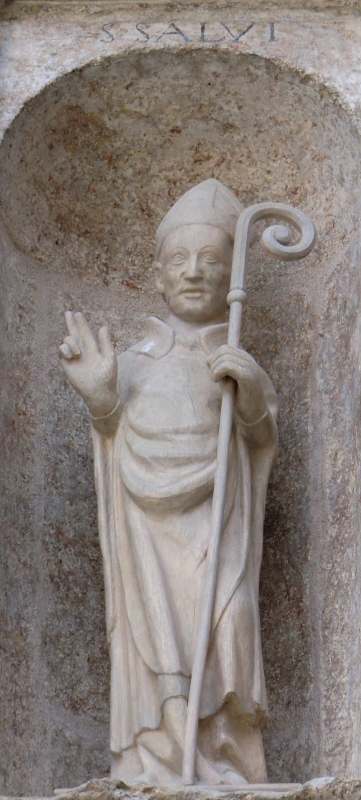
St Salvius of Albi, bishop - 10 September memorial :)


Image:
https://www.heiligenlexikon.de/BiographienS/Salvius_von_Albi.html


September 10

St. Salvius, Bishop
HE was the seventh bishop of Albi, which see had been founded by St. Clarus, who is said to have suffered martyrdom in the third age, and who is honoured on the 1st of July. Before this he had been employed in the first offices of magistracy in the province; but his love for retirement, and the desire of being wholly freed from the distractions which impede a constant union with God, induced him to embrace the monastic state, in which he exhibited an example of piety to his brethren, who afterwards chose him for their abbot. He chiefly confined himself to a cell at a distance from the rest. Here, being seized by a violent fever, he grew so ill, that he lay for dead in the opinion of all about him. Indeed, the saint himself was always persuaded that he really died, and was restored to life by a miracle; be that as it will, he was soon after taken from his retreat, and placed in the see of Albi. He lived as austere as ever, and constantly refused the presents that were made him; but, if any thing were forced upon him, he on the spot distributed the whole among the poor. The patrician Mommolus having taken a great number of prisoners at Albi, the saint followed and redeemed them all. Salvius flourished in the reigns of Gontran, Childebert, and Chilperic: he withdrew the last of these princes from an error he had fallen into concerning the Trinity. In the eighteenth year of his episcopacy, an epidemic disorder made great havoc among his flock: at this season of peril, it was in vain his friends advised him to be careful of his health; animated with a zeal, unwearied as it was undaunted, he flew every where he thought his presence necessary. He visited the sick, comforted them, and exhorted them to prepare for eternity by the practice of such good works as their condition admitted. Perceiving that his last hour was near, he ordered his coffin to be made, changed his clothes, and prepared himself with a most edifying fervour to appear before God. He did not long survive the synod of Brennac, at which he assisted in 580. 1 See the Roman Martyrology, St. Greg. of Tours, and the Gallia Christ. Nova, t. 1, p. 5. 1

~

Note 1. The following extract is taken from a MS. of Count de Boullain-villiers, which his family carefully preserves in the castle of St. Saire: “The titles of the metropolitan of Rouen prove that about the year 800, and near a century after, there was a place in the forest of Bray, consecrated to the memory and honour of St. Salvius, who had been a solitary there. Whether this saint was bishop of Albi or Amiens, or even whether he was any more than a hermit, whose penitential life God hath glorified by divers miracles, is what must remain undecided; the memory of these facts being entirely lost. There remain, however, formal proofs of St. Salvius being a Solitary, in an ancient MS. from five to six hundred years, which contains the office of his feast. He is also represented in a pane of glass in an ancient subterraneous chapel in the dress of a hermit, on his knees, praying with his hands extended. The devotion of the people who visited the church or chapel which was built where his hermitage stood, was supported by miracles and extraordinary cures, which the divine power wrought there, insomuch that the reputation of it went very far. Some houses were built in the neighbourhood for the convenience of pilgrims; but the nature of the country rendered it inaccessible, and the horror of the marshes, augmented by the woods which covered them, hindered the progress of the establishment, which the piety of particulars might have otherwise founded. The canons of Rouen were at the expense of clearing some of the more accessible lands for the subsistence of the priests, who there performed the divine office; and this is the first origin of the parish of St. Saire, and the foundation of the lordship, which the chapter of Rouen possesses there.” This village is about a league and a half from the little town of Neuchatel in Bray. [back]


FROM: http://www.bartleby.com/210/9/105.html


German Bishop: "Emergence of new xenophobia a ‘disgrace’ "

Leader of the German Catholic Church has branded emergence of new xenophobia a ‘disgrace’
by Simon Caldwell
posted Monday, 7 Sep 2015

Cardinal Reinhard Marx, pictured here at an anti-racism rally, 
disapproves of nationalism (CNS photo/Fabrizio Bensch, Reuters)

Cardinal Marx calls criticising rising nationalism as country takes tens of thousands or refugees

The leader of the German Catholic Church has branded the emergence of a new xenophobia in his country as a “disgrace”.

Cardinal Reinhard Marx, president of the German bishops’ conference, said he felt “physically” pained to see protesters making “Hitler salutes” and chanting Nazi slogans at migrants arriving from the Middle East.

In an interview with Der Spiegel magazine, he warned Catholics not to involve themselves with political extremism.

“Xenophobia and being a Catholic do not belong together,” said Cardinal Marx, the Archbishop of Munich-Freising.

“Keep yourselves well away from it … it is irresponsible for everyone.”
Cardinal Marx on Saturday made a spontaneous visit to the railway station in Munich to meet and greet some of the first of the thousands of mostly Syrian migrants arriving by train from Hungary.

He turned up with Bishop Heinrich Bedford-Strohm, the chairman of the Protestant Church in Germany, with whom he had been dining when they suddenly decided, over their lunch, to go to the station and welcome the migrants in person.

The cardinal said the pair had been watching the events unfold on their smart phones at the time.

There were small pockets of opposition to the migrant influx, most notably in Dortmund where 29 members of Die Rechte (the right) party staged a protest rally at the station as a train carrying 1,000 migrants arrived.

But in Munich food had been stockpiled and was handed out to Syrians as they disembarked from trains, for instance, while in Frankfurt, Germans formed a human chain to pass bags of food, clothing and toiletries to exhausted arrivals, who were also greeted with balloons and banners with words such as: “We love refugees.”

In Dresden, a graffiti artist daubed the words “a warm welcome” on to the side of a carriage of a train in Arabic.

Over the last year, Cardinal Marx has repeatedly spoken out against nationalist violence by Germans opposed to Angela Merkel’s open door policy to refugees fleeing war in the Middle East. The country is expecting about 800,000 asylum applications this year alone.

During the summer, he condemned an arson attack that destroyed a reception centre for asylum seekers, saying that the attack revealed that “some groups” were trying to “sow hatred” against migrants.

There were 150 attacks against centres for refugees and asylum seekers in the first half of 2015 alone, some involve guns and firebombs.

Thursday, September 10, 2015

Victoria and Albert Museum's Room 50A will have you rethinking the Middle Ages

This room will destroy your prejudices about the medieval world
by Fr Alexander Lucie-Smith
posted Thursday, 3 Sep 2015

The spectacular Room 50a at the Victoria and Albert Museum in London

No one who visits the Victoria and Albert Museum's Room 50A will leave thinking the Middle Ages were backward

Just recently I visited, not for the first time, what must be one of the finest interiors in this country, namely the vast medieval gallery at the Victoria and Albert Museum – or, to give it its more prosaic designation, Room 50A.

I imagine many readers will be familiar with this gallery, which contains the sanctuary of the church of the Poor Clares from Florence, as well as several wonderful della Robbia ceramics, amid numerous other treasures from the Middle Ages. I am sure no one could disagree with me when I say that this room is packed with spectacular treasures.

What a pity it is, then, that the word “medieval” has such negative connotations in modern British usage. To call something “medieval”, or describe it as “like something out of the Middle Ages”, is the equivalent of saying that it is backward, unenlightened, ugly, out of date, and to be rejected.

There seems to be a conflation in the popular mind between the medieval period and what was sometimes called “the Dark Ages”. In fact, modern historians tend not to us the term “the Dark Ages” of the period between the fall of Rome and the dawn of the Renaissance. No true historian could seriously consign someone like the father of English History, Bede the Venerable (died 735), to the age of darkness, or St Francis (died 1226) to a period before the dawn of enlightenment.

The Middle Ages were, in fact, something of a golden age in architecture, art, literature and political development. They were too a golden age (one of many) in theology, being the time of Peter Abelard (1079-1142), Peter Lombard (1100-1160) and St Thomas Aquinas (1225-1274), to name but three. These men were serious scholars, tremendously well read, and fluent in ancient languages. Funnily enough, it was their works that Martin Luther took pleasure in burning, and their great hero of whom Luther declared: “What has Aristotle to do with Christ?”

Those who speak badly of the Middle Ages will also speak badly of Catholicism, for the medieval period was a time in which the Catholic Church had few serious rivals in the religious sphere in Western Europe. The Middle Ages were the Catholic Ages.

The idea that progress and enlighten came with the Reformation is surely untenable. Far more convincing is the idea that the Reformation was a reaction to the achievements of the Middle Ages: hence its rejection of Aristotle and Greek philosophy, and its rejection and destruction of works of art. Yet the achievements of the Middle Ages are something that we should all feel proud of, despite this negative counter-narrative.

Consider for a moment those countries that did not share in the intellectual and artistic life of the medieval period and the Renaissance. They missed out on the Reformation, true, but they also missed out on the Enlightenment. I am thinking of the successor states to the Russian, Chinese, Persian and Turkish Empires.

They do not share our share our medieval heritage, and, even if they are geographically in Europe, cannot claim to be truly European. Their political culture is very different from ours. Two exceptions to this are Poland and Lithuania, both of which, though dominated by Russia for part of their history, escaped the worst culturally.

One final irony. Those who disparage the medieval period ought to be given pause by the fact that the Palace of Westminster, where Parliament sits, is built in perfect Neo-Gothic style, both inside and out. That is an excellent reminder to us all that the roots of parliamentary democracy itself, among other achievements of the modern age, are rooted in the glorious Middle Ages.

Annulments: Pope has come down in favour of Cardinal Müller

Annulments: Pope has come down in favour of Cardinal Müller, not Cardinal Marx
by Fr Alexander Lucie-Smith
posted Tuesday, 8 Sep 2015

Pope Francis wants to help people stuck by the process 
(CNS photo/Paul Haring)

The Pope wishes to speed up annulments, but not compromise doctrine

The Pope has published two documents today which lay down important reforms in the annulment process. Just how important this may be, only time will tell, but all the indications are that this is a major innovation, and a welcome one.

The two motu proprio are available on the Vatican website so far only in Latin and Italian, but there is a summary of the main points here from Vatican Radio, and there is penetrating commentary, as ever, from the Vaticanista John Allen.

This move by the Pope – and a motu proprio has the force of law for the Church – will make a huge difference to people who up to now have suffered greatly under the present dispensation. I am thinking of those, in the United Kingdom, for example, who have been forced to wait up to five years for the process to play out, even though the outcome of that process has been clear from the beginning. And I am thinking of those in Africa (and there may be other places too) where there is no diocesan tribunal, and who cannot get an annulment at all. For people caught up in these situations, there will now be a faster track approach, or a decision made by the local bishop.

The annulment process has, perhaps unfairly, not had a good press. These reforms will make the process much more “agile” (to use the word of Vatican Radio). It was this that the Extraordinary Synod on the Family asked for last year. Well, now they have it, and rather more quickly than any of us had imagined.

Also of note, bearing in mind the upcoming Synod, is this, in the original Italian:

Non mi è tuttavia sfuggito quanto un giudizio abbreviato possa mettere a rischio il principio dell’indissolubilità del matrimonio; appunto per questo ho voluto che in tale processo sia costituito giudice lo stesso Vescovo, che in forza del suo ufficio pastorale è con Pietro il maggiore garante dell’unità cattolica nella fede e nella disciplina.

In my English translation:

In no wise did it escape my notice that an abbreviated process of judgment might put at risk the principle of the indissolubility of marriage: for this very reason, I have desired that in such cases the Bishop himself, who, because of his pastoral office is with Peter the greatest guarantor of Catholic unity in faith and in discipline, shall be the judge.


This perhaps is the clear statement that many of us have been hoping for. The Pope wishes to speed up annulments, but he does not want to compromise the doctrine of indissolubility. Because bishops will judge, and because bishops are charged with upholding the faith in union with the Holy See, the doctrine of indissolubility will be safeguarded. One notes the way the Pope speaks of “faith and discipline” – the latter reflects the former, and the two cannot be seperated. That is a crucial point and it gives a hint to the discussions at the coming Synod, where, one hopes, all talk of faith and discipline parting compnay will be sternly resisted.

One also notes the reference to the “Catholic unity” that exists between Peter and the bishops. We all know that Catholic means universal. This too is a hint that so called “local solutions” will be given short shrift. The Church is One, as the Creed states: Germany will not be getting what it wants. The Pope has come down in favour of Cardinal Müller, not Cardinal Marx.

Culture: The truth assisted suicide supporters won’t face

The truth assisted suicide supporters won’t face
by Madeleine Teahan
posted Thursday, 3 Sep 2015
MPs will debate a Bill legalising assisted suicide in Britain 
on September 11 (PA)

The champions of the Assisted Dying Bill are desperately hoping that Britons will remain ignorant of the euthanasia horror stories emerging from Europe

Two months ago a 24-year-old Belgian woman was granted the “right to die”. Identified only as Laura, the woman was not terminally ill but was suffering from clinical depression and had decided: “Life, that’s not for me.”

Laura had entertained suicidal thoughts all her life. When she was six she had handled a loaded gun and imagined what it would be like to kill herself. Eighteen years later, instead of making plans for the future, she was arranging her own funeral. She told a local newspaper: “Death feels to me not as a choice. If I had a choice, I would choose a bearable life. But I have tried everything [else] and that was unsuccessful.”

When Rob Marris MP presents his Assisted Dying Bill in the House of Commons next week, we can be confident of two things: he won’t mention Laura, or other victims of Europe’s creeping euthanasia culture, and he will urge MPs to consider Oregon’s experience instead.

He will refer to the American state because his Bill is closely modelled on the law there. Oregon permits assisted suicide – the prescription of lethal drugs which must be self-administered – but it does not allow doctor-administered euthanasia (unlike the Netherlands and Belgium).

Dismissing the evidence from European jurisdictions is politically expedient for supporters of the Bill. But the facts cannot be ignored. After all, Britain arguably has more in common with a country like the Netherlands – a highly urbanised, former maritime trading nation – than with a mountainous US state with a population of four million.

We have a lot in common with Belgium, too: a parliamentary democracy just across the North Sea. We can’t plausibly dismiss Belgium’s “assisted dying” experiment as irrelevant to Britain.

For outsiders, Belgium conjures up idyllic images of city breaks, delicious beers and quaint chocolate shops. We also think of Brussels, home of the European Union, and defender of peace and civilisation across a once warring continent. But beneath this civilised veneer lurks barbarism: the country permits euthanasia not only for the depressed, but also for the anorexic, the deaf and even children.

The average Briton weighing up their views on “assisted dying” – the term preferred by supporters of the practice – may not even be aware of the situation in our closest European neighbours. The BBC’s flagship news programmes aren’t as generous with their coverage of euthanasia horror stories as they are with the personal struggles of “right to die” campaigners – and that’s putting it charitably.

Since legalising assisted suicide and euthanasia in 2002 – 18 years after the Netherlands – Belgium has overtaken its neighbour in the total number of deaths. Bet­ween 2009 and 2013, annual deaths more than doubled from 822 to 1,803.

One study even concluded that euthanasia is under-reported by approximately 50 per cent and that 1,000 patients a year have their lives ended without an explicit request.

An increasing number of those opting for euthanasia are like Laura. In 2010, 4.3 per cent of deaths by euthanasia in Belgium were for neuropsychiatric disorders. By 2013 this had increased to nearly
10 per cent.

It is often said that “one death is a tragedy but a million deaths is just a statistic”. It’s easy to read all the figures from Belgium without flinching.

But Rachel Aviv of The New Yorker recently took one of the statistics and uncovered the shocking story behind it. She looked into the case of Godelieva De Troyer, a beautiful Belgian woman who was killed by a lethal injection administered by Dr Wim Distelmans, the country’s foremost euthanasia doctor.

Aviv reported that Godelieva had attended therapy sessions since she was 19 following a troubled relationship with her parents. She married young and was determined not to repeat the mistakes of her mother and father when she raised her own children. But she eventually divorced her husband, who killed himself two years later.

The happiest time of Godelieva’s life was when she began a new romance in her early fifties. But when that broke down in 2010 she became seriously depressed and her relationship with her son, Tom, deteriorated. In the summer of 2011, when she was 63, Godelieva attended a lecture by Distelmans. In September she began visiting him at his clinic. Four months later she emailed her children telling them she had filed a euthanasia request.

Tom was not on speaking terms with his mother by then. He showed the email to a doctor who was familiar with Distelmans’s work and who reassured him that “there was no way that Distelmans would approve the euthanasia request without first speaking to the patient’s family”. Tom did not intervene because of this advice.

Three months later he received a brief posthumous letter from his mother, announcing that she had been euthanised in a Brussels hospital.

“Tom felt his mind shutting down,” Aviv wrote. “He drove to his mother’s house, which he hadn’t visited in more than a year… In the drawer of Godelieva’s bedroom desk, Tom found drafts of several farewell letters that she had written to friends… There was also a draft of a long letter to her children, which was far more emotional than the one she had sent.

“‘I have not been able to handle the rift with you, Tom,’ she wrote. ‘I have loved you very much but you have not seen it as such.’ She then addressed her three grandchildren: ‘I have missed you very much.’”

Aviv noted that “Godelieva had died with three photographs in her pocket: a picture of her holding Tom on her lap when he was a baby, a picture of her feeding one of Tom’s young daughters ice cream, and a photograph of her and her daughter walking together through a field.”

Godelieva’s case is not an isolated one. Distelmans has performed euthanasia on two deaf twins who had discovered they were going blind. He also ended the life of Nathan Verhelst, born Nancy, a 44-year-old who wanted to die after undergoing a sex change operation. From the moment she was born, Verhelst felt rejected by her mother. She carried this weight all her life and the best support on offer was a lethal injection.

(After Verhelst’s death her mother commented: “For me this chapter is closed. Her death does not bother me. I feel no sorrow, do doubt or remorse… When I first saw Nancy my dream was shattered. She was so ugly. I had a ghost birth.”)

Yet deeply disturbing tales from abroad will not be enough to persuade some parliamentarians about the dangers of licensing assisted death. MPs who are still considering how to vote should reflect on what daily life would be like in England and Wales if the law is changed.

Supporters of the Marris Bill have a simply staggering faith in human nature and bureaucratic institutions. In a decade that has uncovered the horrors of Rochdale, Rotherham, Baby P, Stafford Hospital and Jimmy Savile, their confidence in our health and social services to spot signs
of abuse, neglect and coercion is extraordinary.

I once asked a nurse how a relative who was lying with a catheter in a high dependency unit was doing. With the emotional intelligence of an alien she responded: “Don’t worry! She’s been p—ing for England!”

The same relative was on a general ward a few days earlier. As she felt increasingly ill, she mustered the strength to find a nurse and told her: “I think I’m going to die before morning.” The nurse coldly told her to go back to bed. It was only thanks to a doctor friend’s intervention that her life was saved.

Do advocates of a change in the law honestly believe that if assisted death is legalised lazy, sulky nurses would become Florence Nightingales overnight? That hospitals would be run like five-star hotels, with a patient’s every dying wish meticulously catered for?

And how would humans really respond to a change in the law? Rob Marris recently claimed that there is “no evidence” that sick people in Oregon feel under pressure to end their lives. But an average 40 per cent of those who apply for assisted suicide there cite “not wanting to be a burden” as a main reason for doing so. In Britain, where independence is so highly valued, the elderly already worry that they are a burden on their relatives. In fact, it’s rare to find an old person who doesn’t feel that way. The legalisation of assisted suicide would make the sick and the elderly feel even more guilty about living.

We in Britain also know from experience that once the appetite for social change is whetted with new laws, it soon becomes insatiable. The leap from civil partnerships to the legalisation of gay marriage tells us a lot about the pace of political change in this country. Or consider abortion: supporters pushed for a change in the law in 1967 in order, they said, to end backstreet abortions. Today, abortion is seen as an everyday healthcare option. More than six million abortions have been performed since 1967 and campaigners are still hungry for further liberalisation.

Belgium has seen precisely this sort of political creep. As Rachel Aviv explained in The New Yorker: “Euthanasia for psychiatric patients was rare in the early years of the law, but patients complained that they were being unfairly stigmatised: psychic suffering, they argued, was just as unbearable as physical pain. Like cancer patients, they were subjected to futile treatments that diminished their quality of life.”

The British are sincere champions of the underdog. Once assisted suicide becomes available for the terminally ill, how can we reasonably stop there? Patients with the same conditions as Tony Nicklinson or Paul Lamb – two high-profile cases used to push for a change the law – would require euthanasia rather than assisted suicide, as neither man could physically administer the dosage for himself. “Assisted dying” would only be the prologue to euthanasia. Demands for “equal death” would inevitably follow.

But what about the supposedly humanitarian case for assisted suicide? People often ask opponents of the practice: “Who are you to tell a patient that they must suffer for longer than they want to?” That’s a fair question. But we ought to turn it around and say to assisted suicide advocates: “Who are you to encourage a sick person to kill themselves?”

A lot more is at stake when MPs debate the Marris Bill on September 11 than whether each of us has a right to end our lives with medical assistance. The cultural shift would be utterly devastating.

Consider the news story last month about a man who was about to jump off a bridge in Dublin before a teenager asked: “Are you OK?” With three words, he saved the man’s life.

The new Bill assumes that we live in a vacuum, without friends, without family and, ultimately, without hope. If MPs vote to change the law, a country that once believed that encouraging another person to commit suicide was a serious offence would overnight become a place which greets the desperate, tragic act with a resigned shrug.

Margaret Thatcher was harshly criticised, especially by the Left, when she uttered her much misunderstood phrase “there’s no such thing as society”. Prescribing suicide as a remedy for suffering is a crushing victory for the aggressive individualism so many claim to detest.

If the Marris Bill becomes law, we will cease to be a society in any meaningful sense of the word – only a collection of individuals who wash our hands of people like Laura.

Madeleine Teahan is associate editor of the Catholic Herald

This article first appeared in the latest edition of the Catholic Herald magazine (02/9/15).