Empress Augusta, Porphyrius the General, the 50 philosophers and the 200 Soldiers martyred with the Great Martyr Catherine
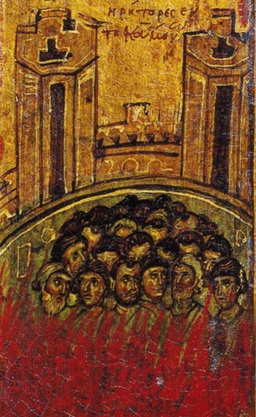
As we read in the life of Saint Catherine, the Emperor Maximian ordered 50 of the Empire's most learned philosophers and rhetoricians to dispute with Great Martyr. As a result of her eloquent testimony, however, they embraced the Christian faith and were summarily burned alive by Maximian's order, after Saint Catherine made the Sign of the Cross over them.
Thereafter, the Empress Augusta, who had heard much about Catherine, wanted to see her. She prevailed upon the military commander Porphyrius to accompany her to the prison with a detachment of soldiers. The Empress was deeply impressed by the tenacious faith displayed by Saint Catherine, whose face was radiant with divine grace. After she had explained the Christian teaching to them, they too embraced the Christian faith.
The next day, Catherine was again brought to the judgment court where, under the threat of being broken on the wheel, she was urged to renounce the Christian Faith and offer sacrifice to the gods. She steadfastly confessed Christ and she herself approached the wheels, but an angel smashed the instruments of execution, which shattered into pieces. Having beheld this wonder, the Empress Augusta, Porphyrius and the detachment of 200 soldiers publicly confessed their faith in Christ. Enraged, Maximian again tried to entice Catherine to renounce her faith, proposing marriage to her, but again she refused his offer and firmly confessed her fidelity to the heavenly Bridegroom Christ. After offering a prayer to Him, she herself laid her head on the block beneath the executioner's sword and was beheaded, as was the Empress Augusta, Porphyrius and the 200 soldiers.
In 1240, some Carmelite brothers from Palestine started a monastery in Toulouse, France. The great Carmelite priest, St. Simon Stock, passed through Toulouse twenty-five years later. A devout woman asked to see him. She introduced herself simply as Joan. She asked the priest earnestly, "May I be part of the Carmelite order as an associate?" St. Simon Stock was the head of the order. He had the authority to grant the woman's request. He said "yes." Joan became the first lay associate. She received the habit of the Carmelite order. In the presence of St. Simon Stock, Joan made a vow of perpetual chastity.
Joan continued her quiet, simple life right in her own home. She tried to be as faithful as possible to the rules of the Carmelites for the rest of her life. Joan went to daily Mass and devotions at the Carmelite church. She filled the rest of the day with visits to the poor, the sick and the lonely. She trained the altar boys. She helped the elderly and infirm by performing useful tasks and running errands. Joan prayed with them and brightened many lives with her cheerful conversations.
Blessed Joan carried a picture of the crucified Jesus in her pocket. That was her "book." Every now and then, she would pull out the picture and gaze at it. Her eyes would light up. People said that Joan read some new and wonderful lesson every time she studied the picture.
Cheerful conversation can brighten many lives. What difference does it make to others?
If the world was to ask us what St Charbel famous for what would we answer? He did not come from a noble family and was not a renowned theologian or philosopher. No dignitaries were present at his funeral.
What is it that makes St Charbel so special? Holiness! Plain and simple holiness. This holy man who is the very blood of our blood and bones of our bones, achieved sainthood by living the simplest life in prayer, humility and work. His eyes were always gazing at the floor but his heart, mind and soul were always lifted to the Lord. He did not concern himself with what the world would think of him, rather he concerned himself only with the Lord.
St Charbel Statue in Annaya, Lebanon. Copyrighted to Living Maronite
St Charbel's life may seem to the world unremarkable. He was born on 8 May 1828 in the village of Bekaafra, high in the mountains of Lebanon. His Maronite parents Antoun Makhlouf and Brigitta Chidiac named him Youssef Antoun Makhlouf. His father died when he was 3 years old, leaving Brigitta a widow with five children. She later remarried a man who joined the priesthood and became the parish priest of the village.
In 1851 at age of 23, Youssef left his family and entered the Lebanese Maronite Order at the Monastery of Our Lady of Mayfouq. It is at that monastery that the famous Maronite icon of Our Lady of Elige is located. One could imagine Youssef spending many nights praying before an icon, seeking the intercession of Our Lady. Later, Youssef transferred to the Monastery of St Maroun in Annaya, where he took the name Charbel, after the Christian martyr, Saint Charbel of Edessa.
St Charbel church in Annaya, Lebanon. Copyrighted to Living Maronite.
Charbel then began studies at the Monastery of Saints Cyprian and Justina in Kiffan. One of his professors at the seminary was Father Nehmtallah Kassab, who later became the Maronite saint, Nehmtallah Hardinie.
Charbel was ordained a priest in 1859 at 31 years of age. He was sent back to the Saint Maroun Monastery, where he lived a life of asceticism. In 1875, Charbel was given permission to live as a hermit at the hermitage of Saints Peter and Paul. He lived for the next 23 years as a solitary hermit.
St Charbel's Room in Annaya, Lebanon. Copyrighted to Living Maronite
On Christmas eve, 1898, while serving the liturgy, Charbel collapsed at the altar and died from a stroke at the age of 70. His death was a quiet affair and his funeral was attended by only four monks. It was only long after his death, when many miracles were attributed to him, that St Charbel became known. He was canonized as the first Maronite Saint on 9 October 1977, by Pope Paul VI.
For those not familiar with the area, Baakafra, where St Charbel grew up, is located above the Qadisha valley in North Lebanon. Nearby, in Becharre, are located the Cedars of God. Over time, this entire secluded area has become a refuge and sanctuary for many Maronites and the perfect place to search for God. It is no surprise that St Charbel, who was born high in Baakafra, developed a love of silence. St Charbel did not rely on words to attain sainthood. He would have come to know silence well in his 23 years in solitude at the hermitage of Saints Peter and Paul. It is that great simple, contemplative silence which has marked Maronite asceticism for generations and it is that silence which the world needs now more than ever.
Ba'kafra, Lebanon where St Charbel grew up. Copyrighted to Living Maronite.
The desire to want nothing (not even words), but to be with our Lord, has been the way of the Syriac monastics from the beginning. No doubt, if St Charbel was here with us now, he would inspire us to turn off social media and phones and all the many distractions of our time and grasp just a moment to build up our souls in contemplation of God.
Contemplation is not only for monks, like St Charbel we can look to detach from the things in this world, the things keeping us away from God. We can all regularly abstain and fast and moderate the things of the flesh. We can be inspired by St Charbel to have a preparedness to pilgrim to a place of holiness deep within ourselves where in solitude we can just be with God and be 'wakeful and pray'. (Matt. 26:41). We all need to carve out our own space and our own time and find silence in the noise of each day.
St Charbel's robe. Copyrighted to Living Maronite
St Charbel died while serving the liturgy and there can be no doubt that the liturgy would have been the centre of St Charbel's life. God uses the physical to make known the intelligible. God the Son clothed himself in humanity so we may come to know him. In the same way, the liturgy raises our mind to the spiritual realities. Like the incarnation in which the invisible Word of God became visible, our liturgy inspires us to deepen the spiritual dimensions of our lives. Be inspired by St Charbel to visit the liturgy regularly. The liturgy is our ladder to salvation and at its summit is the life-giving Eucharist.
Burial place of St Charbel, Annaya, Lebanon. Copyrighted to Living Maronite
So as the Maronite Church celebrates this great feast and the bells in the mountains of Baakafra ring out in joy to the rest of the world, we look to St Charbel to inspire the world by his example of simplicity and humility to strive for holiness.
I am a consecrated Christian solitary brother, observant of the Rule of St. Albert (CCC 920-921). I serve the body of Christ in fraternal community with the Order of Preachers (Rom 11:17).
Please pray for us in our call and mission to serve God and His church. / The monks here depicted are of the eremitic Order of St. Jerome (Hieronymites) to whom I was introduced in Lisbon, Portugal through the 'Mosteiro dos Jeronimos' world heritage site.
The blog title page features an image of the Carmelite Martyrs of Compiègne who gave their lives for the peace of God's people during the French Revolution's reign of terror.
Holy Carmelite Saints & Martyrs please pray for us +
For (well intentioned) questions related to the teaching of the Church in the areas of faith and morals you are very welcome to email me at the following address and I will try to be of assistance or refer you to other resources - Peace in our Jesus :) hermitbrothersjmc@gmail.com