Search This Blog

Friday, February 10, 2012

"Jesus our contemporary" shakes Asia and Europe

ITALY - ASIA
"Jesus our contemporary" shakes Asia and Europe
At the International event organized by the Cultural Project of the Italian Bishops Conference, Card. Joseph Zen emphasizes the vitality of the Church in China and Hong Kong. For Card. Bagnasco, in the West there is a "strange reticence" to speaking of Jesus The Pope: many believers face suffering and persecution for Jesus today.

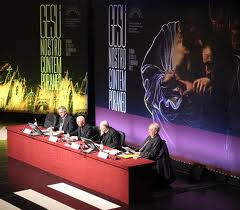
Rome (AsiaNews) - "Jesus is my contemporary through the saints and people who are suffering": this is how Card. Joseph Zen Ze-kiun, bishop emeritus of Hong Kong, summed up his experience speaking at the international conference "Jesus our contemporary" promoted by the Cultural Project of the Italian Bishops Conference, of which Cardinal. Camillo Ruini is president.
Speaking before several hundred people last night, Card. Zen spoke his personal life in Shanghai and Hong Kong and the period when he was teaching in the seminaries of mainland China, underlining the deep faith of the Chinese Church, as well as the difficulties in which it is immersed .

The "contemporary nature of Jesus" is also seen from the "contemporary nature of the cross," said the cardinal and he recalled a great champion of the faith in China, Msgr. Anthony Li Duan, the late bishop of Xian (d. 2005), a great promoter of the unity of the Church in China, and unity with the pope. Card. Zen said that in 2000 Msgr. Li Duan twice refused to submit to the religious policy of the party, refusing to go to an illicit episcopal ordination (without the mandate of the Pope) and a meeting in Beijing where he was to sign a document against Pope John Paul II (who had canonized the Chinese martyrs).

Card. Zen has shown that even within the pressures and persecutions, there are many conversions to Christianity in China. And in Hong Kong, a small community of 350 thousand faithful in a population of 7 million people, every year there are thousands of adult baptisms.

Card. Angelo Bagnasco, president of the CEI, began the conference yesterday, evidencing the differences between European and non-European countries on the issue of faith in Jesus Christ: "While in Africa, Asia, Latin America, the freshness of Christianity is palpable and young Churches (like South Korea) are growing at a dizzying pace, we do not register the same enthusiasm, the same zeal in announcing Jesus Christ as Lord and Savior, because of which the "faith is in danger of dying out like a flame without oxygen".

Today, Card. Bagnasco reiterated, there is "a strange reluctance to speak of Jesus" that threatens to transform believers into "tired receptors of a bland Christianity that is taken for granted". Hence the necessity and urgency of "a season of new evangelization", starting from the knowledge that man "without Christ, easily loses himself" and that the issue "on the ultimate and definitive meaning of life and the world , on the enigma of time and death "is" the question that runs through human history. "

To mark the occasion, Benedict XVI sent a message to the president of CEI in which he spoke of his appreciation for the choice of dedicating the conference "to the Person of Jesus", which will have a deep resonance in Italy's social and ecclesial communities."

For the pope, "... many signals reveal how the name and the message of Jesus, even in such distracted and confused times, provokes ... interest ... even those who are unable to adhere to his word of salvation."

And after having reiterated the urgent need to "open a path to God in the hearts and lives of men," Benedict XVI said that "the story of Jesus of Nazareth, in whose name still many believers in different countries of the world face suffering and persecution, can not therefore be confined to the distant past, but it is decisive for our faith today".

IRAN: Ten Iranian Christians arrested

IRAN
Ten Iranian Christians arrested at a prayer meeting
They were meeting at the home of those arrested. The authorities refuse to give the families information about their whereabouts. Police and security services hunt down converts, shut down churches were services are in Farsi.


Tehran (AsiaNews/Agencies) – More Christians are arrested in Iran. On Wednesday, plainclothes agents raided a house and arrested 10 people who had gathered for prayer service. All 10 detainees were transferred to an unknown location. The authorities refused to give the families any information in this regard.

Although precise details are still not available, Mohabat News reported that a man called Mojtaba Hosseini, 23, was among the people arrested. He had been arrested on 11 May 2008 with eight other people on charges of converting to Christianity. Security officials had asked him to renounce his faith and collaborate with the Intelligence office.

Mohabat News notes that the latest incident is part of a crackdown against Iran's tiny Christian community. Converts are especially targeted.

The authorities have also forcibly closed churches where services are held in Persian (Farsi), Iran's national language. In other churches, the Intelligence Ministry imposed the requirement of keeping out Farsi-speaking people

For this reason, Christian converts are forced to meet in small numbers in private homes. For the authorities, they are tools and spies for the West.

Other religious leaders join Catholic bishops in opposing HHS mandate RSS Facebook February 10, 2012

Prominent Protestant and Jewish leaders have joined in common cause with the US Catholic bishops, declaring their opposition to the HHS mandate requiring contraceptive coverage in health-insurance programs.
Rick Warren, the renowned pastor of the Saddleback Church, said that he stands "in 100% solidarity" with the Catholic bishops. "I'd go to jail rather than cave in to a government mandate that violates what God commands us to do," said the author of The Purpose-Driven Life.
Rev. Richard Land, who heads the Southern Baptist Ethics & Religious Liberty commission, agreed. "Our Baptist forefathers went to prison and died for the freedoms that we have, and now it's our responsibility in the providence of God to defend these freedoms lest they be taken away by government fiat," he said.
Charles Colson, a prominent Evangelical figure and head of the Prison Fellowship, joined with New York Rabbi Soloveichik and Washington's Cardinal Donald Wuerl in co-authoring a column that appeared in the Wall Street Journal, concluding that "under no circumstances should people of faith violate their consciences and discard their most cherished religious beliefs in order to comply with a gravely unjust law."

Thursday, February 9, 2012

Abuse Seminar Vatican: "Put victims first..." Benedict XVI

Put victims first, Pope says in message to abuse seminar

RSS Facebook February 07, 2012

In a message to a seminar on sexual abuse, being held this week at the Gregorian University, Pope Benedict XVI has urged placing the primary focus on the victims of abuse.

The papal message said that "healing for victims must be of paramount concern in the Christian community, and it must go hand in hand with a profound renewal of the Church at every level." The Pope voiced his hope that the seminar would help the Church "to respond in a truly Christ-like manner to the tragedy of child abuse."


Additional sources for this story
Some links will take you to other sites, in a new window.

Wednesday, February 8, 2012

ETHICS/Society: Obama vs Catholic Moral Teaching - Battle escalates

Battle escalates over Obama rule for contraception coverage at Catholic institutions

By Dan Gilgoff and Lesa Jansen, CNN

(CNN) - The battle over a new White House policy compelling Catholic institutions to cover contraception in health insurance plans continues to escalate, with Republican presidential candidates denouncing the rule, liberal groups spotlighting Catholic support for contraception, and the Obama administration vowing to confront religious concerns head on.
"The president's interest is in making sure that … all women here have access to the same preventive care services," White House press secretary Jay Carney said Tuesday.
"He is also concerned about and understands the religious concerns that have been raised," Carney said, stressing that the White House would work to see if "the implementation of the policy can be done in a way that allays some of those concerns."
Earlier Tuesday, a senior adviser to President Barack Obama's re-election campaign, David Axelrod, signaled that the president might be open to compromise on the issue.

"We certainly don't want to abridge anyone's religious freedoms," Axelrod said on MSNBC's "Morning Joe," "so we're going to look for a way to move forward that both provides women with the preventative care that they need and respects the prerogatives of religious institutions."
But the dispute - spurred by a late January announcement by the Department of Health and Human Services that all employers, including Catholic hospitals and schools, will be required to offer free access to FDA-approved contraceptives like the birth control pill and Plan B (the so-called morning-after pill) through health insurance plans - shows no signs of dying down.
"Implementing the policy as is and allaying the concerns are mutually exclusive," Anthony Picarello, general counsel for the U.S. Conference of Catholic Bishops, told CNN on Tuesday. "If they want to allay concerns, they need to change the policy. Nothing less will do."
Churches are exempt from the policy, which goes into effect August 1, and religious institutions that oppose contraception have been given a yearlong extension to comply.
The Roman Catholic Church, which opposes the use of contraception, continued Tuesday to signal that it is intent on resisting the new policy.
"The bishops aren't going to stop until this is fixed, and that means pursuing every legal means available to them to fix it," Picarello said.
The flap was thrust further into the national political spotlight on Tuesday, as Republican presidential candidate Rick Santorum attacked the new rule in his victory speech on a night that he swept primaries and caucuses in Missouri, Minnesota and Colorado.
The administration had told American Catholics that "you have a right to health care, but you will have the health care that we tell you you have to give your people, whether it's against the teachings of your church or not," Santorum said in his Missouri speech.
"I never thought, as a first-generation American, whose parents and grandparents loved freedom and came here because they didn't want the government telling them what to believe and how to believe … that we'd have a president of the United States who would roll over that and impose his secular values on the people of this country."
His GOP rival Mitt Romney has continually denounced the HHS rule in recent weeks.
Speaking in Loveland, Colorado, on Tuesday, Romney said the rule was "in violation of the religious conscience of (Catholic) organizations."
"This kind of assault on religion will end if I am president of the United States," he said.
A survey released Tuesday by Public Religion Research Institute found that Catholics are divided over whether religious colleges and hospitals should have to provide employees with health insurance that covers birth control at no cost. Forty-five percent of Catholic voters support such a requirement, while 52% oppose it.
"Given how closely divided Catholic voters are over the requirement that religiously affiliated hospitals and colleges provide employees with health care plans that cover contraception," said Daniel Cox, PRRI research director, "it seems unlikely that this issue will galvanize Catholics nationally and seriously undermine Obama's electoral prospects with this important religious constituency."
Planned Parenthood also released a survey on the HHS rule Tuesday; it found that 53% of Catholics think that women employed by Catholic hospitals and universities should have the same rights to contraceptive coverage as other women.
"The message to Democrats is that this is something all women deserve to have and that religion just shouldn't be an issue with it," says Tom Jensen, director of Public Policy Polling, which conducted the survey for Planned Parenthood.
Over the past two weekends, the American Catholic hierarchy has distributed letters, harshly condemning the HHS policy, to be read at parishes nationwide during Mass.
"We cannot – we will not – comply with this unjust law," Kansas City, Kansas, Archbishop Joseph F. Naumann wrote in a letter to parishes last weekend. "Our parents and grandparents did not come to these shores to help rebuild America's cities and towns, its infrastructure and institutions, its enterprise and culture, only to have their posterity stripped of their God-given rights."
–CNN's Brianna Keilar contributed to this report.

Sunday, February 5, 2012

MISSION: No one is exempt from Missionary Vocation, says Benedict XVI

NO ONE EXEMPT FROM MISSIONARY VOCATION, SAYS POPE


Says Every Church Activity Should Have Mission Perspective


VATICAN CITY, JAN. 25, 2012 (Zenit.org).- Benedict XVI says that every component of the Church should feel bound by Christ's mandate to preach the Gospel, so that He is proclaimed everywhere.

The Pope said this in a text for World Mission Day, which the Vatican released today. World Mission Day will be celebrated this year Oct. 21.

"All the components of the great mosaic of the Church must feel strongly drawn in by the Lord's mandate to preach the Gospel, so that Christ is proclaimed everywhere," the Holy Father affirmed.

"The mission ad gentes should be, also today, the constant horizon and paradigm of every ecclesial activity, because the very identity of the Church is constituted by faith in the Mystery of God," he added.

Benedict XVI called for a "taking up again [of] the same apostolic impetus of the first Christian communities, which, small and vulnerable, with their proclamation and witness, were able to spread the Gospel in the whole then-known world."

Giving from need

The Holy Father lauded Churches in mission territories, or young Churches, who are themselves actively engaged in missionary work, "even if they themselves are still in need of missionaries."

"So many priests, men and women religious, from every part of the world, numerous laymen and, in fact, whole families leave their countries, their local communities and go to other churches to witness and proclaim the Name of Christ, in whom humanity finds salvation," he noted.

The Pontiff stressed the need for missionary work so that all people have the opportunity to know Christ.

"The meeting with Christ as a living person who satiates the thirst of the heart cannot but lead to the desire to share with others the joy of this presence and to make it known so that all can experience it," he said. "It is necessary to renew the enthusiasm to communicate the faith so as to promote a New Evangelization of the communities and countries of ancient Christian tradition, which are losing their connection with God, in order to rediscover the joy of believing.

"The concern to evangelize must never be left on the margin of ecclesial activity and of the personal life of the Christian, but it must be strongly characterized by the awareness of being recipients and, at the same time, missionaries of the Gospel."

--- --- ---

On ZENIT's Web page:

Full text: www.zenit.org/article-34186?l=english

Saturday, February 4, 2012

WOMEN / Gendercide: when choice becomes an issue

Margaret Somerville | Monday, 30 January 2012
tags : abortionsgendercide

Gendercide: when choice becomes an issue

Indignation over sex-selection shows that abortion is not just a private matter.


girl babyOver 100,000 abortions take place each year in Canada, which, uniquely among Western democracies, has no law restricting access to the procedure. It is legal throughout pregnancy, although the vast majority of physicians will not carry it out after viability of the fetus (the time at which the fetus has a chance of living outside the womb, which the Canadian Medical Association sets at 20 weeks gestation), except for serious medical reasons. Other exceptions to the 20 week limit do, however, occur and are probably not uncommon.

All of which means that if a woman wants an abortion, whatever her reason for deciding that, she may have an abortion. And pro-choice advocates argue that that's how it should be, as women have the right "to absolute reproductive freedom." That means abortion is a private matter between a woman and her physician, just another medical decision; it's nobody else's business and certainly not society's or the law's; and the fetus is "just a bunch of cells," part of the woman's body not a separate being, a "parasite" she is entitled to get rid of.

Pro-choice advocates used to oppose sex-selection abortions, but some have changed their position because they do not want to endorse the legitimacy of any restriction on abortion. The absence of any restrictions not only makes abortion more accessible, it sends a message and establishes a cultural value that having an abortion is "no big deal," as one woman expressed it, which is consistent with pro-choice ideology.

So why is there this huge fuss about sex-selection abortion? If one can have an abortion for any reason or none, why not because a baby of the opposite sex is strongly preferred?

The reason is, as sex-selection abortion most clearly demonstrates, that abortion is not just a private matter. The issue involves shared societal values, cultural norms and clashes of cultural values and shows that the cumulative impact of abortion has societal consequences.

Pro-choice advocates have long proposed that whether women can have unfettered access to abortion should be the litmus test of whether a society has respect for women and their rights. They argue this access is required to protect women's rights to autonomy and self determination - and to protect their dignity. Ironically, however, sex-selection abortion is overwhelmingly the expression of a lack of respect for women in cultures in which sons are highly valued and daughters are massively devalued.

Sex-selection abortion also shifts the analytic, ethical and legal spotlight from the pregnant woman (who is the basis of the pro-choice case), to the unwanted fetus (which is normally ignored in the pro-choice analysis). This is because in sex selection, unlike probably most other abortions, the woman wants a baby -- just not a girl. As a result of this focus on the fetus, we see abortion in a different ethical and legal light.

As is true in all ethical decision making, our choice of language in relation to abortion is also important, because it can affect our emotional response, which factors into how we see abortion's ethical acceptability. Sex-selection abortions are often referred to as "female feticide" or "gendercide" - both emotionally evocative terms. But all abortions are feticide. Why don't we refer to them as such?

And, cumulatively, abortion decisions have an impact on society and are not just a private matter. This is most clear in sex-selection abortion. It's estimated that there are at least 100 million missing girls in India and China as a result of sex-selection abortion and female infanticide. In one Indian study in which 7,000 consecutive abortions were followed, 6,997 were of female fetuses. In some areas of China it's reported there are 160 young men for every 100 young women. This is harmful to both sexes: Women are devalued, treated as objects, abused and harmed. And men cannot find wives.

The Canadian Medical Association Journal editorial suggestion that the way to handle sex-selection abortion in Canada is to withhold information on the sex of the baby until 30 weeks gestation is neither feasible nor ethical. A baby's sex can be determined at eight weeks of gestation with a blood sample from the mother and, in general, people have an ethical and legal right to know the information a physician generates about their condition.

Moreover, testing unborn children for sex is the tip of the prenatal testing iceberg. Tests for many other conditions are already available and more are coming fast. The issues are how may these be used and how should they not be used - and what law governing abortion should be put in place to ensure that the Canadian values we want to enshrine regarding these tests are respected? Much as some politicians, including the Prime Minister, protest against doing so, they must start discussing abortion in Parliament. It is an issue that affects some of the most important values on which we base our Canadian society. And it is not going away.

Margaret Somerville is the founding director of the Centre for Medicine, Ethics and Law at McGill University.

Want to read more articles by Margaret Somerville Click on the links below

JC re. Prayer Request

Hi Sisters and Bros,
I just got some harsh news from a friend's Dad (who happens to be in intensive treatment for a severe cancer),
that my friend Rachel (my god son's Mom) is being tested for breast cancer.  
AJ (Rachel's husband) was recently laid off and remains unemployed as yet, and his Mom's now been put on a ventilator after cancer surgery in South Africa.
So I request your prayers for all of them.
Peace to you in Jesus,
JC
Sacred Heart of Jesus

___________________________________________________________________________________________________________________
"The protection of human life [at all its stages] is the "rock solid and inviolable" foundation upon which all other human rights are based." - Benedict XVI

CAMBODIA: Appeals court gives life term to Comrade Duch

Khmer Rouge Tribunal: Appeals court gives life term to Comrade Duch
At first instance the Director of the S-21 prison, where tens of thousands of Cambodians died, had been sentenced to 30 years. For judges crimes committed "worst in human history." He is the only one who has admitted his guilt. Hundreds of survivors of the regime have heard the reading of the verdict.

Phnom Penh (AsiaNews) - The United Nations tribunal for war crimes in Cambodia today rejected the appeal filed by lawyers for Kaing Guek Eav - better known as Comrade Duch - commuting the sentence of 30 years imprisonment to life. Reading the verdict Kong Srim, President of the Court, emphasized that the crimes committed "were undoubtedly among the worst in recorded human history". This is why the former commander of the notorious S-21, Tuol Sleng Prison in Phnom Penh, deserves "the highest possible penalty." Hundreds of Cambodians - many of them survivors of the genocide perpetrated by the Khmer Rouge - attended the final verdict of the proceedings.

69 year old Comrade Duch, the only one who has admitted his sins and sought forgiveness, after a long journey that has also led him to convert to Christianity, was arrested and sentenced in 2010 to 30 years. Between 15 thousand and 17 thousand people died in the S-21, from hunger, starvation, torture or summary executions. He has appealed the ruling, claiming he was "only" a junior officer, forced to follow orders given by the Khmer Rouge leaders for "fear of being killed." But judges rejected his claim and increased his sentence from 35 years to life.

At the fall of the Khmer Rouge regime Jan. 7, 1979, with the invasion of Phnom Penh by Vietnamese troops, only seven people managed to escape from prison, emerge unscathed and then tell the tragedies suffered in prison. Among these was the famous artist Van Nath, who managed to save himself by painting portraits of Pol Pot, Comrade Duch and other leaders of the Maoist movement. His famous works have also documented a dramatic glimpse of life in cells and the daily torture of men, women, children and babies mercilessly. slaughtered He died September 5, 2011 at the age of 66 (see AsiaNews, 09/07/2011 Phnom Penh: Vann Nath, who painted Khmer Rouge atrocities, dies).

Cambodia still bears the wounds of the rule of the murderous Khmer Rouge led by Pol Pot, who ruled the country from 1975 to 1979, bringing death and destruction. In a few years the regime h eliminated - by starvation or in the infamous Killing Fields, death camps on the outskirts of Phnom Penh - nearly two million people (about one quarter of the population). Many of the victims were intellectuals, doctors, teachers and representatives of the cultural elite. A second trial against three other Khmer Rouge leaders is still underway: Nuon Chea, known by the nickname of "Brother Number Two", Khieu Samphan, former head of state of Democratic Kampuchea, Ieng Sary, former foreign minister of the regime.

However, critics point out that the UN Tribunal, criticized for corruption and inefficiency is only targeting - in part - the symbols of the regime but not guaranteeing real justice to the Cambodian people. Pol Pot died in 1998 due to illness and was never subjected to trial or prosecution for atrocities committed under his command. In addition, many lower ranking officials and members of the Maoist movement executive are still free and in many cases have important roles of government.

Friday, February 3, 2012

SSPX leader: 'we have to say no'RSSFacebookFebruary 03, 2012

The head of the Society of St. Pius X (SSPX) has indicated that the traditionalist group remains at odds with the Vatican on key issues regarding the teachings of Vatican II.

In a sermon delivered on February 2 at St. Thomas Aquinas Seminary, Bishop Bernard Fellay said that the unresolved issue in talks between the SSPX and Rome is the Vatican's insistence that the traditionalists accept the authority of the Council. "And practically, at many levels, we have to say no," he said. Bishop Fellay elaborated:

The key problem in our discussions with Rome was really the Magisterium, the teaching of the Church. Because they say, "we are the pope, we are the Holy See" – and we say, yes. And so they say, "we have the supreme power," and we say, yes. They say, "we are the last instance in teaching and we are necessary" – Rome is necessary for us to have the Faith, and we say, yes. And then they say, "then, obey." And we say, no.

The SSPX leader said that his group's latest response to the Vatican is still under study there.

Additional sources for this story
Some links will take you to other sites, in a new window.