Search This Blog

Thursday, February 16, 2012

'One' Magazine covers the Orthodox Church in America

'One' Magazine covers the Orthodox Church in America

I'm quite a fan of One Magazine. In this article they outlined the history and makeup of the OCA. Many of the photos are sampled from the OCA photo section itself. I've even used many of them here myself (the one below for example).


(One Magazine) - North America is a mosaic of ethnic groups and religions. Orthodox Christians are a tiny minority — about 0.65 percent — and include no more than three million of an estimated 459 million people living in Canada, Mexico and the United States. What they may lack in volume, however, North American Orthodox Christians make up in variety. They comprise immigrants and their descendants from Asia Minor, the Balkans, Europe and the Middle East, as well as Alaska Natives and recent converts, especially from the reformed churches.

The ancient rites of the church of Byzantium unite these Orthodox Christians. Rooted in the New World for more than a century, these North American churches retain strong bonds with the Old World, are divided into a number of ethnic jurisdictions — Albanian, Arab, Belarussian, Bulgarian, Greek, Romanian, Russian, Rusyn, Serbian and Ukrainian — and typically celebrate the divine mysteries in their respective liturgical languages.

One body has attempted to transcend these cultural differences. Originally a jurisdiction of the Russian Orthodox Church, the Orthodox Church in America was established in 1970 and is led by a primate with the title of archbishop of Washington, metropolitan of all America and Canada.

Supreme canonical authority in the Orthodox Church in America rests with a synod of bishops from the 14 jurisdictions that compose this autocephalous, or independent, church. In addition, the Orthodox Church in America includes ethnic Albanian, Bulgarian and Romanian eparchies and jurisdictions in Canada and Mexico.

In English-speaking Canada and the United States, English is the norm in most liturgical services. Yet other languages may be used depending on the pastoral needs of the parish...

Wednesday, February 15, 2012

KOREA: Church defense of unborn is leading priority

South Korean prelate: defense of unborn is leading priority RSS Facebook February 15, 2012

Decrying abortion, the chairman of the South Korean bishops' committee on bioethics is urging the faithful to "make a preferential option for the protection of life."
"We cannot remain indifferent to the fact that the whole society, and even the media, do not say anything about the still widespread practice of abortion," Bishop Gabriel Chang Bong-hun of Cheongju preached at a recent Mass for Life. "We all have to take the lead to become protectors and defenders of the unborn."
Additional sources for this story
Some links will take you to other sites, in a new window.

SEXUALITY: Same Sex attraction and Christian Faith

Liberated love
February 13, 2012
'Courage' offers compassion, fellowship, and hope to those with same-sex attraction.
In January, the Archdiocese of Hartford, Connecticut announced it was becoming the latest diocese to launch a chapter of Courage, the Catholic apostolate that helps men and women struggling with same-sex attraction live in accordance with the teachings of the Church. Deacon Robert Pallotti, director of the office of the diaconate for the archdiocese, helped develop the program for Hartford. He explained that Courage helps people "who need our care and love. In some cases, they have been rejected by society. They need to be accepted, affirmed, and supported as Roman Catholics trying to remain faithful to Church teaching." Courage was founded by Cardinal Terence Cooke, former archbishop of New York, and led for many years by Father John F. Harvey, OSFS. In 2010, Father Harvey died at age 92; the apostolate is currently led by Father Paul Check. There are more than 100 Courage chapters and contacts nationwide; there is also an outreach for spouses, relatives, and friends of persons with same-sex attraction called EnCourage.
Courage makes a distinction between homosexual attractions or feelings and the behavior of acting on those feelings. The feelings themselves are not sinful, the organization notes, but homosexual acts are. Deacon Pallotti continued, "Courage will not reduce a person's identity to their sexual desire; [those with same-sex attraction] are people with full human dignity not defined solely by their sexual desire."
Some of the deacons of the archdiocese initially objected to the program because they mistakenly believed Courage condoned homosexual behavior, but were reassured it did not. Pallotti noted, "Through support and spiritual intervention, we can help people with same-sex attraction lead moral and fulfilling lives. These people are hurting and so are their families. Doing nothing would be a lack of compassion."
Courage's entry into Hartford was not celebrated by all. Phil Attey, executive director of the gay rights group Catholics for Equality, complained in the Connecticut Post that "…at [Courage's] core it's still rooted in dangerous, harmful, and barbaric thinking.  The idea that you can suppress someone's sexuality and still have that person develop into a happy, well-adjusted person, well, there's very little evidence that that's possible."
But many Courage members in established chapters object to characterizations made by critics, and counter that Courage has been an effective tool in helping them become happy, well-adjusted people. Three such members recently spoke with CWR.
Dan
Forty-one-year-old Dan, a Michigan resident who works in the entertainment industry, has been a Courage member for three years. He decided to join the group after attending a Courage conference.
Dan grew up in Michigan, and was part of a devout Catholic family. He was the youngest of four sons. The family left the Catholic Church, however, and joined an evangelical Christian community. "We thought we were doing the right thing," Dan explained. "We still studied the Scriptures, and didn't compromise on morality, including the belief that sex is for a married man and woman."
Dan recalls his first same-sex attractions as early as age six. He was awkward around girls, and thought himself different from other boys. He also had "body issues," and believed he was unattractive.
He describes his father as emotionally distant. His father's father had committed suicide when his father was only three, which left him emotionally scarred. His dad loved him, Dan believes, but was not nurturing.
The primary male activity in the household was working on cars. His three brothers took to it, but he did not. Dan recalled, "I'd rather be cooking in the kitchen with mom."
Rounding out the psychological profile, Dan said he has a "sensitive spirit" and a creative bent, and had an overprotective mother, who "lived her life through me."
In high school and college, Dan's efforts to date women were unsuccessful. He became addicted to pornography, and found himself more interested in the men than the women. The Internet emerged in the late 90s, and he found himself a regular viewer of gay porn. He joined online chat groups, and found himself corresponding with other men with same-sex attractions.
He finally told his parents he was struggling with same-sex attractions, assuring them, "I want to do the right thing."
Dan joined an evangelical group which helped men with sexual problems, but found himself lonely and unhappy. He even recalls going to a strip club to look at naked women in hopes that he would feel arousal. He didn't. In fact, he recalls sitting with a naked woman talking about gardening.
Dan believed the gay lifestyle was wrong, but reasoned, "I may risk hell, but I'm living hell now."
He found a boyfriend and lived with him for a year. Dan enjoyed the friendship, loved the man, but found the sexual relationship "unfulfilling." In fact, he came to believe, "We were not loving each other when we were having sex."
He was angry at God at this time. In fact, whenever he drove past the Catholic cathedral in town, Dan says he would "flip it the bird."
But something unexpected happened. He met a woman at work he found attractive. He said, "It stirred up the old thoughts and desires I'd once had for women." It also reminded Dan of his deeply felt desire to marry and have children of his own.
He told his boyfriend, and to his pleasant surprise, the man "did a Christ-like act of love."
"He told me, 'If you can have that life you want, I'll let you go,'" Dan recalled.
When Dan shares his experiences with others, he stresses that just because a person is living the gay lifestyle, he is not "totally depraved" and is capable of goodness.
Dan enjoyed a relationship with the woman at work for more than a year. They ultimately separated; she didn't want to have children and Dan did.
Dan's family, meanwhile, had returned to the Catholic Church. Additionally, one of his brothers became a priest.  Dan began a period of intense reading of Christian authors, and eventually also returned to the Catholic Church. He has come to believe that his same-sex attraction is a cross that can help him become closer to Christ. He said, "God has allowed me to suffer with same-sex attraction so that I can ultimately become whole and long for heaven."
Some friends were involved with EnCourage, which led to Dan's introduction to Courage three years ago. He has since shared his testimony at the 2010 and 2011 Courage conferences, and has received invitations from bishops to speak to priests in their dioceses about the issue of same-sex attraction.
Dan is grateful for the support Courage offers him. When he's struggling with a temptation ("I'm not over the hurtle—chastity is still a daily battle"), he sends a text message to other men in the group requesting their prayers. He receives immediate encouragement from fellow members, who text him back, "You can do it" or "Call me any time."
"We're in this battle together—we're like a band of brothers," Dan observed. "I'll help you one day, you help me the next."
Those who have never had an experience of same-sex attraction often are unable to relate to the struggle in the same ways fellow members of Courage are, Dan said. He also gets annoyed by those who proclaim that people with same-sex attractions must identify themselves as homosexual and live the gay lifestyle.
"The truth and dignity of man calls us to something far greater," he said.  "Who I am is not my sexual attraction."
He also rejects the notion that if he is a good cook, a talented photographer, or a gifted musician, it is because he has same-sex attraction.
Dan believes he's in a much better place than he was a decade ago, when he believed God had abandoned him. He's open to marriage, "if it's God's will."
He's dialogued with gay activists, who he says have labeled him "a gay Uncle Tom." Dan has two responses to his critics in the gay rights movement: "I don't care what they think about me," and "I am not limited or identified by who I'm sexually attracted to." Many gay activists—he specifically mentioned the writer Dan Savage—encourage promiscuity, including for couples in committed relationships. Dan opined, "That's not a path to happiness."
Dan has committed himself to chastity, although he says it remains a daily struggle. "I remain chaste by the grace of God, and the support of my family and friends," he says. In order to remove the temptation to look at online pornography, Dan removed his home Internet connection last year. To combat loneliness, Dan socializes frequently with friends who understand his struggles.
He's working on a memoir about his experiences, and hopes to go public to a wider audience in the future.
Andrew
Andrew, 31, has been a Courage member since 2009. He is a teacher and lives in western Canada. Born and raised Catholic, he left the Church in his teens and immersed himself in New Age philosophies.
Andrew recalls experiencing same-sex attraction as a boy, and was particularly troubled by an experience he had as a teenager. He went to a massage therapist, and, while receiving a massage, was inappropriately touched by the male masseuse. Young and scared, Andrew was upset that it aroused him, and thought to himself, "Oh my gosh, I'm gay."
In an effort to prove to himself that he was not, Andrew became promiscuous with women. He has come to regret this, explaining, "My behavior was selfish. It was exploitive of others."
The experience also drew him into viewing pornography, which soon became an addiction. His focus shifted from women to men and transsexuals. "I had made sex the center of my life," he says.
Andrew reflects today that his life was a "continuous cycle of seek-and-not-find"—"I never found the love I knew I desired," he explains.
When he was in college, gay rights groups pressed students such as Andrew to "come out," identify themselves as homosexual, and openly live the lifestyle. At the time, Andrew accepted various positions that gay activists were taking, such as that people are born homosexual and that 10 percent of the population is homosexual. Andrew had previously held back from coming out, for fear of hurting his family. But by 2007, he thought it was his only road to happiness.
However, the week he decided to come out, Andrew went to Mass and heard a homily by a "very wise, humble" priest who challenged many of the statements put forth by gay activists. Andrew decided not to come out, and began to read voraciously. He discussed his situation with his bishop, who suggested Andrew get involved with Courage. It was not like other Christian ministries that try to "pray the gay away," he said, but focused on helping the individual develop "a life-identity centered on Christ, the side effect of which is that one gradually disengages from a life-identity that is sexually-centered."
It has been a long process, but Andrew has come back to the Church and regularly receives the sacraments. He still struggles with same-sex attraction, but noted, "I don't want to be gay. I don't want to self-identify as a homosexual person. I'm not a homosexual. Yes, I experience homosexual attraction, but I am first a human being; a human being who has been permitted the experience of same-sex attraction."
Today, Andrew has found peace like "none I have ever had before," which he compares to the "hopelessness" he felt as he prepared to come out. He's never told his family about his same-sex attraction, as he knows it will be difficult for them to understand and accept. Instead, he enjoys the fellowship of other men in Courage who can relate to his experience. Like Dan, he has authored a personal testimony, but has only shared it privately with clergy who support the Courage mission. He hopes one day to go public with his message, so that "people will come to understand their brothers and sisters with same-sex attraction who are truly in need of their love."
Pete
Pete, 62, is something of a rarity among Courage members in that he's been married for 39 years, has an adult daughter, and, although he's struggled with same-sex attraction, he's never acted upon it.
Pete lives in Philadelphia and works as an accountant.  As a boy, he was taunted by his classmates for his perceived effeminate characteristics; they called him "Mary" and many worse epithets. He had a passive father and overprotective mother, and suffered from a "weak masculine identity."
When he first experienced same-sex attraction as a youth, he said, "I didn't want those feelings. I didn't want to be gay. Nobody does."
At age 18, in the late 1960s, more than a decade before the establishment of Courage, Pete went into counseling. Advice he received ranged from encouraging him to join a gay rights group, to "go get hooked up with a girl." Even Pete's father, trying to help in his misguided way, suggested Pete hire a female prostitute.
Pete disregarded both suggestions because he was a practicing Catholic, and wanted a loving, heterosexual, married relationship like his parents had. He never acted on his same-sex attraction, and ended up marrying a woman when he was in his 20s. Pete is glad he never explored homosexual relations, remarking, "If I'd acted it out, I would have become a homosexual."
But, at age 50, Pete's same-sex attraction "came back with a vengeance." He was so troubled by the temptations that he had what he called a "nervous breakdown," manifested in panic attacks and obsessive thinking. He quit his job and his marriage suffered. He returned to counseling, this time with Richard Fitzgibbons, a Philadelphia psychiatrist supportive of Courage. He even had a few opportunities to share his struggles with Father Harvey, Courage's founding leader.
Pete recalled, "Father Harvey was a kindly, saintly man, who had great compassion for people with same-sex attraction. He understood sexual brokenness, but was blunt about Church teaching."
Pete joined Courage six years ago—one of the first married men to do so. "The goals of Courage should be the goals of any man: chaste living, regularly performing spiritual exercises, enjoying fellowship and mutual support, and offering one another good example," he says.
Courage has been a great support for Pete, because his fellow members "walk with you, and they understand your struggle."
Pete also offered a reflection for critics of Courage: "We're not here to argue with or harm anyone. For people dealing with the pain of same-sex attraction, we have a remedy based on Scripture, the sacraments, and fellowship. Courage's intent is not to get you out of the condition, but to help you develop a relationship with Jesus Christ. He has a plan for you."
 
About the Author
Jim Graves

Jim Graves is a Catholic writer living in Newport Beach, California.

Tuesday, February 14, 2012

Female leader leaves Regnum Christi RSS Facebook February 14, 2012

The head of a group of women associated with the Legion of Christ has announced her resignation.
Malen Oriol, the leader of about 600 "consecrated women" in Regnum Christi who led lives of celibacy and service to the Legion's efforts, has announced that she is stepping down from her post, which also involved being an assistant to the director of the Legion of Christ.
Oriol revealed that many of the "consecrated women" of Regnum Christi are approaching their local bishops, looking for ways to live out their vocation apart from the troubled religious order.
Additional sources for this story
Some links will take you to other sites, in a new window.

Monday, February 13, 2012

VOCATION: God takes the 'first step'

God takes 'first step' in every religious vocation, Pope says RSS Facebook February 13, 2012

God is "the One Who takes the 'first step'" in any vocation to priesthood or the religious life, writes Pope Benedict XVI in his message for the annual Day of Prayer for Vocations. "Every specific vocation is in fact born of the initiative of God; it is a gift of the Love of God!" the Pope writes. "We need to open our lives to this love," he says. The 49th annual Day of Prayer for Vocations will be observed on Sunday, April 29. The Vatican released the papal message, entitled "Vocations, the Gift of the Love of God," on February 13.
Additional sources for this story
Some links will take you to other sites, in a new window.

TRAGEDY and God's Healing Presence

LITURGY AND LIFE
By Tom Saretsky
God's healing presence is in those who lend support
5th Sunday in Ordinary Time
Feb. 8, 2012

Job 7: 1-4, 6-7
Psalm 147
1 Corinthians 9: 16-19, 22-23
Mark 1: 29-39

I'm a member of the tragic events response team for our school division. When tragedy strikes a school community, my partner MaryLynn and I are called to help the staff and students deal with the tragedy.
Unfortunately, we have been very busy these past few years, and the scope of the tragedies to which we have responded can make a person ask, "Where is God?"
MaryLynn and I have faith in a God who is intimately present in the midst of despair. God enters our "Gardens of Gethsemane" and stands beside us, even though we may feel alone and abandoned. God is a God who loves and who desires the best for us, despite all the sadness. In helping school communities deal with tragedy, we portray an image that our God is a God who feels, who commiserates with us as we suffer and who mourns as we mourn. We express that tragedy, suffering and death is not God's will.
When I was a kid, and even more when my parents were young, there was a prevalent mindset that bad things were the result of God's will. After being taught this, is it any wonder that people have difficulty with God and religion in general? The belief that God is the cause of all pain and suffering is simply bad teaching and bad religion.
In the first reading, Job has much in common with those who despair the hardships they feel God gives to them. Job suffers greatly in his life, lamenting to God about the misfortunes that plague him. "Does not the human being have a hard service on earth, and are not their days like the days of a labourer? I am allotted months of emptiness, and nights of misery are apportioned to me."
When tragedy strikes, it is convenient to blame God. It takes a great deal of faith to feel that God is present throughout all of the pain, and not the source of it. It is faith that helps a person get through tough times. Jesus did everything he could to convince people that God is good and not vengeful. Jesus valiantly tried to change the mindset of the people through his healing touch, comforting words and strengthening presence.
The psalm today reads: "The Lord heals the broken-hearted, and binds up their wounds." Jesus reached out to those who suffered. He cured the sick and the lame. He identified with the powerless and the oppressed, and brought the untouchables of society, the outcast and sinners, back into community. By Jesus' words and through his actions, people were given hope and a feeling of worthiness. Though "Jesus cured many who were sick with various diseases, and cast out many demons," he never idealized suffering. Instead, Jesus used suffering as an opportunity to reveal the face, compassion and love of God.
Our experiences of suffering reflect a common characteristic. They all provide opportunities for individuals and the larger community to step forward and offer support and assistance. This is how we reflect the face of Jesus to others, and by living the words, "whatsoever you do," becomes a responsibility the community has to extend the boundaries of the kingdom, and to share the love, compassion and healing touch of God.
Suffering is never God's fault, nor is it ever God's will. "The world said, 'Love cuts like the cold wind, and the will of God is plain as the winter. Where is the summer will of God? Where are the green seasons of God's will? Where is the spring and summer of God's will?' "(Flannery O'Connor).
Suffering is part of the human condition. How we deal with it, how we with God's help use suffering in order that we might make a difference in the lives of those who need support is what is important to remember.
God's will, therefore, is that we extend our hands to those who need help in carrying crosses made heavy by sorrow and pain. God's will is that we express words of love to those who feel unloved, and God's will is that we accept all and recognize everyone as children of God created in God's image and likeness.

Saretsky and his wife Norma have two children, Nathan and Jenna. He is a teacher and chaplain at Bishop James Mahoney high school in Saskatoon.

ORDINARIATE: First head of US Anglican ordinariate installed

First head of US Anglican ordinariate installed RSS Facebook February 13, 2012

Father Jeffrey Steenson has been installed as the first Ordinary of the Personal Ordinariate of the Chair of St. Peter. The ordinariate was established on January 1 to assist Anglicans in the United States who wish to enter into full communion with the Catholic Church while retaining elements of their Anglican heritage.
Father Steenson--who will take part in the United States Conference of Catholic Bishops, but will not be ordained a bishop because he is married--preached in his installation homily:

Listen to St. Anselm, the 37th Archbishop of Canterbury, perhaps the greatest theologian ever to grace England's green and pleasant land: "This power was committed specially to Peter, that we might therefore be invited to unity. Christ therefore appointed him the head of the Apostles, that the Church might have one principal Vicar of Christ, to whom the different members of the Church should have recourse, if ever they should have dissentions among them. But if there were many heads in the Church, the bond of unity would be broken" …

Some will argue that the Catholic Church makes Christian unity a difficult thing to achieve. Look at what is being asked of those who are considering the Ordinariate! – Anglicans have not only to be received but even confirmed, and their clergy ordained in the absolute form. Is this not asking them to begin all over again? Certainly not! From Zephyrinus to Callistus to Cornelius to Stephen – these third century popes, most of whom laid down their lives as martyrs, who governed the Church at a time when it seemed as though the gates of hell really might prevail, threatening to destroy her essential unity – the Catholic Church simply asked that the bonds of charity be restored sacramentally by invoking the presence of the Holy Spirit. These are brothers and sisters, returning home.

Sexuality: Chastity as purity of heart and intention

Chastity as purity of heart and intention
Written by  Fr. Ron Rolheiser
To live a chaste life is not easy, not just for celibates, but for everyone. Even when our actions are all in line, it is still hard to live with a chaste heart, a chaste attitude and chaste fantasies. Purity of heart and intention is very difficult.

Why? Chastity is difficult because we are so incurably sexual in every pore of our being. And that is not a bad thing. It's God's gift. Far from being something dirty and antithetical to our spiritual lives, sexuality is God's great gift, God's holy fire, inside us. And so the longing for consummation is a conscious or inchoate colouring underlying most every action in our lives.

And so it is hard to pray for chastity because to pray for it, seemingly, is to pray that sexual yearning and sexual energy should lessen within us or disappear altogether. And who wants to live an asexual and neutered life? No healthy person wants this. Thus, if you are healthy, it is hard to put your heart into praying for chastity because, deep down, nobody wants to be asexual.
But the problem is not with chastity but with our understanding of it. To be chaste does not mean that we become asexual (though spirituality has forever struggled to not make that equation). Chastity is not about denying our sexuality but about properly channeling it. To be chaste is to be pure of heart. That's the biblical notion of chastity. Jesus does not ask us to pray for chastity, He asks us to pray for "purity of heart": Blessed are the pure of heart, they shall see God. They also channel their sexuality properly.

What is purity of heart? To be pure of heart is to relate to others and the world in a way that respects and honours the full dignity, value and destiny of every person and everything. To be pure of heart is to see others as God sees them. Purity of heart would have us loving others with their good (and not our own) in mind. Karl Rahner suggests that we are pure of heart when we see others against an infinite horizon, namely, inside of a vision that sees the other's dignity, individuality, life, dreams and sexuality within the biggest ambiance of all, God's eternal plan. Purity of heart is purity of intention and full respect in love.

When we understand chastity in this way we can more easily pray for it. In this understanding we are not praying to have our sexual energies deadened, we are praying instead to remain fully red-blooded but with our sexual energies, intentions and daydreams properly channeled. We are praying too for the kind of maturity, human and sexual, that fully respects others. In essence, we are praying for a deeper respect, a deeper maturity and a more life-giving love.

And this is a much needed prayer in our lives because sexuality is so powerful that even inside of a marriage relationship sexuality can still have an intentionality that is not wide enough. Charles Taylor, in his book A Secular Age, argues the point that sex too easily loses the big picture and becomes narrow in its focus, a point that is often missed in our understanding of it: "I am not trying to be condescending about our ancestors, because I think that there is a real tension involved in trying to combine in one life sexual fulfilment and piety. This is only one of the points at which a more general tension, between human flourishing in general and dedication to God, makes itself felt. That this tension should be particularly evident in the sexual domain is readily understandable. Intense and profound sexual fulfilment focuses us powerfully on the exchange within the couple; it strongly attaches us possessively to what is privately shared... It is not for nothing that the early monks and hermits saw sexual renunciation as opening the way to the wider love of God ... (And) that there is a tension between fulfilment and piety should not surprise us in a world distorted by sin, that is separated from God. But we have to avoid turning this into a constitutive incompatibility."  

Unfortunately that is forever what both the secular world and Christian spirituality (without a proper understanding of chastity) struggle not to do.

Given the power of sexuality inside us, and given the power of our human drives and yearnings in general, it is not easy to live a chaste life.

It is even more difficult, and rare, to have a chaste spirit, a chaste heart, chaste daydreams and chaste intentions. Our hearts want what they want and pressure us to ignore the consequences. We can easily feel a certain repugnance to praying for chastity. But that is largely because we do not understand chastity properly: It is not a deadening of the heart, a stripping away of our sexuality, but a deeper maturity that lets our sexual energies flow out in a more life-giving way.


___________________________________________________________________________________________________________________
"The protection of human life [at all its stages] is the "rock solid and inviolable" foundation upon which all other human rights are based." - Benedict XVI

Saturday, February 11, 2012

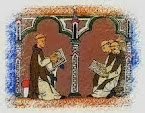
ART: Christ the Bridegroom and the Church His Bride


Unknown, Christ the Bridegroom and the Church His Bride, from Petrus Comestor,
Bible historiale, Koninklijke Bibliotheek, The Hague, 1372