Search This Blog

Tuesday, April 8, 2014

Religious Studies: Irresistibly moved to pray in unexpected places

Irresistibly moved to pray in unexpected places

  • A Buddhist woman prays at Wat Phrathat Doi Suthep in Chiang Mai, Thailand, in 2012. (Dreamstime)
 |  Soul Seeing


As a Christian, I am comforted by Jesus' assurance that "you may ask me for anything in my name, and I will do it" (John 14:14). But as a theologian concerned with religions other than Christianity as ways of salvation, I wonder whether non-Christians can really pray at all, and whether, if they pray, God would listen to their prayers, since they are not made in Jesus' name. My dogmatic certainty in this matter -- whatever little of it I had -- was shaken by what I experienced in Thailand in June 2007.
I was invited to deliver a lecture at a conference on world Christianity and its encounter with other religions at Payap University, a Church of Christ institution located in Chiang Mai, a city of enchanting beauty in mountainous northwest Thailand. As customary during academic conferences, there was a free day for sightseeing. Participants were given a tour of Wat Phrathat Doi Suthep, one of the most famous Buddhist pagodas in Thailand. King Keu Naone of the Lanna Kingdom built it in 1383 on a mountain, at 1,676 meters above the city of Chiang Mai. Dominating the whole pagoda, which is reached by mounting 309 steps, is a monumental golden statue of a sitting Buddha in serene meditation.
Throngs of pilgrims, young and old, women and men, rich and poor, ritually circumambulated around the statue in prayerful silence, hands clasped at their chests. Others stood in front of the Buddha, incense sticks in their hands, eyes closed, lips murmuring prayers. There was, of course, the usual number of tourists, but the vast majority was pious faithful worshiping in utter devotion. There was none of the hustling and chattering I have seen at Catholic pilgrimage centers and even in St. Peter's Basilica in Rome. The atmosphere was suffused with an awe-inspiring aura of sacredness. I was told that on certain feasts, pilgrims would go on foot, sometimes on their knees, from the bottom of the mountain up to the monastery, a pilgrimage that would take days.
After the conference, I stayed another day to see the city of Chiang Mai. I hiked to another famous pagoda, Wat Umong, just on the outskirts of the city. There were heavy, smoke-spewing traffic and ear-splitting din around the pagoda, but inside the enclosure, there was an eerie peace and tranquility. There were several small pagodas where people came in and out for prayer and a garden with Buddhist proverbs in Thai and English on display on the trees to help the faithful meditate as they walk along the path. Deep silence reigned everywhere on this sacred ground; even birds seemed to cease twittering.
The main pagoda stood majestic and magnificent in the middle of the compound. In it, there were several statues of the Buddha and his disciples, with a huge golden Buddha placed at the center of a high stage near the back. On the left side was an altar on which sat a statue of Quanyin ('Quan Am' in Vietnamese), commonly known as the Goddess of Mercy, whom many East Asian Catholics regard as the equivalent of Mother Mary. As I walked toward it, I saw a young woman sitting in a lotus position at a short distance in front of the statue, her head slightly bowed. Not to disturb her, I moved quietly to the back and sat on the floor some 20 feet behind her.
Intrigued by this figure immersed in prayer, I decided to stay for a while. For nearly three quarters of an hour, the young woman sat, wrapped in prayer and meditation, not a limb twitching, not a turning of the head, preternaturally immobile, like the unrippled water of an autumnal pond, under the loving gaze of the Buddha of Compassion as people walked by. Watching her, I was irresistibly moved to pray -- to the Christian God, Jesus, the Buddha, Mary and Quanyin -- by this Buddhist devotee in an unexpected and strange place.
When I left, the young woman was still praying there, for how much longer I would never know. But I came to understand for the first time -- in the depths of my soul -- what Christians mean when they speak of the ecclesia orans, the praying church. That anonymous Buddhist woman embodies, more than anyone I have known, what the "praying church" is.
On my way back to the hotel, as I walked the meandering streets of Chiang Mai, my mind was haunted by memories of the throngs of Buddhist devotees at Wat Phrathat Doi Suthep and of the praying young woman in Wat Umong. It was not the first time that I was blessed with opportunities to witness non-Christian worship and prayer. Several years earlier, I visited the Blue Mosque in Istanbul. It happened to be Ramadan, and I was deeply moved by the sight of hundreds of Muslims on their knees, bowing to the ground in unison, as they expressed their total submission to Allah. Then, as in Chiang Mai, I was moved to pray by the praying non-Christians.
Now my memory lingers on not only John 14:14, but also Blessed John Paul II's statement: "Every authentic prayer is prompted by the Holy Spirit, who is mysteriously present in every human heart" (Redemptoris Missio).
[Fr. Peter C. Phan, a native of Vietnam, emigrated as a refugee to the U.S. in 1975. He is the Ellacuria Chair of Catholic Social Thought at Georgetown University, and the author of many books, including Being Religious Interreligiously: Asian Perspectives on Interfaith Dialogue.]

This story appeared in the April 11-24, 2014 print issue under the headline: Irresistibly moved to pray in unexpected places .

Love to the loveless shown...


Love to the loveless shown...


(Vatican Radio ) In 1918 the English composer
John Ireland was asked to write a tune for the
following year's edition of the Public School
 Hymn Book . The words had already been
chosen: ' 'My song is love unknown, my Saviour's
love to me, love to the loveless shown that
they might lovely be.'...

Listen to Monsignor Philip Whitmore's musical
meditation in a programme produced
by Veronica Scarisbrick: RealAudioMP3
 

Monday, April 7, 2014

SYRIA: Dutch priest shot dead in Homs

Dutch priest shot dead in Homs

Francis van der Lugt appears to have been targeted by lone gunman in rebel-held district of Syrian city

Francis van der Lugt
Francis van der Lugt repeatedly refused to leave Bustan al-Diwan. Photograph: AP

A masked gunman shot dead a Dutch priest in the garden of a monastery in the Syrian city of Homs on Monday.
Father Francis van der Lugt, 75, a Jesuit – the same order as Pope Francis – had lived in Syria for decades and had refused to be evacuated with other civilians from the battleground city of Homs.
The gunman's motives were not known and no one immediately claimed responsibility for the killing, which took place in Bustan al-Diwan, a rebel-held district blockaded for more than a year by forces loyal to the Syrian president, Bashar al-Assad.
But the fact that Van der Lugt was attacked in a rebel-held area may underline the fears of many in Syrian Christian and Muslim minorities over the fate of their communities. Over the past year, hardline rebel groups including the al-Qaida-linked Nusra Front have become more influential among opposition fighters in the city.
Van der Lugt's death was first reported by another Homs-based priest, Assad Nayyef, as well as the British-based Syrian Observatory for Human Rights and Syria's state-run Sana news agency.
It appears that Van der Lugt was directly targeted. A single gunman walked into the monastery, entered the garden and shot him in the head, said the Rev Ziad Hillal, a priest who was in the convent when the attacked occurred. "I am truly shocked. A man of peace has been murdered," he said in a phone interview with Vatican Radio.
The Rev Federico Lombardi, a Vatican spokesman, said Van der Lugt, was "a man of peace who with great courage had wanted to remain faithful, in an extremely risky and difficult situation, to the Syrian people to whom he had dedicated for a long time his life and spiritual service."
An activist based in a blockaded rebel area said rebel fighters were shocked by the priest's death. "The man was living with us, eating with us, sleeping with us. He didn't leave, even when the blockade was eased," said Beibars Tilawi. He said the priest was well-liked for his efforts to get the blockade lifted and alleviate widespread suffering and hunger among civilians.
The secretary of the Dutch Jesuit order, Father Jan Stuyt, said the slain priest had been living in Syria since the mid-1960s and was on good terms with members of the country's Muslim majority. "He is like a martyr for the interreligious dialogue," he said.
Van der Lugt repeatedly refused to leave Bustan al-Diwan despite the violence and a series of UN evacuations. A friend who spoke on condition of anonymity because he feared for his safety said Van der Lugt refused to leave until all Christians were evacuated.
It is not clear how many Christians remain trapped in rebel-held parts of Homs. In February there were about 200 Christian families, according to Syrian Red Crescent figures.
Van der Lugt also sought to draw attention to the suffering of civilians in blockaded Homs. "Hunger defeated us! We can see its signs drawn over the faces," he wrote in January on a Syrian Christian Facebook page.
"People are wandering the streets screaming; We are starving, we need food! They stop by the inhabited houses trying to find some food. Hunger breaks the rules and eliminates all moral principles. We are living a scary reality. Human beings turn into wild animals living in the wild."
Albert Abdul-Massih, who worked with Van der Lugt, said the priest held a doctorate in psychiatry and led an austere life. "He was a Christian clergyman but he wasn't conservative," he said. "We learned humanity from him, and he used to love Muslims as much as he loves Christians … He was treating people for free and he was a fluent Arabic speaker."
Abdul-Massih added: "He called me two days ago and told me that he is hopeful that the siege will end soon. His death was a big loss."
Sana blamed "terrorists" for the priest's death but offered no details. The government uses the term for anti-Assad armed rebels.
Another Jesuit priest, Father Paolo Dall'Oglio of Italy, went missing in July after travelling to meet Islamist militants in the eastern city of Raqqa. The city fell into rebel hands in March 2013 and was subsequently taken over by radicals including the al-Qaida breakaway group the Islamic State in Iraq and the Levant.

Sunday, April 6, 2014

CANADA / Ontario: Historic Greek Catholic parish burns to the ground

Historic Greek Catholic parish burns to the ground
St. Elias has been THE place to look for liturgically proper and genuinely beautiful services. In fact, many Orthodox people link to their photos and videos without knowing that they aren't Orthodox.

(CTV News) - Charred posts are all that remain of a 20-year-old Toronto-area Ukrainian church after a massive fire gutted the iconic building Saturday morning.

Its pastor and spiritual leader, Father Roman Galadza, says parishioners are devastated.

"It's like a death in the family," Galadza told CTV News. "I'm still a bit numb. I feel for (the parishioners)."

Firefighters were called to St. Elias The Prophet Ukrainian Catholic Church near Heritage Road and Bovaird Drive in Brampton just before 7:00 a.m. on Saturday.

The church, which was built completely from wood and was famous for its ornate architecture, was completely engulfed in flames by the time emergency crews arrived.

Fueled by strong winds, firefighters say the blaze spread quickly through the church, causing more than $500,000 in damage.

"Fire crews responded very quickly and by the time they arrived, there was smoke and flame evident. Then by the time the first initial apparatus began … the flames were through the roof and this is all that remains," District Chief James Taylor told CP24 Saturday morning.

Officials say one man was inside the church at the time of the blaze but managed to escape without injuries.

Outside the now-burnt church, parishioner Lileya Nazarowitz broke down in tears as she spoke to reporters about the building and how it served as a gathering place for community members.

"Every year, there were so many things that we did here, so many memories. It's all gone," she told reporters. "It doesn't feel real yet."

The pastor of the church was on the scene and asked firefighters if they could remove a few valuable items – a special book and a goblet – from inside the building. Read: Gospel and chalice.

According to the St. Elias' website, the church was built in 1995 to mirror the traditional "Boyko" architectural style of western Ukraine.

The beloved church was a local landmark known for its brightly decorated walls, high ceilings and priceless religious artifacts.

The building also contained an ornate central dome, known as the "cupola," which contained colourful images of various religious icons.

At the height of the fire, close to 15 fire trucks were working to contain the flames.

Taylor told CP24 that the circumstances of the fire do not seem suspicious and that officials will begin investigating the cause of the blaze once it is extinguished.

No injuries have been reported.

Saturday, April 5, 2014

Isn't everyone your neighbor? You must love them.


If you are bickering, stop. End your quarrel as soon as you can. If you do not, your anger may escalate into hatred--the splinter becoming a beam. If you are not careful, over time, your heart can become the home of a murderer. The first letter of John says, "All who hate a brother or sister are murderers." If you have used words to attack someone verbally, go to that person right now and apologize.

If you are the victim in this situation, be quick to accept the apology. Forgive. You must never extend the argument at this point. Those who insult each other must forgive each other. If you do not, you are made into a liar whenever you pray the Lord's Prayer. Remember. If you are someone who prays often, your prayer must be especially genuine.

Do not be ashamed to use the same mouth that has offered cursing to now offer healing. Christ requires that we seek forgiveness. We must try to heal the wounds we cause. We should never let fear keep us from trying. Make this the work of your life: to live in harmony with others. Respect those with whom you live each day, remembering that we are all on the same path to God. Isn't everyone your neighbor? You must love them.

So be careful not to speak harshly to anyone, but if you do, quickly offer a healing word.

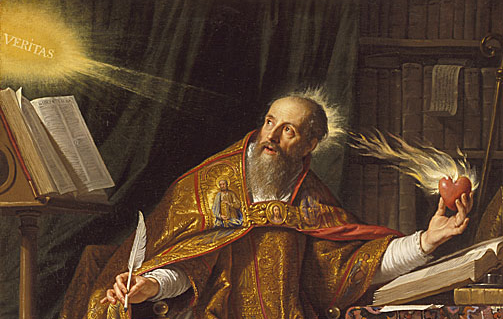
-Augustine: Rule

"How can we make each day a new beginning?"

Abba Moses wondered, "How can we make each day a new beginning?"

Abba Silvanus responded:

"Discover who you are. Be sorry for your sins. Do not feel superior to anyone, nor feel smug about others' weaknesses. Refuse to be a malicious gossip. Discipline yourself until your spirit is gentle. Forgive. Do not hate anybody, even if they hate you. Never return slander for slander. Refuse to become upset when others lie about you. Do not let yourself think badly of anyone, even in the privacy of your heart. This is the peace that passes understanding, and it can be yours if you refuse to judge others. Remember, Jesus commanded: 'Do not judge, so that you may not be judged."'

And when someone asked Abba Silvanus, "How did you become so wise?" he answered, "I don't open my heart to angry thoughts."

A monk visited Abba Poemen to ask, "Do you ever have bad thoughts? If so, what do you do about them?"

Abba Poemen responded,

"Bad thoughts are like clothes stored in a trunk or closet. Over time, clothes turn yellow, get brown spots, and eventually fall apart. Leave them there, and they rot on their own. It's the same with your ungodly thoughts. Do not act on them, and they will disappear."

-Sayings of the Desert Fathers and Mothers - Benedicta Ward, ed.

Friday, April 4, 2014

World Vision loses 10 000 sponsors

What Comes After the Gay-Rights Victory?


world-vision-stearns-580.jpg.jpeg
In 1974, shortly after Richard Stearns, the president of World Vision United States, a Christian humanitarian organization based outside Seattle, converted to Christianity, he got engaged. When his fiancée suggested that they set up a registry for wedding gifts at a department store, he told her, "As long as there are children starving in the world, we're not going to own fine china, crystal, or silver."
At the time, Stearns was in the middle of an M.B.A. program at the Wharton School. In what he would later characterize as a demonstration of "God's sense of irony," he became a vice-president at the Franklin Mint, known for its collectible coins and jewelry, and then the C.E.O. of Lenox, America's largest manufacturer of fine china, before finally abandoning his corporate career, in 1998, to join World Vision.
World Vision United States is the tenth-largest charity in the country, with an annual budget of $982 million. Its parent organization, World Vision International, has more than forty-four thousand staff members, who work in more than a hundred countries on disaster relief, water and food security, education, and health care. World Vision is an ecumenical organization, and employs Christians from more than fifty denominations; the American office requires that all employees confess the Apostles' Creed or adhere to the organization's official Statement of Faith. Accordingly, employees are expected to practice "abstinence before marriage and fidelity within marriage."
But, last Monday, World Vision announced a change in the interpretation of that rule: the requirement of fidelity would now be extended to include same-sex marriages. In a letter announcing the decision, Stearns wrote that World Vision's board of directors had "spent several years praying about and discussing this issue." The board, he said, considered the debates over other divisive matters—including "divorce and remarriage, views on evolution, the role of women in church leadership, and whether birth control is acceptable"—and hoped that, just as the various Christian denominations had worked together, despite their differences, to serve the poor, they could work through this as well.
"I want to be clear that we have not endorsed same-sex marriage," Stearns added. But, as his letter made equally clear, many of the mainline denominations from which World Vision draws its employees and its donations have changed their positions to permit same-sex marriage. The decision, however, put the organization at odds with its more conservative partners, and, almost immediately, many donors announced that they would cease their support. Leaders from the Southern Baptist Convention, the World Assemblies of God Fellowship, and other evangelical churches called for boycotts.
An effort to avoid the battle over human sexuality had instead put World Vision on its front line. Last Wednesday, only two days after announcing the new policy, the organization reversed its decision. In a second letter, Stearns told World Vision's "trusted partners and Christian leaders" that board members had "listened to you and want to say thank you and to humbly ask your forgiveness." He reiterated that the organization "stands firmly on the biblical view of marriage," while reminding his audience that "all people, regardless of their sexual orientation, are created by God and are to be loved and treated with dignity and respect."
On Monday, conservatives demanded to know how World Vision could hold the first of these views and still hire married gay employees; on Wednesday, liberals began to ask how it could hold the second view and still deny employment to gays and lesbians. Two days might have been a record time in which to alienate both sides of the same-sex-marriage debate, but World Vision quickly learned that there may be no such thing as neutral ground in the question of sexuality. In a conference call this Thursday, Stearns said that ten thousand children had lost their sponsors since last Monday.
As Stearns wrote in his first letter, the debate over human sexuality "has torn apart whole denominations, individual congregations, Christian colleges, and even individual Christian families." But the conflict has not been confined to religious organizations. On the same day that World Vision announced its new policy on same-sex marriage, the open-source-software company Mozilla announced the appointment of a new C.E.O., Brendan Eich, who immediately came under fire for his earlier financial support of Proposition 8, California's gay-marriage ban. Employees and developers loudly voiced their objection to Eich's promotion, and on Thursday he announced his resignation.
The simultaneous protests are notable because they involve two very different organizations, whose successes have depended, in large part, on the public credibility of their commitment to a cause. Both organizations, as a result, faced moral rather than legal tests. Unlike in Sebelius v. Hobby Lobby Stores, the religious-objection case argued before the Supreme Court last week, the right of World Vision to hire and fire its employees for religious reasons is uncontested. And Mozilla had no legal grounds to terminate Eich's employment on the basis of his political donations. The two controversies, together, indicate a boundary beyond which judicial rulings and legislative acts cannot resolve disputes—where we have to live with the disagreeable opinions of fellow citizens.
Even as polls find that approval for gay rights is ticking steadily upward, as state after state recognizes marriage equality, statistics do not capture the sharpness of the fractures that still separate its advocates from its opponents. While one might expect gay rights to have become less divisive as they have become more widely accepted, that has not quite been the case—perhaps because the shift in public opinion has been so swift. The minority that remains opposed to same-sex marriage and other gay-rights issues has grown more vocal in its opposition; the question for the new majority has become how to address, or accommodate, such opposition.
With same-sex marriage on its way to wide legal acceptance, some of the conflict has migrated to the domain of employment law. Douglas Laycock, a professor at the University of Virginia Law School, argued for the winning side in a Supreme Court case two years ago that defined the so-called ministerial exception. "World Vision is an unusual organization in a lot of ways, with their affirmation of faith, but they're legally entitled to do that. If you're a religious organization, you can hire members of your religious faith exclusively," Laycock told me.
"Whether anything can limit those rights to use religious preferences in hiring is a huge political debate in Washington," Laycock added. While there were suggestions that World Vision's initial decision to accommodate gay employees might have been influenced by political pressure—the organization received $179 million in government grants last year alone—Laycock was skeptical. "There've been cases over the years in the lower courts that try to allege accepting federal moneys negates the right to hire on the basis of religion," he said. "But, as best I can tell, these organizations receive money for general operations, not specific staff positions. Those cases don't go far."
These religious exemptions, Laycock explained, were first included in the welfare-reform law signed by Bill Clinton in 1996; they were expanded, through an executive order, under George W. Bush, and have been maintained by Barack Obama, despite a promise, during his campaign, to curtail them. So, while it is unlikely that money motivated World Vision's initial decision, last Monday, to hire married gays and lesbians, its swift reversal was almost certainly motivated by the withdrawal of funds from conservative supporters. A similar protest, from the other side, led Eich to quickly resign his position as C.E.O. of Mozilla.
It seems that there can be no neutral position on gay rights for individuals or institutions. One side appears to demand the exclusion of gays and lesbians; the other side wishes to condemn those who would endorse that exclusion. Both sides are willing to go beyond advocating for legislative or judicial measures, and apply pressure in the form of economic boycotts.
For the new moral majority in support of gay rights, there is an unexpected challenge: to live with dissent while continuing to advance the cause of equality. This challenge is, at least in part, the result of a hard-won victory, many years in the making, and the speed of its advances in the past few years. In his last book, Martin Luther King, Jr., warned of the uncharted terrain for a movement that had succeeded in part through judicial victories. "So far, we have had constitutional backing for most of our demands for change, and this has made our work easier, since we could be sure of legal support from the federal courts," King observed. "Now we are approaching areas where the voice of the Constitution is not clear."
"We are faced with the fact that tomorrow is today," King continued. "We are confronted with the fierce urgency of now." Tomorrow came more quickly for gay rights than anyone could have imagined, but the controversies at World Vision and Mozilla suggest that neither the old majority nor the new one has discerned how to confront the fierceness of that urgency.
Photograph: World Vision

World Vision loses 3000 donors & changes stance

Religion

Christian Group That Flip-Flopped on Gay Marriage Loses Donors

After losing over 3,000 sponsors for needy children, the relief group backed out of plans to allow hiring for legally married gays and lesbians

A donor boycott organized by conservative evangelical groups has forced the Christian relief organization World Vision to reverse a policy change that would have allowed the non-profit to hire married gay and lesbian employees.
The backlash began when the multinational charity announced Monday that its American branch would expand hiring to include people in legal same-sex marriages. After announcing the decision, World Vision lost between 3,000 and 3,500 sponsors for needy children across the globe as evangelical groups across the country called for a boycott, according to the group.
The Washington state-based non-profit employs about 1,100 people in America who are required to remain abstinent if single and uphold their Christian principle that marriage is between a man and a woman. On Monday, in an interview with Christianity Today, World Vision President Richard Stearns announced the board would be altering its long-standing employee conduct code to welcome married gays and lesbians. But pockets of the group's largely Evangelical Christian base were outraged by the new policy. By Wednesday, World Vision had reversed its decision.
"The board acknowledged it made a mistake and chose to revert to our longstanding policy requiring sexual abstinence for all single employees and faithfulness within the Biblical covenant of marriage between a man and a woman," a World Vision statement read. "We are brokenhearted over the pain and confusion we have caused many of our friends, who saw this decision as a reversal of our strong commitment to Biblical authority."
World Vision President Richard Stearns told Christianity Today that the board's initial decision to open hiring to gay and lesbian spouses was an effort to promote unity as some of the denominations represented by its members have begun performing and accepting same-sex marriages. But the organization's decision on the issue had the opposite effect.
Although some Christians applauded the decision, more conservative Evangelical leaders swiftly denounced the organization for going against traditional Christian values. "At stake is the gospel of Jesus Christ," wrote Russell Moore, the president of the Ethics and Religious Liberty Commission of the Southern Baptist Convention. "It's obvious that World Vision does not believe in the Bible," said Franklin Graham on Family Leadership Council CEO Tony Perkin's radio show on Monday.
By Tuesday, reports began circulating that thousands had backed out of sponsorships for needy children across the globe. Liberal Christians rallied to try to replace the lost sponsors, while conservatives flooded the organizations call center and email with angry calls and letters.
The reversal, however, seems to have stemmed the tide. Evangelical leaders have been slowly reaffirming their support for World Vision. "Traditional evangelicals have responded with appreciation for World Vision's affirmation of Christian orthodoxy," said Institute of Religion and Democracy President Mark Tooley in a Thursday podcast. According to a World Vision spokesperson, since the reversal the angry calls have quieted and sponsorship cancellations have decreased dramatically, though there is no official count of how many sponsors have returned.
More liberal Christians, like Patheos blogger Tony Jones say that though conservatives won this battle, they will lose the war against complete acceptance of gay and lesbian couples. "Twenty years from now," he wrote Thursday, "WV will be hiring married gay employees in Seattle."
 
Multiple Soldiers Wounded By Shooter At Fort Hood


Thursday, April 3, 2014

Russian Orthodox patriarchate capitulating to Putin

Ukrainian prelate raps Moscow patriarchate for failure to condemn Russian aggression in Crimea 

CWN - April 02, 2014


Catholic World Report has provided a translation of an interview in which Major Archbishop Sviatoslav Shevchuk, the leader of the Ukrainian Catholic Church, speaks of the role that Church has played during the recent political upheaval in Ukraine, and criticizes the Russian Orthodox Church for its failure to condemn the Russian usurpation of Crimea.
The silence of the Moscow patriarchate is "the sign of a definite weakness," the Ukrainian prelate says. "For whenever the Church finds herself unusually close to a specific governmental institution, whenever harmonious state-church relations turn into a sort of domination of one by the other, then, obviously, the Church becomes incapable of speaking the truth in all its fullness in specific historical circumstances. And therefore I think that this is exactly what we are seeing now."
Patriarch Filaret, the Ukrainian Orthodox leader who broke with Moscow after the independence of Ukraine, has condemned the Russian move into Crimea. "Our response is similar," Major Archbishop Shevchuk says.


Additional sources for this story
Some links will take you to other sites, in a new window.

Ukrainian Catholic jurisdiction in eastern Ukraine

Ukrainian Catholic leader creates jurisdiction in eastern Ukraine

CWN - April 02, 2014


Amid continued tensions between Russia and Ukraine, the head of the Ukrainian Greek Catholic Church has created a new ecclesiastical jurisdiction headquartered near the Russian border.
Major Archbishop Sviatoslav Shevchuk created the Archiepiscopal Exarchate of Kharkiv "with the consent of the Synod of the Ukrainian Greek Catholic Church and after consulting with the Apostolic See," according to the Holy See Press Office, and has named a Kiev monk, Father Vasyl Tuchapets, to be its first prelate. Pope Francis has confirmed the creation of the new see and the choice of the first bishop.
Kharkiv is Ukraine's second-largest city and is the largest city in eastern Ukraine, the area of the nation with the strongest pro-Russian sympathies. The creation of a new Eastern-rite Catholic see there will probably draw protests from the Russian Orthodox Church, which still regards Ukraine as its "canonical territory" and has frequently protested the activities of the Ukrainian Catholic Church there.
Additional sources for this story
Some links will take you to other sites, in a new window.