In 1919, she began working as a surgical nurse in Austria. When the Germans took over the country, she became a local opponent of the Nazi regime. Her conflict with them escalated after they ordered her to remove all the crucifixes she had hung up in each room of a new hospital wing.
Sister Maria Restitua refused, and was arrested by the Gestapo in 1942. She was sentenced to death for "aiding and abetting the enemy in the betrayal of the fatherland and for plotting high treason."
She spent the rest of her days in prison caring for other prisoners, who loved her. The Nazis offered her freedom if she would abandon the Franciscan sisters, but she refused. She was beheaded March 30, 1943 in Vienna, and was beatified by Pope John Paul II on June 21, 1998.
From: http://www.catholicnewsagency.com/saint.php?n=639
Tuesday, June 3, 2014
Monday, June 2, 2014
CARMEL: Commemorative 'United Carmelite Shields' for the 750 years since St Simon Stock received the Brown Scapular
Escudo Conmemorativo de los 750
años de la Entrega del Santo Escapulario a
San Simón Stock; la unión de las
dos ramas del Carmelo.


'The love of God never leaves us,’ Pope tells at-risk children
'The love of God never leaves us,' Pope tells at-risk children
Catholic World News - June 02, 2014
The meeting took place under the auspices of the Pontifical Council of Culture's "Courtyard of the Gentiles of Children" initiative.
In his conversation with the nine- and ten-year-olds, who presented him with dirt from the catacombs, Pope Francis spoke about the darkness of the dirt being brought to the light.
He added:
When the Apostle John, who was such a good friend of Jesus, wanted to say who God is, do you know what he said? "God is love."
"God is love. And we go forward together toward the light to find the love of God. But is the love of God within us, even in moments of darkness? Is the love of God hidden there? Yes, always! The love of God never leaves us. It is always with us. Let us have faith in this love.
Additional sources for this story
Some links will take you to other sites, in a new window.
Some links will take you to other sites, in a new window.
- Parole del Santo Padre Francesco ai bambini che partecipano all'iniziativa "Il Treno dei Bambini" promosso dal Pontificio Consiglio della Cultura (Holy See Press Office)
- Pope Francis to school children: The light gives us joy and hope (Vatican Radio)
- The Pope on the Children's Train (VIS)
- Children's Train "Diggers Of Light" (Pontifical Council for Culture)
Sunday, June 1, 2014
twitter@pontifex 05/31/2014
05/31/2014
In the difficult moments of life, Christians can turn to the Mother of God and find protection and care.

From:
Pope celebrates end of Marian month of May
Pope celebrates end of Marian month in Vatican Gardens

"Mary 'went in haste' to her elderly cousin Elizabeth. She wasted no time, immediately went to serve," Pope Francis said. "And 'the Virgin of readiness' is now ready to help us when we pray, when we ask for her help and protection."
Pope Francis said in the "very many" moments of life in which we need help, the Madonna does not wait, and is immediate ready to serve.
Beatification date of 19 October 2014 set for Paul VI
Pope Francis announces beatification date for Paul VI

Paul VI, seen here in 1963 with US President John Kennedy,
wrote the encyclical Humanae Vitae in 1968
Pope Francis has set another of his predecessors on the road to sainthood.
He approved a miracle credited to the intercession of Paul VI - who died in 1978 after a 15-year pontificate and is remembered by many for his ban on artificial contraception for Catholics.The beatification ceremony will be held at the Vatican on 19 October, Pope Francis announced.
The move came two weeks after the canonisation of two other 20th Century popes - John XXIII and John Paul II.
Beatification is the third of four steps in the process by which someone officially becomes a saint.
It requires at least one miracle to have been attributed to the intercession of a candidate for sainthood who, once beatified, is given the title blessed.
After beatification, a separate miracle would have to be verified in order for Paul VI to be canonised - declared a saint - allowing him to be venerated by the universal Church as "an example of holiness that can be followed with confidence".
Church teaching on families
Paul VI was born Giovanni Battista Montini in the Lombardy region of Italy in 1897, the son of a prominent newspaper editor.
He was elected pope in 1963 and continued the reforms of his predecessor, John XXIII.
Paul VI died in August 1978 and was succeeded briefly by Pope John Paul who died in October 1978.
During his 15-year pontificate he wrote seven encyclicals - the most controversial of which was Humanae Vitae (Of Human Life), published in 1968.
Its uncompromising position on birth control led to protests around the Catholic world and some national Roman Catholic Church hierarchies openly modified the statement.
In 1995 Pope John Paul II supported Paul VI's view on birth control in his encyclical, Evangelium Vitae (The Gospel of Life).
The teaching on contraception is widely disregarded by modern-day Catholics, says the BBC's David Willey in Rome.
October's beatification ceremony will be held at the end of a crucial meeting of global bishops to discuss Catholic teaching on family life, called by Pope Francis.
The bishops will be discussing the results of a worldwide survey commissioned by the Pope about what parts of the Church's teaching on human sexuality Catholics actually follow today.
As is customary, the Vatican gave no details about the miracle - which the Holy See requires must be a phenomenon certified by doctors as having no medical explanation.
But Italian media report the miracle involved a Californian baby who was born healthy despite the pre-birth diagnoses of a ruptured foetal bladder and absence of amniotic fluid.
The mother reportedly refused to abort the child, instead praying for Paul VI's intercession at the behest of a nun.
From: http://www.bbc.com/news/world-europe-27357192
Martyr WWII / Austria - Blessed Maria Restutita Kafka
Blessed Maria Restutita Kafka
WEDNESDAY, OCTOBER 29, 2014

Sign of the Cross must not be lost
The importance of the Sign of the Cross must not be lost
St Francis de Sales wrote with clarity about the extraordinary power of an apparently basic gesture
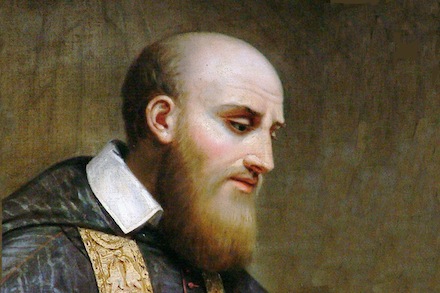
A painting of St Francis de Sales
I have been reading a small book, The Sign of the Cross, by St Francis de Sales, published by the American publishing company, Sophia Institute Press. Written in 1600 it was a response by the saint, who became Bishop of Geneva in 1602, to the leading Geneva Calvinist theologians who had rejected what they saw as a Catholic gesture. According to the foreword of the book, crucifixes and bare crosses are still today largely absent in American Evangelical churches "and the act of making the Sign of the Cross is regarded by many non-Catholics as superstition at best."
I hadn't known this; I always assumed that this most basic gesture was a universal Christian act, understood by all Christians for what it is: a graphic reminder of Christ's sacrifice. In his defence of it, de Sales lays out with authority and clarity all the reasons for its importance. As he puts it, "These are the arguments that my adversary has made and now I shall oppose them." He does not go in for the kind of false ecumenism so popular in the post-conciliar 1970s and 1980s where Catholics would water down their faith in meetings with other Christians so as not to give offence or to appear divisive. For de Sales, his book is more than a defence of the Sign of the Cross; it is an act of charity to men who have gone astray in their beliefs: "My dear adversary," he writes, "If you have not yet been healed from having written your treatise…" For him, his slim book, the third in a series of four that he wrote on this subject, was part of his apostolate to bring the Calvinists, who had largely overrun Geneva, back to the true Faith.
As he points out, the Cross is a "folly to the pagans". It also represents the Passion of Christ and by it "we confess the Trinity." He reminds his readers that it is used in blessings, consecrations and sacraments, as well as "to chase off demons" and as a protection from them. As de Sales writes, "The demons flee from the Cross as though it were a living representation of the Crucifixion."
St Francis also reminds us that the early Christians used the Sign of the Cross as "a public profession of their Christianity or as a confession of it either in public or in private. For when the persecutions were widespread and severe, the Christians…recognised one another by this sign when they crossed themselves." In my last blog I happened to mention Blessed Maria Restituta Kafka, the only nun to be condemned to death in Nazi Germany: a modern-day example of persecution of people of faith – Christians as well as Jews. She had refused to take down the crucifixes she had placed on the walls of the hospital in which she worked. She knew that in if she did so it would be a betrayal of everything she believed and stood for.
Blessed Restituta understood the power and significance of the Sign of the Cross. Indeed, before her execution she asked the prison chaplain to make the Sign of the Cross on her forehead. At her beatification on June 21, 1998, St John Paul II stated, "Many things can be taken from us Christians but the Cross as a sign of salvation will not be taken from us…"
The biographical note to the little book by St Francis de Sales informs us that his apostolate was highly successful, but at the cost of much sacrifice. In trying to bring the inhabitants of the Chablais back to the Faith from Calvinism, he was sometimes "thrown out of his lodgings and has to sleep in the open air. Many times he celebrated Mass in empty churches or continued preaching when the congregation walked out…" Empty churches? Catholics offended at being corrected for their liberal attitudes? There is a familiar ring to this; we need more bishops like the Bishop of Geneva in our country today.
From: http://www.catholicherald.co.uk/commentandblogs/2014/05/29/the-importance-of-the-sign-of-the-cross-must-not-be-lost/
I hadn't known this; I always assumed that this most basic gesture was a universal Christian act, understood by all Christians for what it is: a graphic reminder of Christ's sacrifice. In his defence of it, de Sales lays out with authority and clarity all the reasons for its importance. As he puts it, "These are the arguments that my adversary has made and now I shall oppose them." He does not go in for the kind of false ecumenism so popular in the post-conciliar 1970s and 1980s where Catholics would water down their faith in meetings with other Christians so as not to give offence or to appear divisive. For de Sales, his book is more than a defence of the Sign of the Cross; it is an act of charity to men who have gone astray in their beliefs: "My dear adversary," he writes, "If you have not yet been healed from having written your treatise…" For him, his slim book, the third in a series of four that he wrote on this subject, was part of his apostolate to bring the Calvinists, who had largely overrun Geneva, back to the true Faith.
As he points out, the Cross is a "folly to the pagans". It also represents the Passion of Christ and by it "we confess the Trinity." He reminds his readers that it is used in blessings, consecrations and sacraments, as well as "to chase off demons" and as a protection from them. As de Sales writes, "The demons flee from the Cross as though it were a living representation of the Crucifixion."
St Francis also reminds us that the early Christians used the Sign of the Cross as "a public profession of their Christianity or as a confession of it either in public or in private. For when the persecutions were widespread and severe, the Christians…recognised one another by this sign when they crossed themselves." In my last blog I happened to mention Blessed Maria Restituta Kafka, the only nun to be condemned to death in Nazi Germany: a modern-day example of persecution of people of faith – Christians as well as Jews. She had refused to take down the crucifixes she had placed on the walls of the hospital in which she worked. She knew that in if she did so it would be a betrayal of everything she believed and stood for.
Blessed Restituta understood the power and significance of the Sign of the Cross. Indeed, before her execution she asked the prison chaplain to make the Sign of the Cross on her forehead. At her beatification on June 21, 1998, St John Paul II stated, "Many things can be taken from us Christians but the Cross as a sign of salvation will not be taken from us…"
The biographical note to the little book by St Francis de Sales informs us that his apostolate was highly successful, but at the cost of much sacrifice. In trying to bring the inhabitants of the Chablais back to the Faith from Calvinism, he was sometimes "thrown out of his lodgings and has to sleep in the open air. Many times he celebrated Mass in empty churches or continued preaching when the congregation walked out…" Empty churches? Catholics offended at being corrected for their liberal attitudes? There is a familiar ring to this; we need more bishops like the Bishop of Geneva in our country today.
From: http://www.catholicherald.co.uk/commentandblogs/2014/05/29/the-importance-of-the-sign-of-the-cross-must-not-be-lost/
The Church may appear to be on the wrong side of history but ...
The Church may appear to be on the wrong
side of history but it is on the right side of truth
side of history but it is on the right side of truth
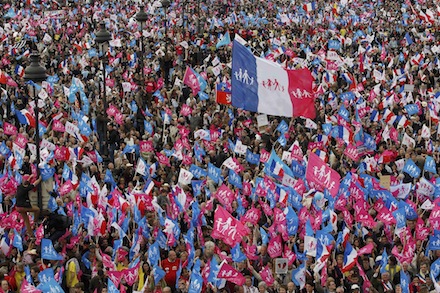
People attend a protest march against France's legalisation of
same-sex marriage in Paris (CNS)
Young people who go on to higher education today, if they are not put off at the start by the enormous loans they will have to pay off, are generally thinking of worldly success. Whether in academic research or in other careers they hope their university education will fit them for good jobs and better salaries. When my daughter graduated from UCL some years ago the vice-chancellor made a speech in which he congratulated the new graduates on the road to success in life and congratulated his own university in having equipped them for a bright future. I found it somewhat dispiriting. It should be remembered that the dressed-up skeleton of Jeremy Bentham, founder of Utilitarianism, who believed that it is "the greatest happiness of the greatest number that is the measure of right and wrong", sits in a strange box structure, an "auto icon", inside the main entrance to UCL as if he were its presiding genius.
Given my memory of this mummified symbol of rational thinking, I was glad to come across a different kind of speech, delivered by Mary Eberstadt, Senior Fellow at the Ethics and Public Policy Centre in Washington DC, on 19 May to the 2014 graduates of the Catholic Seton Hall University in New Jersey. In contrast to a Benthamite view, she told them that "Each human person bears the face of Christ and plays a unique role in history". She reminded them that they would have an important role to play in the communities they joined after graduation, in their call to "see God in every human being."
Eberstadt spoke of an "insidious new intolerance" in society that prevented ideas being freely debated. Although she did not cite it, I suspect the most glaring example of this in recent years is society's determination to change the traditional definition of marriage at the same time as refusing to allow reasonable discussion or debate over it. Those who oppose the change are often informed that they "are on the wrong side of history" as if there is an inexorable march of progress in human affairs and those standing in the way are simply Luddites. But as Eberstadt pointed out, "There is no wrong side of history. There is only the wrong side of truth." She emphasised the power of example, reminding her listeners that this is "the most underestimated force on the planet" and that their own example, "as a coach, a teacher, a neighbour, a friend, a grandfather or grandmother" would inspire others in the future in ways they might not realise.
She gave the example of a priest she knew "who once prayed on his knees in snow outside an abortion clinic" and who inspired a woman about to go inside to cancel her appointment and give birth to her child instead – "All because she saw this stranger praying in the snow." That priest, "like all of you" she told her listeners, "mattered more than he knew." She urged her audience to defend human dignity, saying that standing up for truths like these, and "protesting politely yet forcefully on behalf of them", will be vital in the years to come.
Referring to the "new moral movement" that Pope Francis has been calling for, she told the graduates they were "foot soldiers and officers in the making of this moral movement now being born" and that their families, teachers and well-wishers "will never forget how proud we all are of you today."
No doubt the wizened ghost of Bentham would call this speech, as in his famous dismissal of the idea of natural rights, "Nonsense on stilts." Maybe he was on the wrong side of truth?
From: http://www.catholicherald.co.uk/commentandblogs/2014/05/30/there-is-no-wrong-side-of-history-there-is-only-the-wrong-side-of-truth/
Given my memory of this mummified symbol of rational thinking, I was glad to come across a different kind of speech, delivered by Mary Eberstadt, Senior Fellow at the Ethics and Public Policy Centre in Washington DC, on 19 May to the 2014 graduates of the Catholic Seton Hall University in New Jersey. In contrast to a Benthamite view, she told them that "Each human person bears the face of Christ and plays a unique role in history". She reminded them that they would have an important role to play in the communities they joined after graduation, in their call to "see God in every human being."
Eberstadt spoke of an "insidious new intolerance" in society that prevented ideas being freely debated. Although she did not cite it, I suspect the most glaring example of this in recent years is society's determination to change the traditional definition of marriage at the same time as refusing to allow reasonable discussion or debate over it. Those who oppose the change are often informed that they "are on the wrong side of history" as if there is an inexorable march of progress in human affairs and those standing in the way are simply Luddites. But as Eberstadt pointed out, "There is no wrong side of history. There is only the wrong side of truth." She emphasised the power of example, reminding her listeners that this is "the most underestimated force on the planet" and that their own example, "as a coach, a teacher, a neighbour, a friend, a grandfather or grandmother" would inspire others in the future in ways they might not realise.
She gave the example of a priest she knew "who once prayed on his knees in snow outside an abortion clinic" and who inspired a woman about to go inside to cancel her appointment and give birth to her child instead – "All because she saw this stranger praying in the snow." That priest, "like all of you" she told her listeners, "mattered more than he knew." She urged her audience to defend human dignity, saying that standing up for truths like these, and "protesting politely yet forcefully on behalf of them", will be vital in the years to come.
Referring to the "new moral movement" that Pope Francis has been calling for, she told the graduates they were "foot soldiers and officers in the making of this moral movement now being born" and that their families, teachers and well-wishers "will never forget how proud we all are of you today."
No doubt the wizened ghost of Bentham would call this speech, as in his famous dismissal of the idea of natural rights, "Nonsense on stilts." Maybe he was on the wrong side of truth?
From: http://www.catholicherald.co.uk/commentandblogs/2014/05/30/there-is-no-wrong-side-of-history-there-is-only-the-wrong-side-of-truth/
Subscribe to:
Posts (Atom)