Search This Blog

Sunday, October 19, 2014

ICELAND / History: Monasteries, Convents, and Churches

Vague ancient sources mention hermits in Iceland before Christianity was adopted and cloisters were established.  One of the stories tells us about Asolfur Konalsson from Ireland.  He did not want company with pagan people.  Jorundur the Christian is also mentioned.  Mani the Christian is supposed to have built a church at Kolgumyrar in the Hunavatn-county and served there 24 hours a day.  Some female hermits are mentioned:  Gudrun Osvifursdottir (she was young when Christianity was adopted; Laxdaela Saga), Hildur, who became a hermit at the Holar Cathedral during the time of bishop Jon Ogmundsson, Groa Gissurardottir (Gissur was the son of Isleifur Gissurarson, the country's first bishop), who reclused herself when she grew old at Skalholt, Ketilbjörg lived in recluse at Skalholt during bishop's Pall Jonsson (†1202), and Katrin reclused herself at Munkathvera before the convent at Reynisstadur, where she became the first abbess, was established.

Old sources imply that Hroflur (Rudolf) established a monestary at Baer in Borgarfjordur close to the year 1030.  He was called back to England in 1049.  There were more attempts at establishing cloisters during the early years of the church.  Bishop Magnus Einarsson at Skalholt bought a part of the Westman Islands and attempted the establishment of a monestary there.  He was lost in a fire in 1148 and nothing came off his ideas.  Jon Loftsson at Oddi built a monestary at Keldur around the year 1190, where he wanted to spend his last years.  It was probably abandoned after his death in 1197.

In the 12th century the church was well established and seven cloisters were founded.  They were the offsprings of the great increase in number of cloisters in Europe at the time, and the fact, that many of the country's church leaders had been educated there.
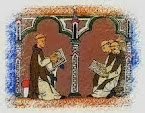
Little was documented about everyday life in the monestaries and convents.  Therefore we have to rely on the archaeologists of the future to cast some light on that.  We tend to connect the cloisters with culture and education, and last but not least, the preservation of the old Saga manuscripts.  Cloister cartularies mention large libraries in some instances.  The Thingeyrar monestary seems to have been the most important one, when it comes to literary production and the rewriting of the Saga literature.  Stories of kings and bishops were written before and after the turn of the 12th century.

Historians are certain that the Saga of King Olafur Tryggvason was written in Latin in 1190.  The monk Gunnlaugur Leifsson also wrote it a few years later and also bishop Jon Ogmundarsson's biography.  The 14th century canons were traced to the Benedictine school in North Iceland, where the Thingeyrar and Munkathvera monestaries educated their students.  Abbot Bergur Sokkason at Munkathvera most probably wrote the canons of Michel and Nicolaus, and the so-called Laurentius Saga hints, that he was responsible for most of the 14th century canons.  He became prior of the Munkathvera monestary in 1322 and abbot in 1325.  Among other esteemed writers of the period were Arni Laurentiusson, and Arngrimur Brandsson, both monks at Thingeyrar.  The prior of the Videy monestary, Styrmir the learned, was an esteemed writer as well.

The monestary at Helgafell in the West was an important centre for writing and education.  The famous Skard's book, preserved in two vellum manuscripts, most probably was written there.  It comprises the stories of the apostles.  

Preserved cloister cartularies are the best sources of their economy.  Many business contracts have been preserved.  Monestaries and convents also were important establishments for the elderly, who could afford to spend their last years in the care of the monks or the nuns.  Widows were the most common customers, but also the odd married couple.  Each instance required the permission of the bishop.

The reformation started in continental Europe in 1517, when Luther nailed his protests on the castle church door in Wittenberg.  King Christian III started his rule in Denmark in 1536.  One of his first decrees was the reformation of the church in his kingdom with himself as its highest authority.  That way he managed to acquire the wealth and property of the catholic church.

Gissur Einarsson, Iceland's first lutheran bishop, registered all the ordained people of the monestaries and convents of the Skalholt see.  They did not turn out to be very many.  King Christian's church ruling arrived in Iceland in 1537.  Bishop Gissur translated it to Icelandic in 1541 and was accepted by a convocation the same year.  It offered monks and nuns to stay at the monestaries and convents for the rest of their lives, or financial support to seek other vocations.

The Thingeyrar monestary was founded by Jon Ogmundsson bishop of the northern see in 1112, but there are no records of monestary life there until 1133, when Vilmundur Thorolfsson was ordained its firs abbot.  It was a Benedictine monestary up to the reformation. See Travel Guide Thingeyrar

The Munkathvera monestary was established by Bjorn Gislason, bishop at Holar in 1155.  It was also dedicated to the holy Benedict and its first abbot was Hoskuldur, who is not recorded in any available sources. See Travel Guide Munkatvera

The Hitardalur monestary was established in 1166, probably to commemorate the big fire in Hitardalur in 1148, when bishop Magnus Einarsson of Skalholt and a large number of other people were killed.  Farmer Thorleifur Thorlaksson at Hitardalur donated his property for the establishment of a monestary, but no records have been found about monestary lifel there.  Only two abbots are vaguely mentioned, Hreinn Styrmisson (ordained in 1166; †1177), and Haflidi (†1201 according to annals).  It was probably a Benedictine monestary. See Travel Guide Hitardalur

The Thykkvabaejar monestary was founded by Klaengur Thorsteinsson, bishop at Skalholt in 1168, and dedicated to the holy Augustus.  Most of the monks of this order were ordained priests.  They practised discipline and celibacy.  Its first abbot was Thorlakur Thorhallsson, later bishop of Skalholt (the southern see) and canonized by pope Johannes Paul II on January 14th 1984 as the protecting saint of Iceland.  He was educated by Eyjolfur Saemundarson (Saemundur the learned).  Thorlakur was ordained as a priest very young.  He also studied in Paris France and Lincoln England.  He probably got acquainted with the Augustine order in France.  He first became prior and then abbot.  The monestary was famous for its religious rites and the celibacy of the brothers.  Bishop Pall Jonsson of Skalholt allowed the people of Iceland to pledge in the name of Thorlakur in 1198, and the next year the parliament confirmed his sacredness.  Thorlakur was elected bishop of Skalholt in 1174. See Travel Guide Thykkvabaejarklaustur

The Flatey monestary.  Bishop Klaengur Thorsteinsson consecrated an Augustine monestary on the island Flatey on Bay Breidafjodur in 1172.  For unknown reasons it was moved to Helgafell in 1184 or 1185.  It probably served its purpose better on the mainland.  Its firs abbot was Ogmundur Kalfsson and the monestary served until the reformation. See Travel Guide Flatey
Only two convents, both of the Benedictine order, were established during the middle ages in Iceland.

The convent at Kirkjubaer was established in 1186.  Three years later a woman named Halldora was ordained its firs abbess.  Its initiator most probably was Thorlakur Thorhallson, bishop of the southern see.  This convent served until the reformation. See Travel Guide Kirkjubaejarklaustur.

The convent of Reynistadur 
was initiated by Jonrundur, bishop of the northern see, and Hallbera, who later became it s abbess (1295).  Bishop Jorundur had donated a few estates for this purpose, and the convent was built at Stadur in Reynisnes.  He convinced Hallbera and other wealthy women to donate handsomely to the convent.  Jorundur and his successors remained the protectors of the convent, which served until the reformation.

The Modruvellir Augustine monestary was established by bishop Jorundur in 1296.  Its first prior was Teitur, who is not documented any further.See travel Guide Morduvellir

The Augustine monestary on Island Videy probably was established at the initiative of Thorvaldur Gissurarson and Snorri Sturluson in 1225.  Bishop Magnus at Skalholt was Thorvaldur's brother.  It was consecrated by him and he donated his income from the area between river Botnsa and the Hafnarfjordur bay to the monestary.  Thorvaldur managed the monestary until he died in 1235.  During the period 1344-1352 it was occupied by the Benedictine order.  It served until the reformation. 
See Travel Guide Videy

The Augustine monestary at Skrida was established in 1494 at the initiative of bishop Stefan of Skalholt.  In the beginning it was managed by a prior, and its firs abbot's name was Narfi.  He was ordained in 1497.  Vague sources mention, that the monestary never housed many brothers and only one monk lived there in 1198.  According to archaeological excavations in 2006 contradicts these sources.  The monestary served until the reformation.  See Travel Guide Skriduklaustur

In 2007, two catholic convents are serving in Iceland, one in town Hafnarfjordur and the other in the fishing village Stykkisholmur.

The Last Catholic Bishop in Iceland

The Last Catholic Bishop in Iceland

On this day, 07 Nov 1550, the last Catholic Bishop in Iceland and an important figure in Icelandic history was beheaded because of his opposition to Lutheranism and the control from Denmark's King Christian III.

Jón was born in 1484 at a farm south of Akureyri called Gryta. He was educated at nearby Munkaþverá (monastery). At this location was the Benedictine Abbey of Iceland. There you can see this statue.

Jón was ordained a Catholic priest in about 1504 and was sent on two missions to Norway. In 1522, he became the episcopal see of Hólar. Bishop Jón struggled against Denmark and the Reformation until he and his two sons were killed on this day 462 years ago. He is an ancestor to many Icelanders alive today and my 11th Great Grandfather.

Our ancestor, Jón, was known for many exceptional talents including the composition of poetry. He had at least six children with Helga Sigurðardóttir. The Catholic Church was dissatisfied with Jón's faith because he ignored the rule to be celibate. However, many Icelandic priests and bishops through the years ignored this church law and because Iceland was so far away from Rome, not much was done to prevent this practice.

Lutheran Reformation began slowly in Iceland. Icelanders studying in Denmark and Germany brought these new ideas home with them. Martin Luther had posted his Ninety-Five Theses on 31 Oct 1517 in Wittenberg, Germany. During the 1520s, there was a German merchant community at Hafnarfjörður where the first Lutheran Church was built but the Alþingi passed a resolution pledging allegiance to the King of Norway and vowing to keep their Holy Faith (Catholic). The country's two bishops, Ögmundur Pálsson of Skálholt and Jón Arason of Hólar signed that decree.

King Christian III of Denmark began imposing Lutheranism on all the held lands and ordered Icelanders to change their religion, too. In 1538, both bishops Ögmundur and Jón rebelled against the decree.

By 1541, they had agreed to pay taxes to Denmark as long as they were allowed to keep the Icelandic laws and customs. Unfortunately, shortly afterwards, Bishop Ögmundur, who was old and blind, was taken prisoner to Denmark, where he died in 1542.

Bishop Jón's unrelenting opposition is thought to have come from Icelandic nationalism, Catholic faith, and also his personal desire to retain control. He resented changing religions and believed that Iceland should remain Catholic. Pope Paul III sent a letter of support that urged Jón to continue to be a champion for the Catholic religion in Iceland.

In February 1549 the Danish King sent a letter to the Icelandic people saying that Bishop Jón was to be considered an outlaw and he was not obeying the King's orders so they should not help him or obey him. Skálholt was reformed in 1549 but many lives were lost in the civil war that ensued.

In the summer of 1549, Jón, his two sons, Björn and Ari, and a large group of men captured Marteinn Einarsson beneath Snæfellsjökull. He was the Lutheran Bishop appointed by the King of Denmark. Legend tells us that Ari did not want to take forceful action but his mother presented a woman's skirt to Ari, which was a traditional custom of shaming a man.

The next summer in 1550, Jón with 200 men and his two sons each with 100 men rode to the Alþingi to fight against Lutheranism. In October 1550, Jón made another action against his last big enemy in Iceland, Daði Guðmundsson, but he took less than 100 men including his two sons. Historians say he had few men because he was confident of success. Daði's estate was at Sauðafell and Ari had already claimed this land. During the Battle of Sauðafell, Jón and his group were captured in the church.

Jón, Björn, and Ari were taken to Snóksdalur. On 23 Oct 1550, Christian Skriver, the Danish representative, took over their safe keeping until the next summer Alþingi. Daði, Bishop Marteinn and Christian Skriver took the prisoners to Skálholt and wondered what they should do with them until the summer. They were afraid that the northern fishermen, followers of Jón, would cause a problem. A clergyman named Jón Bjarnason was reported to say, 'The axe and the earth will keep them best.' Without a trial, they were sentenced to death on 06 Nov 1550. The next day, Björn and Ari were executed. Jón was offered his life if he would renounce Catholicism but he only said he wished to accompany his sons. After seven chops with the axe, he finally died.

Legends claim that just as the first axe blow was coming, a priest called Sveinn said to Jón, "Líf er eftir þetta, herra!" ("There is a life after this one, Sire!") Jón turned to Sveinn and said, "Veit ég það, Sveinki!" ("That I know, little Sveinn!") Ever since veit ég það, Sveinki has been a traditional saying and means the person has said something completely obvious.

The following photo is the place of execution near Skálholt.

At the age of their deaths, Jón was 66-years-old. His sons, Björn of 44 years and Ari of 40 years are both my 10th Great Grandfathers. Björn is on our Jónasson side and Ari is on the Ólafsson ancestral tree.

Another son, Sigurður, went to Skálholt to bring his father and brothers home for burial. They put bells on the coffins. People came up to the coffins with reverence of these men they believed to be saints. Tradition says that as their bodies were carried to Hólar, the bell called "Líkaböng" automatically started ringing on its own and it rang so loud that it split. They were buried at Hólar.

Jón had a daughter named Þórunn. It is believed that she inspired 30 – 60 men to seek revenge. Doing the King's business, Christian Skriver and his group were traveling on the Reykjanes peninsulas. Spending the night at Kirkjubol, this group of northerners (with permission from the farmer) penetrated the roof and killed Christian and his men. They also killed all the Danes in the area that they could find. I heard a story once that Christian was killed by forcing molten metal down his throat but I cannot find any reliable sources to corroborate this story.

Their bodies were buried north of the Kirkjubol home fields. Legend states these dead Danes started haunting the area so their bodies were exhumed. Their heads were chopped off and put at their buttocks, to prevent their souls from any further hauntings. When the King found out about this, he was outraged. He sent Danish soldiers to the farm and the farmer was beheaded at the farm called Straumur. There is a nice 5 km walking trail from Gardskagi to Kirkjubol to Sandgerdi, all along the shore of the Reykjanesskagi. There you can see diverse bird life and seals.

Iceland submitted to Danish King Christian III at the Alþing 01 Jul 1551 and the Lutheran Reformation was official. But our ancestor, Jón Arason, was considered a national hero as a protector of Iceland as a nation. Jón Arason had many descendants that were also priests and bishops including five Lutheran bishops of Skálholt and three of Holar. Artifacts from this era are preserved in Reykjavík at the National Museum.

In 1950, a tower with a chapel and chamber was built which houses the remains of Bishop Jón.

The church was built from 1756-1763. The church stones are from Hólabyrda, the mountain above Hólar. An infant grave is inside the wall which is the baby of the German mason who built the church. The altarpiece was made in Germany about 1500 and brought to Hólar by Bishop Jón. It is beautiful with Bible based wood-carved figures with gold gilded panels.

The mosaic picture of Jón Arason and his burial location is the photo below.

For more information on the Reformation in Iceland:  http://hdts.wordpress.com/archive/past-papers/reformation-in-iceland/

More about Hólar:  http://www.sagatrail.is/Gamlihttpdocs/enski/15holar.htm

Special Thanks to Hálfdan Helgason for his genealogy assistance and partnership through the years.

Saturday, October 18, 2014

The perennial relevance of St Teresa of Avila

Pope: The perennial relevance of St Teresa of Avila

2014-10-15 Vatican Radio

(Vatican Radio) Pope Francis has sent a message to mark the Jubilee Year for the 500th anniversary of the birth of St Teresa of Avila, a Discalced Carmelite and Doctor of the Church. On this her feast day, the Pope writes that St Teresa teaches us that the path to God is the path towards love for one another.

Listen to Lydia O'Kane's report

In the message released on the Feast day of St Teresa of Avila, the Holy Father underlines that this great Saint who was born on the 28th of March 1515 and died on the 4th of October 1582 was a woman of immense spirituality and focuses on four gifts in particular that she possessed, those being joy, prayer, fellowship and being in touch with the realities of her own time.

The Pope writes that St Teresa emphasizes the joy in discovering God, resulting in the love for one another nourished by prayer, which he says "overcomes pessimism and generates good deeds."

Focusing on the Carmelite nun's mystical experience, the Pope says that it did not separate her from the world or from the concerns of the people, on the contrary, he adds she has given new impetus and courage for action."

Pope Francis notes that what St Teresa has to say through her writings has "perennial relevance" and he adds that it applies to individuals in their journey towards God and men.


(from Vatican Radio)

Tuesday, October 14, 2014

Vatican Synod on the Family: Full Text of documents published

From: http://www.news.va/en/news/synod-on-family-midterm-report-presented-2015-syno
 
EXTRAORDINARY GENERAL ASSEMBLY OF THE SYNOD OF BISHOPS
RELATIO POST DISCEPTATIONEM
His Eminence Cardinal Péter Erdő
General Rapporteur (unofficial translation)
 
Introduction
Part I
Listening: the context and challenges to the family
  • The socio-cultural context
  • The relevance of emotional life
  • Pastoral challenges
Part II
The gaze on Christ: the Gospel of the Family
  • The gaze on Jesus and gradualness in the history of salvation
  • The family in God's salvific plan
  • The discernment of values present in wounded families and irregular situations
  • Truth and beauty of the family and mercy
Part III
Discussion: pastoral perspectives
  • Proclaiming the Gospel of the family today, in various contexts
  • Guiding couples on the path in preparation for marriage
  • Accompanying the first years of married life
  • Positive aspects of civil unions and cohabitation
  • Caring for wounded families (separated couples, the divorced who have not remarried, the divorced and remarried)
  • Welcoming homosexual persons
  • The transmission of life and the challenge of declining birthrate
  • The challenge of education and the role of the family in evangelization
Conclusion
--------------------------------------------------------
Introduction
During the prayer vigil held in St Peter's Square on 4 October 2014 in preparation for the Synod on the family, Pope Francis evoked the centrality of the experience of family in all lives, in a simple and concrete manner: "Evening falls on our assembly. It is the hour at which one willingly returns home to meet at the same table, in the depth of affection, of the good that has been done and received, of the encounters which warm the heart and make it grow, good wine which hastens the unending feast in the days of man. It is also the weightiest hour for one who finds himself face to face with his own loneliness, in the bitter twilight of shattered dreams and broken plans; how many people trudge through the day in the blind alley of resignation, of abandonment, even resentment: in how many homes the wine of joy has been less plentiful, and therefore, also the zest - the very wisdom - for life [.]. Let us make our prayer heard for one another this evening, a prayer for all".
The source of joys and trials, of deep affections and relations - at times wounded - the family is truly a "school of humanity" ("Familia schola quaedam uberioris humanitatis est", Vatican Council II, Constitution on the Church in the Modern World, Gaudium et Spes, 52), of which we are in great need. Despite the many signs of crisis in the institution of the family in various contexts of the "global village", the desire for family remains alive, especially among the young, and is at the root of the Church's need to proclaim tirelessly and with profound conviction the "Gospel of the family" entrusted to her with the revelation of God's love in Jesus Christ.
The Bishop of Rome called upon the Synod of Bishops to reflect upon the situation of the family, decisive and valuable, in its Extraordinary General Assembly of October 2014, a reflection which will then be pursued in greater depth in the Ordinary General Assembly scheduled to take place in October 2015, as well as during the full intervening year between the two synodal events. "The convenire in unum around the Bishop of Rome is already an event of grace, in which episcopal collegiality is made manifest in a path of spiritual and pastoral discernment": thus Pope Francis described the synodal experience, indicating its tasks in the dual process of listening to the signs of God and the history of mankind and in the resulting dual and unique fidelity.
In the light of the same discourse we have gathered together the results of our reflections and our dialogues in the following three parts: listening, to look at the situation of the family today, in the complexity of its light and shade; looking, our gaze fixed on Christ, to re-evaluate with renewed freshness and enthusiasm what the revelation transmitted in the faith of the Church tells us about the beauty and dignity of the family; and discussion in the light of the Lord Jesus to discern the ways in which the Church and society can renew their commitment to the family.
FIRST PART
Listening: the context and challenges to the family
The socio-cultural context
Anthropological and cultural change today influences all aspects of life and requires an analytic and diversified approach, able to discern the positive forms of individual freedom. It is necessary to be aware of the growing danger represented by an exasperated individualism that distorts family bonds and ends up considering each component of the family as an isolated unit, leading in some cases to the prevalence of an idea of the subject formed according to his or her own wishes, which are assumed as absolute.
The most difficult test for families in our time is often solitude, which destroys and gives rise to a general sensation of impotence in relation to the socio-economic situation that often ends up crushing them. This is due to growing precariousness in the workplace that is often experienced as a nightmare, or due to heavy taxation that certainly does not encourage young people to marriage.
Some cultural and religious contexts pose particular challenges. In African societies the practice of polygamy remains, along with, in some traditional contexts, the custom of "marriage in stages". In other contexts the practice of "arranged marriages" persists. In countries in which Catholicism is a minority religion, there are many mixed marriages with all the difficulties that these may lead to in terms of legal form, the education of children and mutual respect from the point of view of religious freedom, but also with the great potential that derives from the encounter between the differences in faith that these stories of family life present. In many contexts, and not only in the West, the practice of cohabitation before marriage, or indeed cohabitation not orientated towards assuming the form of an institutional bond, is increasingly widespread.
Many children are born outside marriage, especially in certain countries, and there are many who subsequently grow up with just one of their parents or in an enlarged or reconstituted family context. The number of divorces is growing and it is not rare to encounter cases in which decisions are taken solely on the basis of economic factors. The condition of women still needs to be defended and promoted, as situations of violence within the family are not rare. Children are frequently the object of contention between parents, and are the true victims of family breakdown. Societies riven by violence due to war, terrorism or the presence of organized crime experience deteriorating family situations. Furthermore, migration is another sign of the times, to be faced and understood in terms of the burden of consequences for family life.
The relevance of emotional life
Faced with the social framework outlined above, a greater need is encountered among individuals to take care of themselves, to know their inner being, and to live in greater harmony with their emotions and sentiments, seeking a relational quality in emotional life. In the same way, it is possible to encounter a widespread desire for family accompanied by the search for oneself. But how can this attention to the care for oneself be cultivated and maintained, alongside this desire for family? This is a great challenge for the Church too. The danger of individualism and the risk of living selfishly are significant.
Today's world appears to promote limitless affectivity, seeking to explore all its aspects, including the most complex. Indeed, the question of emotional fragility is very current: a narcissistic, unstable or changeable affectivity do not always help greater maturity to be reached. In this context, couples are often uncertain and hesitant, struggling to find ways to grow. Many tend to remain in the early stages of emotional and sexual life. The crisis in the couple destabilizes the family and may lead, through separations and divorce, to serious consequences for adults, children and society as a whole, weakening the individual and social bonds. The decline in population not only creates a situation in which the alternation of generations is no longer assured, but over time also risks leading to economic impoverishment and a loss of hope in the future.
Pastoral challenges
In this context the Church is aware of the need to offer a meaningful word of hope. It is necessary to set out from the conviction that man comes from God and that, therefore, a reflection able to reframe the great questions on the meaning of human existence, may find fertile ground in humanity's most profound expectations. The great values of marriage and the Christian family correspond to the search that distinguishes human existence even in a time marked by individualism and hedonism. It is necessary to accept people in their concrete being, to know how to support their search, to encourage the wish for God and the will to feel fully part of the Church, also on the part of those who have experienced failure or find themselves in the most diverse situations. This requires that the doctrine of the faith, the basic content of which should be made increasingly better known, be proposed alongside with mercy.
 
PART II
The gaze upon Christ: the Gospel of the Family
The gaze upon Jesus and gradualness in the history of salvation
In order to "walk among contemporary challenges, the decisive condition is to maintain a fixed gaze on Jesus Christ, to pause in contemplation and in adoration of His Face. ... Indeed, every time we return to the source of the Christian experience, new paths and undreamed of possibilities open up" (Pope Francis, Address of 4 October 2014). Jesus looked upon the women and the men he met with love and tenderness, accompanying their steps with patience and mercy, in proclaiming the demands of the Kingdom of God.
From the moment that the order of creation is determined by orientation towards Christ, it becomes necessary to distinguish without separating the various levels through which God communicates the grace of the covenant to humanity. Through the law of gradualness (cf. Familiaris Consortio, 34), typical of divine pedagogy, this means interpreting the nuptial covenant in terms of continuity and novelty, in the order of creation and in that of redemption.
Jesus Himself, referring to the primordial plan for the human couple, reaffirms the indissoluble union between man and woman, while understanding that "Moses permitted you to divorce your wives because your hearts were hard. But it was not this way from the beginning" (Mt 19,8). In this way, He shows how divine condescension always accompanies the path of humanity, directing it towards its new beginning, not without passing through the cross.
The family in God's salvific plan
Since, by their commitment to mutual acceptance and with the grace of Christ couples promise fidelity to one another and openness to life, they acknowledge as constitutive elements of marriage the gifts God offers them, taking their mutual responsability seriously, in His name and before the Church. Now, in faith it is possible to assume the goods of marriage as commitments best maintained with the help of the grace of the sacrament. God consecrates love between spouses and confirms its indissolubility, offering them help in living in fidelity and openness to life. Therefore, the gaze of the Church turns not only to the couple, but to the family.
We are able to distinguish three fundamental phases in the divine plan for the family: the family of origins, when God the creator instituted the primordial marriage between Adam and Eve, as a solid foundation for the family: he created them male and female (cg. Gn 1,24-31; 2,4b); the historic family, wounded by sin (cf. Gn 3) and the family redeemed by Christ (cf. Eph 5,21-32), in the image of the Holy Trinity, the mystery from which every true love springs. The sponsal covenant, inaugurated in creation and revealed in the history of God and Israel, reaches its fullest expression with Christ in the Church.
The discernment of values present in wounded families and in irregular situations
In considering the principle of gradualness in the divine salvific plan, one asks what possibilities are given to married couples who experience the failure of their marriage, or rather how it is possible to offer them Christ's help through the ministry of the Church. In this respect, a significant hermeneutic key comes from the teaching of Vatican Council II, which, while it affirms that "although many elements of sanctification and of truth are found outside of its visible structure ... these elements, as gifts belonging to the Church of Christ, are forces impelling toward Catholic unity" (Lumen Gentium, 8).
In this light, the value and consistency of natural marriage must first be emphasized. Some ask whether the sacramental fullness of marriage does not exclude the possibility of recognizing positive elements even the imperfect forms that may be found outside this nuptial situation, which are in any case ordered in relation to it. The doctrine of levels of communion, formulated by Vatican Council II, confirms the vision of a structured way of participating in the Mysterium Ecclesiae by baptized persons.
In the same, perspective, that we may consider inclusive, the Council opens up the horizon for appreciating the positive elements present in other religions (cf. Nostra Aetate, 2) and cultures, despite their limits and their insufficiencies (cf. Redemptoris Missio, 55). Indeed, looking at the human wisdom present in these, the Church learns how the family is universally considered as the necessary and fruitful form of human cohabitation. In this sense, the order of creation, in which the Christian vision of the family is rooted, unfolds historically, in different cultural and geographical expressions.
Realizing the need, therefore, for spiritual discernment with regard to cohabitation, civil marriages and divorced and remarried persons, it is the task of the Church to recognize those seeds of the Word that have spread beyond its visible and sacramental boundaries. Following the expansive gaze of Christ, whose light illuminates every man (cf. Jn 1,9; cf. Gaudium et Spes, 22), the Church turns respectfully to those who participate in her life in an incomplete and imperfect way, appreciating the positive values they contain rather than their limitations and shortcomings.
Truth and beauty of the family and mercy
The Gospel of the family, while it shines in the witness of many families who live coherently their fidelity to the sacrament, with their mature fruits of authentic daily sanctity must also nurture those seeds that are yet to mature, and must care for those trees that have dried up and wish not to be neglected.
In this respect, a new dimension of today's family pastoral consists of accepting the reality of civil marriage and also cohabitation, taking into account the due differences. Indeed, when a union reaches a notable level of stability through a public bond, is characterized by deep affection, responsibility with regard to offspring, and capacity to withstand tests, it may be seen as a germ to be accompanied in development towards the sacrament of marriage. Very often, however, cohabitation is established not with a view to a possible future marriage, but rather without any intention of establishing an institutionally-recognized relationship.
Imitating Jesus' merciful gaze, the Church must accompany her most fragile sons and daughters, marked by wounded and lost love, with attention and care, restoring trust and hope to them like the light of a beacon in a port, or a torch carried among the people to light the way for those who are lost or find themselves in the midst of the storm.
 
Part III
The discussion: pastoral perspectives
Proclaiming the Gospel of the family today, in various contexts
The Synod dialog has allowed an agreement on some of the more urgent pastoral needs to be entrusted to being made concrete in the individual local Churches, in communion cum Petro et sub Petro.
The announcement of the Gospel of the family is an urgent issue for the new evangelization. The Church has to carry this out with the tenderness of a mother and the clarity of a teacher (cf. Eph 4,15), in fidelity to the merciful kenosi of Christ. The truth is incarnated in human fragility not to condemn it, but to cure it.
Evangelizing is the shared responsibility of all God's people, each according to his or her own ministry and charism. Without the joyous testimony of spouses and families, the announcement, even if correct, risks being misunderstood or submerged by the ocean of words that is a characteristic of our society (cf. Novo Millennio Ineunte, 50). On various occasions the Synodal Fathers underlined that Catholic families are called upon themselves to be the active subjects of all the pastoral of the family.
It will be decisive to highlight the primacy of grace, and therefore of the possibilities that the Spirit gives in the sacrament. This is about letting it be known that the Gospel of the family is a joy that , because in Christ we are (Evangelii Gaudium, 1). In the light of the parable of the sower (cf. Mt 13,3), our task is to cooperate in the sowing: the rest is God's work. We must not forget that the Church that preaches about the family is a sign of contradiction.
For this reason, what is required is a missionary conversion: it is necessary not to stop at an announcement that is merely theoretical and has nothing to do with people's real problems. It must not be forgotten that the crisis of faith has led to a crisis in matrimony and the family and, as a result, the transmission of faith from parents to children has often been interrupted. Confronted by a strong faith, the imposition of certain cultural perspectives that weaken the family is of no importance.
Conversion has, above all, to be that of language so that this might prove to be effectively meaningful. The announcement is about letting it be experienced that the Gospel of the family is the response to the deepest expectations of a person: to his or her dignity and its full realization in reciprocity and communion. This is not merely about presenting a set of regulations but about putting forward values, responding to the need of those who find themselves today even in the most secularized countries.
The indispensable biblical-theological study is to be accompanied by dialog, at all levels. Many insisted on a more positive approach to the riches contained in diverse religious experiences, while not being blind to the difficulties. In the diverse cultural realities the possibilities should first be grasped and in the light of them the limits and radicalizations should be rejected.
Christian marriage cannot only be considered as a cultural tradition or social obligation, but has to be a vocational decision taken with the proper preparation in an itinerary of faith, with mature discernment. This is not about creating difficulties and complicating the cycles of formation, but of going deeply into the issue and not being content with theoretical meetings or general orientations.
The need was jointly referred to for a conversion of all pastoral practices from the perspective of the family, overcoming the individualistic points of view that still characterize it. This is why there was a repeated insistence on renewing in this light the training of presbyters and other pastoral operators, through a greater involvement of the families themselves.
In the same way, the necessity was underlined for an evangelization that denounces clearly the cultural, social and economic factors, for example, the excessive room given to market logic, that prevents an authentic family life, leading to discrimination, poverty, exclusion, and violence. For this reason a dialog and cooperation has to be developed with the social structures, and lay people who are involved in cultural and socio-political fields should be encouraged.
Guiding couples on the path in preparation for marriage
The complex social reality and the changes that the family is called on today to deal with require a greater undertaking from the whole Christian community for the preparation of those who are about to be married. As regards this necessity the Synodal Fathers agreed to underline the need for a greater involvement of the entire community privileging the testimony of the families themselves, as well as a rooting of the preparation for marriage in the path of Christian initiation, underlining the connection between marriage and the other sacraments. In the same way, the necessity was highlighted for specific programs for preparation for marriage that are a true experience of participation in the ecclesial life and that study closely the diverse aspects of family life.
Accompanying the early years of married life
The early years of marriage are a vital and delicate period during which couples grow in the awareness of the challenges and meaning of matrimony. Thus the need for a pastoral accompaniment that goes beyond the celebration of the sacrament. Of great importance in this pastoral is the presence of experienced couples. The parish is considered the ideal place for expert couples to place themselves at the disposal of younger ones. Couples need to be encouraged towards a fundamental welcome of the great gift of children. The importance of family spirituality and prayer needs to be underlined, encouraging couples to meet regularly to promote the growth of the spiritual life and solidarity in the concrete demands of life. Meaningful liturgies, devotional practices and the Eucharist celebrated for families, were mentioned as vital in favoring evangelization through the family.
Positive aspects of civil unions and cohabitation
A new sensitivity in today's pastoral consists in grasping the positive reality of civil weddings and, having pointed out our differences, of cohabitation. It is necessary that in the ecclesial proposal, while clearly presenting the ideal, we also indicate the constructive elements in those situations that do not yet or no longer correspond to that ideal.
It was also noted that in many countries an "an increasing number live together ad experimentum, in unions which have not been religiously or civilly recognized" (Instrumentum Laboris, 81). In Africa this occurs especially in traditional marriages, agreed between families and often celebrated in different stages. Faced by these situations, the Church is called on to be "the house of the Father, with doors always wide open [.] where there is a place for everyone, with all their problems" (Evangelii Gaudium, 47) and to move towards those who feel the need to take up again their path of faith, even if it is not possible to celebrate a religious marriage.
In the West as well there is an increasingly large number of those who, having lived together for a long period of time, ask to be married in the Church. Simple cohabitation is often a choice inspired by a general attitude, which is opposed to institutions and definitive undertakings, but also while waiting for a secure existence (a steady job and income). In other countries common-law marriages are very numerous, not because of a rejection of Christian values as regards the family and matrimony, but, above all, because getting married is a luxury, so that material poverty encourages people to live in common-law marriages. Furthermore in such unions it is possible to grasp authentic family values or at least the wish for them. Pastoral accompaniment should always start from these positive aspects.
All these situations have to be dealt with in a constructive manner, seeking to transform them into opportunities to walk towards the fullness of marriage and the family in the light of the Gospel. They need to be welcomed and accompanied with patience and delicacy. With a view to this, the attractive testimony of authentic Christian families is important, as subjects for the evangelization of the family.
Caring for wounded families (the separated, the divorced who have not remarried, the divorced who have remarried)
What rang out clearly in the Synod was the necessity for courageous pastoral choices. Reconfirming forcefully the fidelity to the Gospel of the family, the Synodal Fathers, felt the urgent need for new pastoral paths, that begin with the effective reality of familial fragilities, recognizing that they, more often than not, are more "endured" than freely chosen. These are situations that are diverse because of personal as well as cultural and socio-economic factors. It is not wise to think of unique solutions or those inspired by a logic of "all or nothing". The dialog and meeting that took place in the Synod will have to continue in the local Churches, involving their various components, in such a way that the perspectives that have been drawn up might find their full maturation in the work of the next Ordinary General Assembly. The guidance of the Spirit, constantly invoked, will allow all God's people to live the fidelity to the Gospel of the family as a merciful caring for all situations of fragility.
Each damaged family first of all should be listened to with respect and love, becoming companions on the journey as Christ did with the disciples of the road to Emmaus. In a particular way the words of Pope Francis apply in these situations: (Evangelii Gaudium, 169).
Such discernment is indispensable for the separated and divorced. What needs to be respected above all is the suffering of those who have endured separation and divorce unjustly. The forgiveness for the injustice endured is not easy, but it is a journey that grace makes possible. In the same way it needs to be always underlined that it is indispensable to assume in a faithful and constructive way the consequences of separation or divorce on the children: they must not become an "object" to be fought over and the most suitable means need to be sought so that they can get over the trauma of the family break-up and grow up in the most serene way possible.
Various Fathers underlined the necessity to make the recognition of cases of nullity more accessible and flexible. Among the propositions were the abandonment of the need for the double conforming sentence; the possibility of establishing an administrative means under the responsibility of the diocesan bishop; a summary process to be used in cases of clear nullity. According to authoritative propositions, the possibility should then be considered of giving weight to the faith of those about to be married in terms of the validity of the sacrament of marriage. It needs to emphasized that in all these cases it is about the ascertaining of the truth over the validity of the obstacle.
As regards matrimonial suits, the speeding-up of the procedure, requested by many, as well as the preparation of a sufficient number of operators, clerics and lay people, dedicating themselves to this, requires an increase in the responsibilities of the diocesan bishop, who in his diocese might charge a specially trained priest who would be able to offer the parties advice on the validity of their marriage.
Divorced people who have not remarried should be invited to find in the Eucharist the nourishment they need to sustain them in their state. The local community and pastors have to accompany these people with solicitude, particularly when there are children involved or they find themselves in a serious situation of poverty.
In the same way the situation of the divorced who have remarried demands a careful discernment and an accompaniment full of respect, avoiding any language or behavior that might make them feel discriminated against. For the Christian community looking after them is not a weakening of its faith and its testimony to the indissolubility of marriage, but rather it expresses precisely its charity in its caring.
As regards the possibility of partaking of the sacraments of Penance and the Eucharist, some argued in favor of the present regulations because of their theological foundation, others were in favor of a greater opening on very precise conditions when dealing with situations that cannot be resolved without creating new injustices and suffering. For some, partaking of the sacraments might occur were it preceded by a penitential path - under the responsibility of the diocesan bishop -, and with a clear undertaking in favor of the children. This would not be a general possibility, but the fruit of a discernment applied on a case-by-case basis, according to a law of gradualness, that takes into consideration the distinction between state of sin, state of grace and the attenuating circumstances.
Suggesting limiting themselves to only "spiritual communion" was questioned by more than a few Synodal Fathers: if spiritual communion is possible, why not allow them to partake in the sacrament? As a result a greater theological study was requested starting with the links between the sacrament of marriage and the Eucharist in relation to the Church-sacrament. In the same way, the moral dimension of the problem requires further consideration, listening to and illuminating the consciences of spouses.
The problems relative to mixed marriages were frequently raised in the interventions of the Synodal Fathers. The differences in the matrimonial regulations of the Orthodox Churches creates serious problems in certain contexts to which have to be found suitable responses in communion with the Pope. The same applies to inter-religious marriages.
Welcoming homosexual persons
Homosexuals have gifts and qualities to offer to the Christian community: are we capable of welcoming these people, guaranteeing to them a fraternal space in our communities? Often they wish to encounter a Church that offers them a welcoming home. Are our communities capable of providing that, accepting and valuing their sexual orientation, without compromising Catholic doctrine on the family and matrimony?
The question of homosexuality leads to a serious reflection on how to elaborate realistic paths of affective growth and human and evangelical maturity integrating the sexual dimension: it appears therefore as an important educative challenge. The Church furthermore affirms that unions between people of the same sex cannot be considered on the same footing as matrimony between man and woman. Nor is it acceptable that pressure be brought to bear on pastors or that international bodies make financial aid dependent on the introduction of regulations inspired by gender ideology.
Without denying the moral problems connected to homosexual unions it has to be noted that there are cases in which mutual aid to the point of sacrifice constitutes a precious support in the life of the partners. Furthermore, the Church pays special attention to the children who live with couples of the same sex, emphasizing that the needs and rights of the little ones must always be given priority.
The transmission of life and the challenge of the declining birthrate
It is not difficult to notice the spread of a mentality that reduces the generation of life to a variable of an individual's or a couple's plans. Economic factors sometimes have enough weight to contribute to the sharp drop in the birthrate which weakens the social fabric, compromising the relationship between generations and rendering the view of the future less certain. Being open to life is an intrinsic requirement of married love.
Probably here as well what is required is a realistic language that is able to start from listening to people and acknowledging the beauty and truth of an unconditional opening to life as that which human life requires to be lived to its fullest. It is on this base that we can rest an appropriate teaching regarding natural methods, which allow the living in a harmonious and aware way of the communication between spouses, in all its dimensions, along with generative responsibility. In this light, we should go back to the message of the Encyclical Humanae Vitae of Paul VI, which underlines the need to respect the dignity of the person in the moral evaluation of the methods of birth control.
So help is required to live affectivity, in marriage as well, as a path of maturation, in the evermore profound welcoming of the other and in an ever-fuller giving. It has to be emphasized in this sense the need to offer formative paths that nourish married life and the importance of a laity that provides an accompaniment consisting of living testimony. It is undoubtedly of great help the example of a faithful and profound love made up of tenderness, of respect, capable of growing in time and which in its concrete opening to the generation of life allows us to experience a mystery that transcends us.
The challenge of education and the role of the family in evangelization
The fundamental challenge facing families today is undoubtedly that of education, rendered more difficult and complex by today's cultural reality. What have to be considered are the needs and expectations of families capable of testifying in daily life, places of growth, of concrete and essential transmission of the virtues that provide form for existence.
In this Church can carry out a precious role in supporting families, starting from Christian initiation, through welcoming communities. What is asked of these, today even more than yesterday, in complex as well as mundane situations, is to support parents in their educative undertaking, accompanying children and young people in their growth through personalized paths capable of introducing them to the full meaning of life and encouraging choices and responsibilities, lived in the light of the Gospel.
Conclusion
The reflections put forward, the fruit of the Synodal dialog that took place in great freedom and a spirit of reciprocal listening, are intended to raise questions and indicate perspectives that will have to be matured and made clearer by the reflection of the local Churches in the year that separates us from the Ordinary General Assembly of the Synod of bishops planned for October 2015. These are not decisions that have been made nor simply points of view. All the same the collegial path of the bishops and the involvement of all God's people under the guidance of the Holy Spirit will lead us to find roads of truth and mercy for all. This is the wish that from the beginning of our work Pope Francis has extended to us, inviting us to the courage of the faith and the humble and honest welcome of the truth in charity.
(from Vatican Radio)

Monday, October 13, 2014

Synod on Family: First phase of debate concludes

Synod concludes first phase of debate on family life

2014-10-13 Vatican Radio


(Vatican Radio) Bishops and lay experts attending the Synod on the Family are coming to the end of their first week's work and moving into their different language discussion groups for the second phase of their meeting.  With Pope Francis present at almost every session, a vast variety of family issues have been under the spotlight over the past five days. At the briefing for journalists in the Vatican press office on Friday, Fr Lombardi and his assistants were joined for the first time by three lay experts, Jocelyne Khoueiry, from the Lebanese bishops' commission for family and life, and Alice and Jeffrey Heinzen, advisors on natural family planning to the U.S. bishops' conference, as Philippa Hitchen reports: 
Listen: 
 Supporting children of separated families, reaching out to the widowed and lonely, and accompanying couples searching for reconciliation and healing in their lives. Those are some of the practical questions being discussed in the Synod Hall by participants who've come from all corners of the globe to share their perspectives on the problems facing family life today. Central to these debates are the very real experiences of men and women serving as experts and auditors. People like Jocelyne Khoueiry, a former leader of a female Christian militia group during Lebanon's civil war and founder of an organisation for lay women in her country.
"We fought in the past," she said, "to protect our sovereignty and our country but now we're fighting to rebuild our culture and our identity, based on the values and principles that we have always dreamed  of."
Those values include the central role of the family as the foundation of society. But how can the Church also reach out to men and women whose marriages have broken down? How can it help children of separated families, learning to deal with new parental figures in their lives? For the first time today I also heard how the Church needs to be more attentive to those who are widowed, a condition that will effect one member of every couple at some point in their lives.
Another hot button issue that emerged from the questionnaires ahead of this Synod was family planning and the very high numbers of Catholics who ignore the Church's ban on artificial methods of contraception. Alice and Jeffrey Heinzen urged couples to look again at the advantages of natural methods of fertility regulation, which they say can now prove up to 99% effective, if they are properly understood and practised
"You know there has been so much new research since 1968 when Humanae Vitae was first introduced…..it's time for couples to take a second look…..when we step aside from the faith part, the practical side of a husband and wife understanding more about their fertility… when I've talked to men over the years…..the level of trust raises to a different level….why would you not want to have some information that can keep your wife happy all the time?"
After a summing up session on Monday morning, participants now move into 10 smaller groups where they must try and reach some agreement to be presented at the end of this 2 week meeting. But as Canadian Fr Tom Rosica underlined, this meeting may be less about results and more about the radical new listening method that Pope Francis has introduced. 
"The opennes, the dialogue, the discussions....and also the listening style of Pope Francis have caused something new to come about."
(from Vatican Radio)

Sunday, October 12, 2014

MISSIONS: Canadian missionaries / Pope Francis

Homily of His Holiness Pope Francis
Mass of Thanksgiving for the Canonization of Saints François de Laval and Marie de l'Incarnation

Sunday, 12 October 2014

We have heard Isaiah's prophecy: "The Lord God will wipe away the tears from all faces…" (Is 25:8).  These words, full of hope in God, point us to the goal, they show the future towards which we are journeying.  Along this path the Saints go before us and guide us.  These words also describe the vocation of men and women missionaries.
Missionaries are those who, in docility to the Holy Spirit, have the courage to live the Gospel.  Even this Gospel which we have just heard: "Go, therefore, into the byways…", the king tells his servants (Mt 22:9).  The servants then go out and assemble all those they find, "both good and bad", and bring them to the King's wedding feast (cf. v. 10).
Missionaries have received this call: they have gone out to call everyone, in the highways and byways of the world.  In this way they have done immense good for the Church, for once the Church stops moving, once she becomes closed in on herself, she falls ill, she can be corrupted, whether by sins or by that false knowledge cut off from God which is worldly secularism.
Missionaries have turned their gaze to Christ crucified; they have received his grace and they have not kept it for themselves.  Like Saint Paul, they have become all things to all people; they have been able to live in poverty and abundance, in plenty and hunger; they have been able to do all things in him who strengthens them (cf. Phil 4:12-13).  And with this God-given strength, they have the courage to "go forth" into the highways of the world with confidence in the Lord who has called them. This is the life of a missionary. And then to end up far from home, far from their homeland; many times killed, assassinated! As has happened, in these days, to many of our brothers and sisters.
The Church's mission of evangelization is essentially a proclamation of God's love, mercy and forgiveness, revealed to us in the life, death and resurrection of Jesus Christ.  Missionaries have served the Church's mission by breaking the bread of God's word for the poor and those far off, and by bringing to all the gift of the unfathomable love welling up from the heart of the Saviour.
Such was the case with Saint François de Laval and Saint Marie de l'Incarnation.  Dear pilgrims from Canada, today I would like to leave you with two words of advice; they are drawn from the Letter to the Hebrews, but thinking about the missionaries, they will be of great benefit for your communities.
The first is this, this is what the Word of God says: "Remember your leaders, those who spoke the word of God to you; consider the outcome of their way of life, and imitate their faith" (13:7).  The memory of the missionaries sustains us at a time when we are experiencing a scarcity of labourers in the service of the Gospel.  Their example attracts us, they inspire us to imitate their faith.  They are fruitful witnesses who bring forth life!
The second is this: "Recall those earlier days when, after you had been enlightened, you endured a hard struggle with sufferings… Do not therefore abandon that confidence of yours; it brings a great reward.  For you need endurance…" (10:32,35-36).  Honouring those who endured suffering to bring us the Gospel means being ready ourselves to fight the good fight of faith with humility, meekness, and mercy, in our daily lives.  And this bears fruit. Remembering those who preceded us, who founded our Church. The Church of Quebec is prolific! Prolific in many missionaries, who went everywhere. The world was filled with Canadian missionaries, like these two. Now the advice: that this memory does not lead us to abandon forthrightness. Do not abandon courage! Perhaps… no, not perhaps. It is true. The devil is envious and does not tolerate a land that is so prolific in missionaries. Our prayer to the Lord is that Quebec returns to this path of fruitfulness, to giving the world many missionaries. And that these two who—so to say–founded the Church in Quebec assist us as intercessors; that the seed which they sowed may grow and give fruit of new men and women with courage,  with foresight, with a heart open to the call of the Lord. Today we must ask this for your homeland! And they from heaven will be our intercessors. May Quebec being that source of brave and holy missionaries.
This, then, is the joy and the challenge of this pilgrimage of yours: to commemorate the witnesses, the missionaries of the faith in your country.  Their memory sustains us always in our journey towards the future, towards the goal, when "the Lord God will wipe away the tears from all faces…".
"Let us be glad and rejoice in his salvation" (Is 25:9).
(from Vatican Radio)