Search This Blog

Tuesday, April 19, 2016

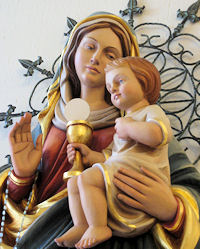
13 May - Our Lady of the Blessed Sacrament

Our Lady of the Blessed Sacrament

This title penetrates the mystery itself of the Eucharist, and when well understood, manifests to us the most important part granted to Mary in the economy of the Holy Eucharist.

If we have thoroughly seized Pierre Eymard's thought we understand that she is, first, the Mother of Jesus, giving to the Word her most pure blood, which was changed on the day of the Incarnation into His own Body, into His own Blood, in order to consecrate it later, on the night of the Last Supper, into His Sacrament of Love.

Our Lady of the Blessed Sacrament is Mary receiving in quality of universal dispensatrix of grace, the full and absolute disposition of the Eucharist and the graces that It contains, because this Sacrament is the most efficacious means of salvation, the fruit par excellence of the Redemption of Jesus Christ. To her, consequently, it belongs to make Jesus in the Sacrament known and loved; to her it belongs to spread the Eucharist throughout the world, to multiply churches, to raise them in infidel lands, and to defend faith in the Eucharist against heretics and the impious; to her it belongs to prepare souls for Communion, to rouse them to make frequent visits to Jesus, and to assist zealously at the Holy Sacrifice of the Mass. She is the treasure-house of all the graces comprised in the Eucharist, both those that prepare the soul for It and those that flow from It.

— Month of Our Lady of the Blessed Sacrament by St. Peter Julian Eymard

From: https://www.catholicculture.org/culture/liturgicalyear/calendar/day.cfm?date=2016-05-13

Sunday, April 17, 2016

Pope speaks of Christian woman killed for faith

Pope Francis speaks of Christian woman killed for her faith

Pope Francis leaves after celebrating a Mass 
in St. Peter's Basilica at the Vatican, Sunday, 
April 17, 2016. Pope Francis ordained eleven 
new priests Sunday. (AP / Alessandra Tarantino)
The Associated Press, Published Sunday, 
April 17, 2016 8:52AM EDT

VATICAN CITY - Pope Francis says one of the refugees he met on the Greek island of Lesbos was the Muslim widower of a Syrian Christian woman killed by extremists for refusing to renounce her faith.

Francis told the faithful in St. Peter's Square on Sunday that "she is a martyr."

Departing from his prepared remarks, Francis shared his experiences of the day earlier with thousands of people gathered for his blessing. He says among the 300 refugees he greeted Saturday on Lesbos was a Syrian widower with two children.

The pope said: "He is Muslim, and he told me that he married a Christian girl. They loved each other and respected each other. But unfortunately the young woman's throat was slashed by terrorists because she didn't want to deny Christ and abandon her faith."

Thursday, April 7, 2016

Best way for Catholics to mark the Reformation; Celebrate the papacy!

The best way for Catholics to mark the Reformation is to celebrate the papacy
by Fr Alexander Lucie-Smith
posted Friday, 1 Apr 2016

The Pope Emeritus prepares to greet Pope Francis during the 
opening of the Holy Door of St Peter's Basilica 
(CNS photo/Stefano Spaziani, pool)

The splintering of Protestantism is the best advert for a pope ever devised

The reminder from the ever excellent Cardinal Müller that the Reformation is nothing to celebrate, while a statement of the obvious – after all, how can one celebrate disunity? – still leaves us with a question: just how are we to mark the 500th anniversary of Martin Luther’s revolt against Church doctrine?

Just ignoring it would not be right. The Reformation was a huge event and we are still living with its consequences, no one can deny. Much better that we should mark the anniversary in a way that deepens our understanding of it. Why did it happen? What can we learn from it? And what can we do, five centuries on, to heal the breaches created then?

The usual answer to the first question is that the Reformation came about as a movement of reform, as a specific reaction to the corruption of the Catholic Church. I doubt, though, that any serious historian could assert this today, or find any compelling evidence to back up this myth. If we look at the German lands, there is plenty of evidence that the Catholic Church was in many ways still a vital body. Indeed, the proof of this is that half of Germany did not follow Luther: the Catholic Church still retained much credibility. Again, in England, the advanced decay of the pre-Reformation Church, and in particular its monasteries, is a myth. The Tudor Church boasted men like John Fisher and Thomas More, and its monasteries were seized as part of the biggest landgrab in history, rather than for moral reasons. Many of the monks died for the faith, which is hardly a sign that the monasteries had failed as religious institutions.

So why did the Reformation come about? It was partly a political movement: the German princes and Henry VIII arrogating powers to themselves; a nationalist movement, anti-Roman and anti-Spanish, both in Germany and England; and of course a religious movement too. It has to be admitted that Luther asked questions to which the Catholic answer was judged by many to be no longer adequate. And the chief of these questions was: “How can I be saved?”

All this leads to a huge contemporary problem. How are we to mark the anniversary of the Reformation when the question about salvation is no longer at the forefront of the modern consciousness? As far as I can see, even in the traditional lands of the Reformation, no one is exactly agonising over the question of salvation. Indeed, in hugely advanced societies like Sweden, which the Pope will be visiting to mark the anniversary, the general feeling seems to be that one does not need salvation through Christ or anyone else for that matter. Religious statistics are notoriously unreliable, but it seems pretty obvious that Sweden is one of the least religious countries on earth. Luther would be horrified!

Given that the “How can I be saved?” question is not the one on everyone’s lips, there is a danger that the Reformation anniversary will turn out to be a celebration of its political aspects. Luther is, let us not forget, a German national hero. As for England, the other day I met an MP (let him be nameless) who told me that in supporting Brexit, he was simply aiming to do what Henry VIII and Cranmer did, taking back sovereignty from a foreign power. Actually, he is right: the Act in Restraint of Appeals, which separated England from Rome, contains the famous line “This England is an Empire”, meaning that England was sovereign and not subject to any other powers such as the papal one. Just as Luther is a hero in Germany, Henry VIII is to many here, still.

What then is to be done? I think the best way to mark the Reformation is to emphasise that the Church can only be universal, that is Catholic, in that Christ only brought one revelation, and only founded one Church. The idea of a national church is completely absurd. Coupled with this there needs to be a strong presupposition in favour of internationalism (which, as my Brexiteer MP and I agreed, was quite in keeping with leaving the EU, as that institution is not to be confused with Europe itself).

Finally, I think we need to make the Reformation anniversary into a celebration of the role and nature of the papacy as the focus of unity and guarantor of doctrinal truth, for the splintering of Protestantism (of which Luther would not have approved, I feel) is the best advert for the papacy ever devised. Instead of asking the question “How can I be saved?” we need to turn our attention to the question “What is the Church?”

Relics found in ruined Syrian monastery confirmed as St Elian’s

Relics found in ruined Syrian monastery confirmed as St Elian’s
by Catholic News Service
posted Wednesday, 6 Apr 2016

A Syrian soldier surveys damages at 
Mar Elian monastery in Qaryatain, (AP Photo)

The relics were discovered amid the rubble of the desecrated Mar Elian Church in Qaryatain


It has been confirmed that the relics of Syrian St Elian, which originally were thought to have been destroyed by members of the Islamic State militia, have been found amid the rubble of the desecrated Mar Elian Church in Qaryatain, Syria.

The sanctuary was bulldozed in August 2015, according to Fides, the news agency of the Congregation for the Evangelisation of Peoples.

Fr Jacques Mourad, the prior of the Syriac Catholic monastic community, was kidnapped three months earlier when the terrorists initially raided the church.

Fr Mourad, who was freed on October 11, reported the discovery of the relics to Fides on April 5.

“The fact that the relics of Mar Elian are not lost is for me a great sign: It means that he did not want to leave the monastery and the Holy Land,” the priest said.

The relics of St Elian, a third-century martyr, were discovered after Syrian military forces had retaken control of Qaryatain.

Even while the Islamic State forces controlled the area, however, local Christians preserved their veneration of St. Elian, Fides said.

Fr Mourad had told his flock: “It is not important that the monastery is destroyed, it is not even important that the tomb was destroyed. The important thing is that you bear Mar Elian in your heart, wherever you go, even in Canada, or Europe, because he wants to stay in the hearts of his followers.”

A priest of the Syriac Catholic Archdiocese of Homs and monks from the Mar Musa monastery were set to go to Mar Elian to survey its condition, Fides reported.

Fr Mourad asked that they collect and guard the remains.

“We know that the old sanctuary was destroyed, the archaeological site was devastated, while the new church and monastery were burned and partly bombed,” he said. “The life of grace will bloom again around the memory of the saints. It will be a great blessing for our entire church.”

Tuesday, March 29, 2016

CISTERCIANS / Austria: A hot spot for spirituality

A hot spot for spirituality
by John Gottfried
posted Thursday, 24 Mar 2016

Hundreds of young people attend the regular 
Youth Vigils at the monastery

A Viennese monastery famous for its chart-topping chant album is also breaking records for vocations. What is the secret of its success?

Deep in the woods outside Vienna there is a monastery, Stift Heiligenkreuz, which draws more than 100,000 tourists a year. They come on day trips to visit one of the most beautiful medieval monasteries in the world. They see the Romanesque abbey church and the 13th-century cloister, enjoy lunch at the restaurant and perhaps buy some monastery wine in the small shop.

But Heiligenkreuz is more than a popular attraction. It is living and growing. This one monastery ordains more priests than some archdioceses, although it is perhaps only known in Britain for the million-selling record Chant, which topped the charts in 2008. The oldest continuously occupied Cistercian monastery in the world, founded in 1133, is now thriving. There are currently more than 90 monks – 30 years ago it was half that – with an average age of under
50. Vocations are booming.

Last year Heiligenkreuz clothed another eight novices, and candidates come from all over the world, including recently from England.

Fourteen monks currently teach at the faculty of theological studies, sited in the monastery’s new campus. With some 300 students, this is now the largest Catholic study centre in the German-speaking world. It is part theological academy, part seminary, teaching not only members of its community but also laity (both men and women), and 160 future diocesan priests and Religious from throughout Europe and the developing world.

Heiligenkreuz is part of the original Cistercian order, rather than the later reformed Trappist tradition, and so perhaps closest in feel to English Benedictine houses such as Ampleforth, Downside and Worth. The monastery has active responsibilities not only in teaching but also parochial life. It administers more than a dozen parishes, two large priories (one, founded in 1988, in the Ruhr) as well as a fledging house in Sri Lanka.

During the regular Youth Vigil at the monastery, hundreds of young people attend an evening of prayer, with talks, Confession and then Adoration. They come from all over the country – some frequent visitors, some new to the community and attracted by word of mouth or the many fans on Facebook – and stay in sleeping bags or hitch a lift home.

What are the roots of this success? Recent history shows that Heiligenkreuz has been doing well for some time – “not because of our CD”, says Fr Karl Wallner, rector of the college and spokesman for the monastery. “Rather, we did the CD because we were already a strong and youthful community, encouraged by the visit from the Pope.” (Benedict XVI came to Heiligenkreuz as part of an official visit to Austria in September 2007.)

“We do God’s work in normal ways everyone can relate to, without being biased to one temporary tendency or another,”


Fr Karl Wallner says. “Our former abbot [Gerhard Hradil, at 87 now the oldest member of the community] says keeping the Rule of St Benedict and the Ten Commandments is enough for anyone. So we are pretty normal, not ‘traditionalist’ or any other ‘ist’. We are just Catholic, living for God, though we wear funny clothes.”

Sebastian Cody, a British media consultant who has been visiting Heiligenkreuz for decades, says the reforms of the 1960s were a turning point. “I was privileged, as a very young man, to meet the late Abbot Karl Braunsdorfer. He was a Council Father who, when he returned to the monastery in the mid-1960s, had the responsibility to institute reform. And what he set – after no doubt deep soul-searching, faced with the many temptations of that era – sowed the seeds for the later flourishing, although at the time of his death in 1978 he might not have seen all the fruits.”

Braunsdorfer, whose Cause was opened by Cardinal Schönborn in 2008, worked for a revival of the monastic spirit. The liturgy was reformed along the lines laid out by the Second Vatican Council. A new Latin edition of the monastic breviary was made especially for Heiligenkreuz, and Gregorian chant was again given pride of place. The habit was retained. Any visitor will be struck by the dignified liturgy that is at the heart of life in Heiligenkreuz. Monks pray in Latin and the vernacular, three-and-a-half hours together every day, beginning at 5.15am.

At the same time the community gives off a powerful sense of being a vast complex of dynamic enterprise. “Everyone is living the Rule at an intense level, busy yet with a contemplative centre,” says Annabel Cole, a writer from London who first visited in the late 1990s. “When you pray in the abbey it can seem as if time has stood still. Yet the monks going about their day are modern, industrious men.”

One of the monks, Fr Johannes Paul Chavanne, says: “Prayer is the most important part of our daily life. We are, so to speak, professional pray-ers. We are also people of the 21st century. We use computers, mobile phones. We take part in what happens in the world. After all, we have to know what to pray for.”

The community is of a size to accommodate many forms of vocation, from helping tackle the migrant crisis in central Europe to venerating the True Cross (Leopold V donated a large relic to Heiligenkreuz, which means “Holy Cross”, in 1188). Academic research at all levels is a tradition, as is bookbinding and fine art. The Venetian sculptor Giovanni Giuliani was deeply connected to the monastery in the 18th century. The community recently welcomed a late vocation from a leading sculptor from the former East Germany, whose works in stained glass and bronze adorn the new campus.

Two American monks produce English-language blogs, sancrucensis. wordpress.com and cistercium.blogspot.co.uk, and the community has a popular YouTube channel, The Monastic Channel, with many short videos in English. There is even a documentary about the Chant project – Top Ten Monks, made by HBO, the American television network famous for The Sopranos and Game of Thrones.

The monks are still in the recording business, last year issuing an inter-denominational album with Deutsche Grammophon, Chant For Peace, which brings together Jewish and Christian settings of the psalms.

The Benedictine tradition of hospitality is important at Heligenkreuz. For those just seeking silence and an encounter with God there are simple rooms in the guest house, whereas men with a serious interest in the monastic life can stay for some days of “monastic experience”.

For the most energetic, Fr Wallner organises regular “sport weeks”: extensive workouts in the impressive gym which are simultaneously cloistered retreats.

“They find us interesting, cool, exotic,” Fr Wallner says of the monastery’s visitors. “When they see us praying in long robes, singing in Latin – the modern world as they know it, it’s boring for them by comparison.

“People should see that the Church is not dying, but that Christian faith is living. We are a hot spot for spirituality. For many people outside we really are a sign of hope. I think we have to accept that in the deserts of our civilisation Heiligenkreuz is seen as an oasis of strength.”

From 1938 to 1945 the abbey’s existence was threatened and many of the monks were imprisoned. Now Heiligenkreuz is the largest Cistercian monastery in Europe. That’s reason enough to be joyful and hopeful for both monasticism and the new evangelisation in the modern world.

This article first appeared in the March 25 2016 issue of The Catholic Herald. To download the entire issue for free with our new app, go here
VOCATION: The much-loved Sister who showed me that being a nun is a wonderful vocation

The much-loved Sister who showed me that being a nun is a wonderful vocation
by Francis Phillips
posted Thursday, 24 Mar 2016

Visiting nuns venerate the relics of 
St Thérèse of Lisieux at Westminster Cathedral (PA)

She never had any children, but as a dormitory mistress she lavished her maternal gifts on us

In Europe and the UK the vocation to become a nun is very uncommon today, especially among the teaching orders. My old school, once a convent boarding school, is typical of many others: although it is still a Catholic girls’ school it is now completely under lay management and staff and the boarding element has long gone, along with the nuns. The beautiful chapel, designed by Adrian Gilbert Scott, where Mass was once celebrated every morning at 7.30 sharp, is now only used on special feast days.

I mention this as I returned there on Tuesday for the funeral and burial of a much-loved former dormitory mistress and Sister. Listening to her life story as it was described by a fellow nun at the start of Mass and also in the homily, I was reminded what a wonderful vocation it is to be a nun – the very opposite of the unnatural and suppressed life of the emotions that a modern secular society might consider it.

In my thoughts I contrasted this dearly loved Sister, born in County Galway in 1919 from a family of ten children and who made her first profession in 1940 during the War, with the life of Anita Brookner whom I blogged about last week. Dr Brookner, who was unmarried, mourned the fact that she never had children; it was a source of grief in her life that no amount of success in novel-writing could mitigate.

The Sister whose memory we celebrated on Tuesday also never had children of her own, for obvious reasons. But she was still a wonderful “mother”. Once asked by one of the girls if she regretted not having children, she smiled and answered with her characteristic robustness, “But you girls are my children!” And we were. All her great maternal gifts were lavished on the generations of girls who passed through the school during her 70 years there. She could be strict and she could be firm; she wouldn’t tolerate nonsense or unkind behaviour; but we all knew she loved us. That was why the chapel was full on Tuesday and why so many former pupils were in tears. We were mourning a true spiritual mother.

The homilist, the abbot from the local monastery, reminded us that true holiness is about being fully human: “The glory of God is a human being fully alive”. His own memories of Sister, he said, were bound up with “manure” – as she had often begged the abbey for manure for her rose garden. She had also “always liked a tipple”. As well as being a skilled gardener, seamstress and cook, Sister’s life as I have said, was bound up with her girls. In extreme old age and living in a care home run by fellow nuns, her most frequent question was, “How are the children?”

The Rosary was her favourite prayer and her beads were broken through much use. Love for the Sacred Heart – she had a small statue by her bed – was her favourite devotion. Changes in the Church after Vatican II brought their own sorrows; Sister was sad at the dearth of vocations and the closure of the boarding school, when there were no members of the Community left to supervise the girls at night and at weekends. She was also the only nun to keep on wearing the old black habit with its starched white wimple, when the rest of the community chose to wear a modernised form of religious dress.

She was aware of the waning of the Faith. But it didn’t affect her own fidelity to her vows in the slightest. As a young Irish girl from the country she had given her life to God and she never looked back once she had put her shoulder to the plough. As we laid her in the nuns’ graveyard in the grounds of the school which she had loved and served so well, I thought what a full and happy life she had led, albeit hidden, humble and hard-working. May she rest in peace.

Friday, March 18, 2016

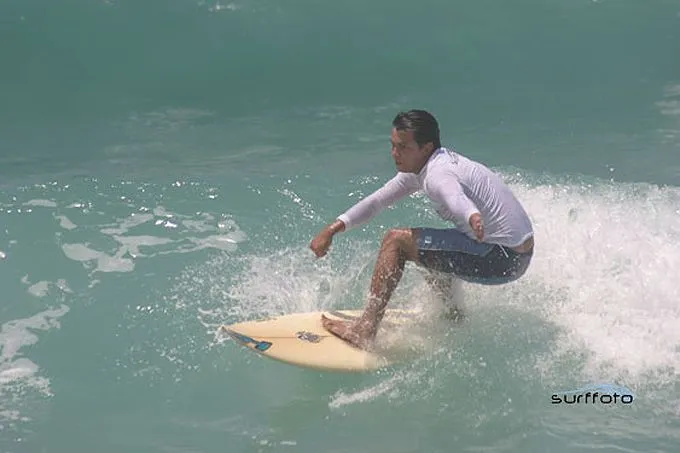
Brazil's 'Surfer Angel': Guido Schaffer Beatification :)

Beatification cause for Brazil's 'Surfer Angel'

Guido Schaffer, a Brazilian seminarian who drowned while 
surfing in 2009 and whose cause for beatification 
has been opened. Photo courtesty of guidoschaffer.com.br.

Rio de Janeiro, Brazil, Nov 12, 2014 / 01:24 pm (CNA).- 
The Congregation for the Causes of Saints has approved the cause of beatification of Guido Schaffer, who was a Brazilian seminarian known as the “Anjo Surfista,” or “Surfer Angel.”

The Archdiocese of Rio de Janeiro will now establish a tribunal to handle the cause. The archdiocese requested approval of the cause in May by sending the Vatican numerous documents on the life of Schaffer “to show that he lived in accord with the teachings of the Church.”

Schaffer died of drowning in May of 2009, at the age of 34, while surfing at Barra da Tijuca in Rio de Janeiro. His untimely death came just weeks before he was to be ordained to the priesthood.

Formation directors and seminarians at St. Joseph Seminary in Rio, where he studied theology, remember Schaffer with great fondness.

“He was very sensitive toward others and was a man of great faith and was passionate for the word of God," said Father Roberto Lopes, episcopal vicar for the causes of saints in the archdicoese, last May.

"On the day of his burial, the Church of Our Lady of Copacabana was filled with bishops, priests and many believers who saw him a young man who was different and deeply loved God," he added.

Schaffer left a major impact on the poor due to his work with the native tribes of Brazil alongside the Missionaries of Charity.

The late seminarian was the son of physicians, and had expressed interest in serving in the medical field after his ordination to the priesthood.

“He was the son of physicians, he was well-off economically but he was not attached to material things,” Father Lopes said.

“He worked at the Holy Home of Mercy and wanted to live there once he was ordained a priest.”

Father Lopes said Schaffer’s life “inspires more and more young people to follow the way of holiness while continuing to do everything that young people do.”

He recalled that during World Youth Day in Rio de Janeiro in 2013, many young people visited an expo on Schaffer’s life.

"The number of people who visited the expo was amazing and still today there are many who seeking information and attribute graces received to his intercession.” Fr. Lopes concluded.

Tags: Sports, Archdiocese of Rio de Janeiro, Guido Schaffer, Surfing

Friday, March 11, 2016

St Theodore Tyro (the Recruit) - Martyr / 17 February memorial :)


From:
http://archangelicons.com/files/Theodore%20Tyro%201%20a.jpg