Search This Blog

Friday, September 26, 2014

Tuesday, September 23, 2014

MISSION: Pope's Albania visit - Martyrs' legacy and coexistence

Martyrs' legacy and coexistence key themes of Albania visit

2014-09-23 Vatican Radio


(Vatican Radio) Pope Francis hast left the Albanian capital, Tirana, at the end of his one day visit to the former communist country. After a brief farewell ceremony, as the president and prime minister said goodbye to their special guest, the Pope's Alitalia plane took off slightly ahead of schedule and was expected to arrive back in Rome just before 9.30pm.
The brief, but very intense 11 hour journey to Albania has been focused on two main themes: the witness of the martyrs and the importance of peaceful co-existence, as our Vatican Radio correspondent for this visit, Christopher Wells reports:
Listen:
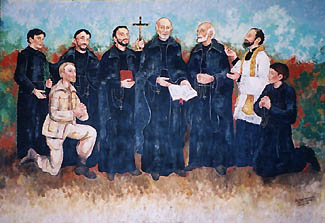
Looking to the martyrs of Albania's atheistic communist regime means looking to the past – but not to a dead past. The witness of Albania's Church of Silence speaks loudly, bearing witness to the nation's traditions of faith, the firm rock upon which the future can be built.
It is a future that can be built around the mutual coexistence that has characterized Albania since the fall of communism. More than simply living in the same place, living together in peace and harmony involves mutual respect for the person of the other – a respect for the dignity of the human person that must be rooted in faith in God, the Creator of all.
The Albanian people clearly have a strong sense of the past, especially the tragic history of the recent past. Albanian Catholics are rightly proud of their martyrs, who, relying on God, stood firm in their Faith.
Their hopes for the future, awakened in the transition toward democracy, have yet to be achieved. One can sense the concern for the future, the fear that the promise of a new springtime for Albania might not live up to expectations. But if they are worried about the future, they are not discouraged. One can sense the optimism in everyone you meet.
Pope Francis came to Albania to support and encourage this "young people." He reminded them that the future cannot be built on the empty promises of individualism and selfishness. It must be built on mutual love and respect, which must ultimately rest on the message of salvation of Jesus Christ.
That is the great message of encouragement and hope – a hope that will never disappoint – that Pope Francis has brought to the people of Albania.

Cardinal Muller (CDF) meets SSPX Bishop Fellay

Congregation for the Doctrine of the Faith:
Cardinal Muller meets the superior general of the Society of St. Pius X

Vatican City, 23 September 2014 (VIS) – The Holy See Press Office has issued a statement to confirm that this morning from 11 a.m. to 1 p.m., a cordial meeting took place at the premises of the Congregation for the Doctrine of the Faith between Cardinal Gerhard Ludwig Muller, prefect of the Congregation for the Doctrine of the Faith, and Bishop Bernard Fellay, superior general of the Society of St. Pius X. The meeting was also attended by Archbishop Luis Ladaria Ferrer, S.J., secretary of the same Congregation, Archbishop Joseph Augustine Di Noia, O.P., adjunct secretary and Archbishop Guido Pozzo, secretary of the Pontifical Commission Ecclesia Dei, along with two assistants from the Society of St. Pius X, Rev. Niklaus Pfluger and Rev. Alain-Marc Nély.

During the meeting, various problems of a doctrinal and canonical nature were examined, and it was decided to proceed gradually and over a reasonable period of time in order to overcome difficulties and with a view to the envisioned full reconciliation.

Pope Francis at Mass: Christian life simple, radical

Pope Francis at Mass: Christian life simple, radical

2014-09-23 Vatican Radio


(Vatican Radio) Pope Francis said Mass in the chapel of the Santa Marta residence on Tuesday morning. In remarks following the readings of the day, the Holy Father focused on the simplicity of the Christian life and the Gospel's call to radical simplicity in life and action.
Christ's words had a "new" sound to them, as did the authority with which he spoke them – and this was why people followed him in such large numbers. Christ's words had "the power of salvation" in them. Even so, there were those, who followed him "for the sake of convenience" only, without too much purity of heart, or perhaps with the desire to be "a little better" only. Pope Francis said that little has changed in two thousand years. Even today, many listen to Jesus as did the nine lepers of the Gospel who, "happy" with their newfound health, "forgot" the Lord, who had restored it to them:
"Jesus continued to talk to people and loved the people and He loved the crowd, to the point that He says, 'these who follow me, that immense crowd, are my mother and my brothers – that's who they are'. He explains: 'those who listen to the Word of God, put it into practice'. These are the two conditions in order to follow Jesus: to listen to the word of God,  and to put it into practice. This is the Christian life – nothing more. Simple, simple. Maybe we've made it a little difficult, with many explanations that no one understands, but the Christian life is thus: listening to the Word of God and practicing it."
That is why – as described in the passage from the Gospel of Luke (8:19-21) that was read at Mass – Jesus replies to those who reported that her relatives were looking for him by saying, "My mother and my brothers are those who hear the word of God and put it into practice." The point is not to hear casually, but to bend our ears – really to listen to the word of God, which we find in the Gospel – the pages of which need to be heard, and heeded, rather than merely read by rote "Listening to the Word of God," said the Holy Father, "means reading it and then asking, 'What does this say to me? How does this speak to my heart? What is God saying to me, with this word?" This, said Pope Francis, is a life-changing line of questioning:
"Every time we do this – each time we  open the Gospel and read a passage and ask ourselves: 'Is God speaking to me with this? Is He saying something to me?' – and if He is saying something, what is it that He is saying? This is [what it means] to listen to the Word of God: to listen with your ears and hear with your heart. Open your heart to the Word of God. The enemies of Jesus heard the word of Jesus, but were there in order to try to find a mistake, to make Him slip, so that He would lose His authority. They never asked themselves, though: 'What is God saying to me in this Word?' God not only speaks to all: yes, he does speak to all of us – but He also speaks to to every one of us – to each of us. The Gospel was written for each of us."
The Holy Father went on to say that putting into practice what we have heard is "is not easy" and that "it is easier to live a mellow life without worrying about the exigencies of the Word of God." He went on to remind the gathered faithful that the Commandments and the Beatitudes are sure guides for anyone who would really attempt to understand the requirements the Gopsel places on us and act accordingly – always counting on Jesus' help. "[The Lord]," Pope Francis concluded, " "is merciful and forgives all," and waits for everyone, "because He is patient.":
"Jesus receives everyone, even those who go to hear the Word of God and then betray Him. Think of Judas. 'Friend,' He says, in that moment where Judas betrays him. The Lord is always sowing His word, and asks [us] only [to have] an open heart [with which] to listen and willingness to put it into practice. For this reason, then prayer today, which is that of the Psalm [119:35]: 'Lead me Lord in the path of thy commandments,' that is, the path of your Word, that I may learn with your guidance to put it into practice."

Pope prays at Saint Mary Major after Albania trip


Pope prays at Saint Mary Major after Albania trip

2014-09-23 Vatican Radio


(Vatican Radio) Pope Francis paid a private visit to the Basilica of St. Mary Major on Monday morning to thank Our Lady for  the success of his just-ended one-day apostolic visit to  Albania.
A brief statement from the Director of the Press Office of the Holy See, Fr. Federico Lombardi SJ, said the Pope  made the trip across the city center  to spend time with Our Lady salus populi Romani – Protectress of the Roman people – whose icon in the church is among the city's most beloved objects of Marian devotion.
The bouquet of flowers he presented to Our Lady was the one he received on Sunday evening during his meeting with the disabled at the Betania Home for the disabled in Tirana.
The faithful present in the Basilica at the time joined the Pope for the final recitation of the Salve Regina.
Pope Francis returned to the Vatican at 12.30 Rome time.

Wednesday, September 17, 2014

ISIS and the Pope: 'Regensburg Vindicated' - George Weigel

REGENSBURG VINDICATED
by George Weigel
9 . 17 . 2014 
 
On the evening of Sept. 12, 2006, my wife and I were dining in Cracow with Polish friends when an agitated Italian Vaticanista (pardon the redundancy in adjectives) called, demanding to know what I thought of "Zees crazee speech of zee pope about zee Muslims." That was my first hint that the herd of independent minds in the world press was about to go ballistic on the subject of Benedict XVI's Regensburg Lecture: a "gaffe"-bone on which the media continued to gnaw until the end of Benedict's pontificate.
Eight years later, the Regensburg Lecture looks a lot different. Indeed, those who actually read it in 2006 understood that, far from making a "gaffe," Benedict XVI was exploring with scholarly precision two key questions, the answers to which would profoundly influence the civil war raging within Islam—a war whose outcome will determine whether 21st-century Islam is safe for its own adherents and safe for the world.
The first question was about religious freedom: Could Muslims find, within their own spiritual and intellectual resources, Islamic arguments for religious tolerance (including tolerance of those who convert to other faiths)? That desirable development, the pope suggested, might lead over time (meaning centuries) to a more complete Islamic theory of religious freedom.
The second question was about the structuring of Islamic societies: Could Muslims find, again from within their own spiritual and intellectual resources, Islamic arguments for distinguishing between religious and political authority in a just state? That equally desirable development might make Muslim societies more humane in themselves and less dangerous to their neighbors, especially if it were linked to an emerging Islamic case for religious tolerance.
Pope Benedict went on to suggest that inter-religious dialogue between Catholics and Muslims might focus on these two linked questions. The Catholic Church, the pope freely conceded, had had its own struggles developing a Catholic case for religious freedom in a constitutionally-governed polity in which the Church played a key role in civil society, but not directly in governance. But Catholicism had finally done so: not by surrendering to secular political philosophy, but by using what it had learned from political modernity in order to reach back into its own tradition, rediscover elements of its thinking about faith, religion, and society that had gotten lost over time, and develop its teaching about the just society for the future.
Was such a process of retrieval-and-development possible in Islam? That was the Big Question posed by Benedict XVI in the Regensburg Lecture. It is a tragedy of historic proportions that the question was, first, misunderstood, and then ignored. The results of that misunderstanding and that ignorance—and a lot of other misunderstanding and ignorance—are now on grisly display throughout the Middle East: in the decimation of ancient Christian communities; in barbarities that have shocked a seemingly-unshockable West, like the crucifixion and beheading of Christians; in tottering states; in the shattered hopes that the 21st- century Middle East might recover from its various cultural and political illnesses and find a path to a more humane future.
Benedict XVI, I am sure, takes no pleasure in history's vindication of his Regensburg Lecture. But his critics in 2006 might well examine their consciences about the opprobrium they heaped on him eight years ago. Admitting that they got it wrong in 2006 would be a useful first step in addressing their ignorance of the intra-Islamic civil war that gravely threatens peace in the 21st-century world.
As for the conversation about Islam's future that Benedict XVI proposed, well, it now seems rather unlikely. But if it's to take place, Christian leaders must prepare the way by naming, forthrightly, the pathologies of Islamism and jihadism; by ending their ahistorical apologies for 20th-century colonialism (lamely imitating the worst of western academic blather about the Arab Islamic world); and by stating publicly that, when confronted by bloody-minded fanatics like those responsible for the reign of terror that has beset Syria and Iraq this summer, armed force, deployed prudently and purposefully by those with the will and the means to defend innocents, is morally justified.
 
RELATED: Just War Doctrine https://www.ewtn.com/expert/answers/just_war.htm
 
George Weigel is Distinguished Senior Fellow of Washington's Ethics and Public Policy Center. His previous articles can be found here.

SEPTEMBER 14 - "Why exalt the Cross?" Pope Francis

Pope at Angelus: Why exalt the Cross?

2014-09-15 Vatican Radio


(Vatican Radio) "Why do Christians exalt the Cross of Christ?" asked Pope Francis of pilgrims and tourists Sunday who had gathered beneath the window of his study for the midday Angelus.  Because, he told them, that Cross on which Christ was nailed "is the source of the mercy of God that embraces the whole world". It's not just any cross, it is the source of our salvation.
And today – on the Feast of the Exaltation of the Holy Cross – the Pope said we should pray for Christians who are being persecuted and killed because of their faith in Christ. "This happens especially there where religious freedom is still not guaranteed or fully realized. It happens, however, even in well-to-do countries which, in principle, protect freedom and human rights, but where in practice believers, and especially Christians, encounter restrictions and discrimination. So today we remember them and pray especially for them".
The Pope also warned against considering the cross a sign "magic": "The Holy Cross .... is not a sign of 'magic'! Belief in the Cross of Jesus involves following Him on his path. Thus Christians collaborate in His work of salvation by accepting together with Him sacrifice, suffering, even death for the love of God and neighbor".
Below a Vatican Radio translation of the Holy Fathers reflections before the Angelus prayer:
Dear brothers and sisters,
On September 14th the Church celebrates the Feast of the Exaltation of the Holy Cross. Some non-Christian person might ask: why "exalt" the Cross? We can say that we do not exalt just any cross any or all crosses: we exalt the Cross of Jesus, because God's love for humanity was revealed most in it. That's what the Gospel of John reminds us in today's liturgy: "God so loved the world that He gave only begotten Son" (3:16). The Father has "given" the Son to save us, and this has resulted in the death of Jesus and His death on the Cross. Why? Why was the Cross necessary? Because of the gravity of the evil which kept us slaves. The Cross of Jesus expresses both things: all the negative forces of evil, and all of the gentle omnipotence God's mercy. The Cross would appear to declare Christ's failure, but in reality marks His victory. On Calvary, those who mocked him said, 'If you are the Son of God, come down from the cross "(cf. Mt 27,40). But it was the opposite that was true: it was because Jesus was the Son of God, that He was there, on the Cross, faithful to the end to the loving plan of the Father. And for this reason God has "exalted" Jesus (Philippians 2.9), conferring universal kingship on Him.
So what do we see, when we look to the Cross where Jesus was nailed? We contemplate the sign of the infinite love of God for each of us and the source of our salvation. That Cross is the source of the mercy of God that embraces the whole world. Through the Cross of Christ the evil one is overcome death is defeated, we are gifted life, hope is restored. This is important: Through the Cross of Christ hope is restored. The Cross of Jesus is our only true hope! That is why the Church "exalts" the Holy Cross, which is why we Christians bless ourselves with the sign of the cross. That is, we don't exalt crosses but THE glorious Cross of Christ, a sign of God's love, our salvation and journey towards the resurrection.  This is our hope.  
While we contemplate and celebrate the Holy Cross, we think emotionally of so many of our brothers and sisters who are being persecuted and killed because of their faith in Christ. This happens especially there where religious freedom is still not guaranteed or fully realized. It happens, however, even in well-to-do countries which, in principle, protect freedom and human rights, but where in practice believers, and especially Christians, encounter restrictions and discrimination. So today we remember them and pray especially for them.  
On Calvary, at the foot of the Cross, there was the Virgin Mary (cf. Jn 19,25-27). She is the Virgin of Sorrows, whom we celebrate tomorrow in the liturgy. To Her I entrust the present and the future of the Church, so that we all may always know how to discover and accept the message of love and salvation of the Cross of Christ. To Her I entrust in particular the newly wed couples whom I had the joy of joining in marriage this morning, in St. Peter's Basilica.
 
RELATED: Homily for the Feast of the Exaltation of the Cross http://www.news.va/en/news/pope-francis-homily-for-feast-of-the-exaltation-of
 
(From archive of Vatican Radio)

MISSION: 'Go forth with the Gospel message' Pope encourages

 Pope tells Catholics to go forth with the Gospel message
2014-09-17 Vatican Radio


(Vatican Radio) Pope Francis encouraged Catholics go forth and bring the Gospel message to the world and to their communities.
Speaking on Wednesday during his General Audience the Pope spoke of the universal and apostolic nature of the Catholic Church.
He explained that the word catholic means that she is universal, something that she shows by speaking all languages, which – he said – is the effect of Pentecost when the Holy Spirit gave to the Apostles and the whole Church the gift of proclaiming the Good News of God's salvation and love to all, even to the ends of the earth.
And, speaking off-the-cuff to those present in St. Peter's Square, Pope Francis said we should all carry with us a "pocket" Gospel, so we can dip into it during the day that – he said – is a good thing to do.
The Pope also highlighted the missionary nature of the Catholic Church which – he said - is called to show the tenderness and power of God.
Turning his attention to the many missionaries the Church is blessed with, he said the Holy Spirit compels us to encounter our brothers and sisters, even those most distant from us, and to share with them God's message of love, peace and joy.
Ours – Pope Francis said – is a Church that goes forth, impelled by the life-giving breath of the Spirit.
And speaking of the heroic lives of many missionaries who have left their homelands and have gone forth to proclaim the Gospel in distant lands, he recalled his conversations with a Brazilian Cardinal who has worked at length in the Amazon area. The Pope revealed that, when possible, the Cardinal goes to visit a cemetery in the Amazon where many missionaries are buried: "these brothers and sisters could all be canonized now" he said.
Thanking the Lord for the Church's many missionaries; the Pope said "perhaps amongst the many young people present today in the Square there is someone who would like to become a missionary. May he go forth!" The Pope said, "This is good and courageous".            
Please find below the official synopsis of the Pope's catechesis:
Dear Brothers and Sisters: When we profess the Creed, we affirm that the Church is catholic and apostolic.  The word catholic signifies that she is universal.  This means that the Church is found everywhere and teaches the whole truth regarding the heavens and the earth.  The Church shows her catholicity by speaking all languages which is the effect of Pentecost, when the Holy Spirit gave to the Apostles and the whole Church the gift of proclaiming the Good News of God's salvation and love to all, even to the ends of the earth.  The Church then is of her nature missionary, given to evangelization and encounter; that is, she is apostolic.  Founded on the Apostles and in continuity with them, the Church is called to proclaim the Gospel to everyone, and to show the tenderness and power of God.  This too flows from Pentecost.  It is the Holy Spirit who prevents us from being self-absorbed, of thinking that the blessings of God are for us alone.  Rather, the Spirit compels us to encounter our brothers and sisters, even those most distant from us in every way, to share with them the love, peace, and joy of the Risen Lord.  May we always live in solidarity with all of humanity, and never closed in on ourselves.  May we go out, in communion with the Successors of the Apostles, to announce Christ and his love to all.  And may we always be a sign of the Church our Mother: holy, catholic and apostolic.  

(From Vatican Radio)