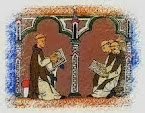
Blessed Feast of Pope St. Peter Celestine V, hermit founder of the Celestine Benedictines (OSB Cel.) !!!
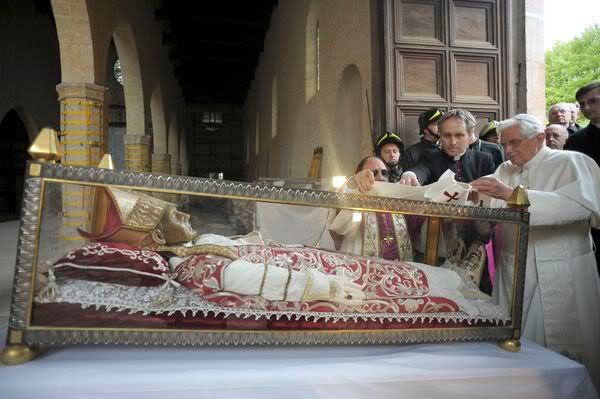
From: http://i84.photobucket.com/albums/k27/jakyl32/365%20Rosaries-%20May/519benedictcelestine.jpg

Bishop Camillo Ballin, an Italian-born Comboni missionary, heads the Roman Catholic Vicariate of Northern Arabia. He is overseeing the first-ever building of a new cathedral in Bahrain, on land given to the Church by Bahrain's King Hamad bin Isa Al Khalifah.
The cathedral, named Our Lady of Arabia, will serve an estimated 2.5 million Catholics, the great majority of them foreign guest workers, in Bahrain, Kuwait, Qatar and Saudi Arabia. The new structure will be a focal point for the territory's 10 parishes and more than 100 underground communities.
Constantinople (The Republic) — Bartholomew I, spiritual leader of 250 million Orthodox Christians, says a meeting with Pope Francis in Jerusalem this month will help move the two churches closer to ending their nearly 1,000-year divide.
In an interview with The Associated Press in his Istanbul office, Bartholomew also praised Turkish Prime Minister Recep Tayyip Erdogan for improving rights for Christians but said pointedly, "it is not enough."
The meetings between the ecumenical patriarch and the leader of the world's Roman Catholics on May 25-26 will commemorate the historic visit of their predecessors 50 years ago that launched a dialogue aimed at ending the two churches' schism in 1054.
"We shall say through our meeting and our prayer that it is the intention of both of us to work further for Christian unity and reconciliation," Bartholomew said, sitting at his desk piled high with papers in his Patriarchate office. Around him, golden icons from Byzantium on the walls loomed over standing photos of the patriarch greeting world leaders, including U.S. President Barack Obama and Erdogan.
Although the Orthodox and Catholic churches remain estranged on key issues, including married clergy and the centralized power of the Vatican, there have been moves toward closer understanding, beginning with the 1964 meeting between Pope Paul VI and Ecumenical Patriarch Athenagoras in Jerusalem. It was the first encounter between a pope and Orthodox patriarch in more than 500 years.
Following the meeting, mutual excommunication edicts were dropped, and a Catholic-Orthodox Joint Declaration of 1965 called for greater harmony.
Echoing that declaration, Bartholomew said the road to unity remains long, but that Pope Francis's acceptance of the invitation to meet in Jerusalem demonstrates that both leaders want to end the divide.
"When it will take place, we don't know; how it will take place, we don't know. Only God knows," he said.
The two leaders will celebrate Mass together at the Church of the Holy Sepulchre, where the faithful believe Jesus was crucified and buried, and issue another declaration. Bartholomew said it had not been finalized. I hope this is an honest mistake in terminology.
In the interview, Bartholomew expressed disappointment that Erdogan had not re-opened the Theological School of Halki, the Orthodox Church's most important seminary. Bartholomew spent seven years as a student and another four more as an assistant to the dean at the grounds on an island in the sea of Marmara. The school, whose doors were closed in 1971 under a Turkish law that required private higher education to be controlled by the state, have been meticulously maintained since, in case students are allowed to return.
Many expected that the seminary would be reopened last year as part of a package of reforms aimed at boosting minority rights in Turkey.
"These are hopes which are not fulfilled so far," Bartholomew said. "It is a matter of human rights and especially of religious freedom."
Erdogan has said Halki's reopening depends on reciprocal measures from neighboring Greece that would improve the rights of Muslims there. Asked about that demand, Bartholomew threw up his hands.
"Are we responsible for that?" he asked. "I am in favor of a mosque and even more mosques where there are Muslims, in order to give them the possibility to pray according to their own faith. But what can I do?"
Bartholomew said that the issue is not about Greek law, it is about Turkey's responsibility to protect religious freedom.
"I am a Turkish citizen and I was born here. I served in the Turkish army for two years," he said. "I want my full rights as such as a Turkish citizen and not only for myself but for my church and my community."
Later, he glanced over at a table near his desk with photos of Turkish President Abdullah Gul and his Greek counterpart, Antonis Samaras. There were images of a dove and of an olive tree, symbolizing peace between the two often warring cultures. Bartholomew credited Erdogan with improvements in rights for Christians in Turkey and noted that whereas ethnic Greeks once left Turkey in droves, many are returning, especially because of Greece's financial turmoil.
"We recognize these steps. We express our gratitude to Mr. Erdogan. But we say that it is not enough," he said.
 To give honour to the Blessed Virgin Mary is as natural to the people of the Gaeltachd as breathing the air. As well as being expressed in the personal and community prayer of the people, it is also expressed in their language and in their description of everyday things. The Gael sees no boundary between the world of faith and the secular world – every thing and every event may be pervaded by the grace of God which in practice is principally obtained through the intercession and protection of Mary, the Mother of God. Especially in times of trouble or threat the Gael places special reliance on her power of intercession and looks to her for safety and refuge.
In Scots Gaelic there is a special name for the Virgin Mary which is used for her alone – "Moire" (Mary). The ordinary word for Mary is "Mairi" but this word is never used to denote the Virgin Mary. Her special place in the lives and culture of the people demands a special name. On the lips of many Gaelic speakers today can be regularly heard the phrase "A Mhoire" (By Mary).
Innumerable blessings, hymns, religious songs, legends, and pious customs relating to "Moire Mhin Mhathar" (Sweet Mother Mary) form the great majority of all the collected material of Gaelic folklore in the Isles. Mary's name is to be found in connection with plants, nuts, birds, and the sea itself, called "cuilidh Moire" (Mary's Treasury). All of life was permeated by devotion to the Blessed Virgin: "safe delivery" into the world was attributed to her protection as was "safe passage" to the world to come.
The relatively modern hymns of Donald John MacDonald, mostly composed in the late 1970s, beautifully and powerfully express the depth of devotion of the island people to Our Lady:

A Mhoire mhìn-gheal, a mhéinn nan gràsan,
Do dh'aona Mhac Dhè bu tu fhèin a mhàthair:
Stiuir mo cheum-sa tro rè mo làithean
Air sligh' an dòchais gu sòlas Phàrrais.
Fair gentle Mary, rich source of grace,
You were the mother of God's only begotten Son:
Guide my footsteps throughout my days
On the journey of hope to the joy of
(translation: John Campbell)
Fishermen marked their devotion to the Mother of God, and their unswerving belief in her power to protect them from danger, in the names that they gave to their fishing boats: Morning Star, Reul na Mara, and Ocean Star.
But on land there was little tangible evidence of the peoples' devotion other than the naming of churches. The Rosary was recited both privately and publicly but there was no need to "declare tangibly" for all to see what had been previously held in the bosom of the faith and the culture.
This all changed after the Second World War. In the late 1940s the Ministry of Defence announced its intention to establish a  South Uist
Resistance to the proposal was led by Canon John Morrison ("Father Rocket"), the energetic Parish Priest of Ardkenneth. He realised that if the development on the scale anticipated went ahead, not only would his parish be effectively destroyed, but a distinctive way of life, language, and culture would be in serious jeopardy. He mustered political support and ran a highly effective campaign in the national media opposing the intended development. At the same time, he supervised the building of the wayside shrines to the Blessed Virgin Mary which are a unique feature of Ardkenneth Parish to this day. These are not just expressions of the devotion of the people but they were deliberately placed alongside the intended military roads to remind 'strangers' that they were now in a 'different' place.
The perceived threat to the distinctive faith, language, and culture of the people which the proposal for the militarization of large tracts of South Uist would be prompted a tide of prayer of intercession for the protection of the Blessed Virgin Mary. In conjunction with the Marian Year of 1954, the statue of Our Lady went round the houses and villages of Ardkenneth and Bornish parishes where neighbours would come together for the recitation of the rosary.
It was during the same Marian Year of 1954 that permission to use the title 'Our Lady of the Isles' (Moire ro Naomh nan Eilean; Ban -Tighearna nan Eilean) was obtained from Archbishop William Godfrey, Apostolic Delegate to
Then Canon Morrison began his final and his most ambitious project – a shrine was to be built to Our Lady of the Isles on the
The project was completed in 1957 and the statue was dedicated on the Feast of the Assumption 1958. On the day of dedication there was an honour guard of the Queen's Own Cameron Highlanders through which passed the visiting clergy, an Archbishop, two Bishops, Canons and Monsignors, a choir of schoolchildren sang, and it rained almost incessantly.
Eight months later, in April 1959, the announcement was made by the Ministry of Defence that the rocket range development proposal was to be much scaled down. It was to be a missile testing and firing range with mostly visiting military personnel. There was to be no 'new' town and no removal of people.
For the past fifty years 'the Range', as it is popularly known locally, has been an undoubted blessing for the people of these islands. It has brought much needed, well-paid employment and far from 'destroying' the distinctive faith, language, and culture of the people, the process of assimilation has led to many service personnel choosing to make their home here when their time of military service was over. The Blessed Virgin Mary, Our Lady of the Isles, has protected her people and brought them great blessings.
 The portable statues of Our Lady still go round the houses and villages of Ardkenneth and Bornish Parishes and the Rosary is still recited. The wayside shrines of Ardkenneth parish are still lovingly cared for. 'Statue Rueval' stands against the backdrop of radar domes: Our Lady of the Isles, with her beloved Son's hand raised in blessing for the people of these islands. Through her intercession, she protects us, delivers us from threat, and enables the blessings of her Son to be bestowed upon us. Perhaps, too, her presence on the hill of Rueval reminds another generation of 'strangers' that they are entering a distinctive world of faith, language, and culture, where deep devotion to the Blessed Virgin Mary is still as natural to the people as breathing the air.
From: http://www.rcdai.org.uk/articles/our-lady-of-the-isles.html


).JPG)